 Bird Album
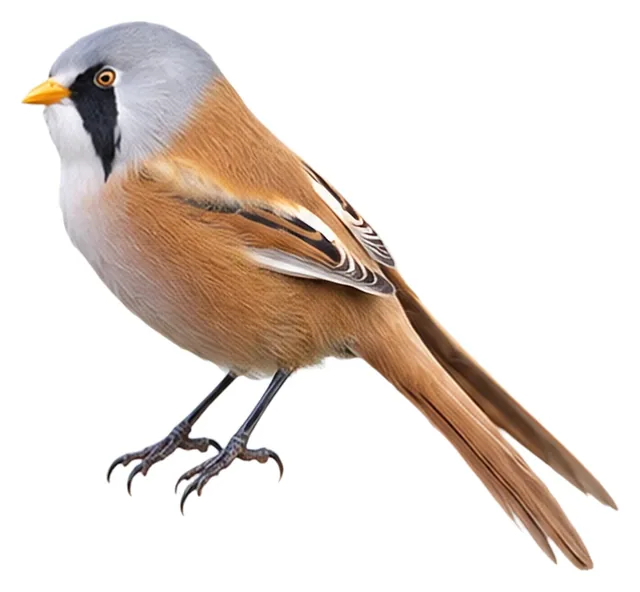
Bearded Reedling
Panurus biarmicus (Linnaeus, 1758)
≈13 cmLength17 cmWingspan14 gWeight
This small orange-brown bird has a long tail, and the male has two black “mustaches” on the face.
Busiest months: May and October · Most records: United Kingdom, Spain, Poland
How to identify
Field marks
- Male head gray, with black “mustaches” on both sides
- Mostly orange-brown overall, with a whitish throat and breast
- Tail long, with white edges to the tail feathers
- Wings with contrasting black and white patches
Male, female and young
Male with a gray head and black mustaches; female paler, with a brownish head and no black mustaches; juvenile resembles the female, with black patches on the back.
Voice
A metallic “ping” used for contact.
Where and when it's recorded

Bearded Reedling has been recorded at 665 of the 8,171 birding hotspots we track, in 55 countries and regions.
Records by month Northern Hemisphere
Where it's recorded most
- Titchwell Marsh RSPB ReserveUnited Kingdom3,684 records
- Minsmere RSPB ReserveUnited Kingdom3,451 records
- Cley & Salthouse Marshes NWT NR – Cley Marshes including Hides and Visitor CentreUnited Kingdom2,285 records
More places
- Rainham Marshes RSPB Reserve, SSSI and LNRUnited Kingdom1,146 records
- Stodmarsh NNRUnited Kingdom952 records
- Oare Marshes LNRUnited Kingdom870 records
- Laguna de Pitillas RN – AreaSpain834 records
- Blacktoft Sands RSPB ReserveUnited Kingdom672 records
- Lakenheath Fen RSPB ReserveUnited Kingdom622 records
- Cley & Salthouse Marshes NWT NR – East BankUnited Kingdom620 records
Countries and regions with the most records
eBird records via GBIF up to 2024-12-31. A record means someone listed it; more records partly mean more birders, not more birds.
About
The bearded reedling (Panurus biarmicus) is a small, long-tailed passerine bird found in reed beds near water in the temperate zone of Eurasia. It is frequently known as the bearded tit or occasionally as bearded parrotbill, as historically it was believed to be closely related to either the tits or parrotbills. Today it is known to lack close relatives and it is the only species in the family Panuridae.
Excerpt from Wikipedia, CC BY-SA 4.0 · authors · Read more on Wikipedia
Questions
How big is the Bearded Reedling?
The Bearded Reedling is about ≈13 cm long, with a wingspan of 17 cm and weighs around 14 g.
Where does the Bearded Reedling live?
Its breeding range: Palearctic: western, central. It is most often recorded in United Kingdom, Spain and Poland.
When is the best time to see the Bearded Reedling?
At the hotspots we track, it is recorded most in May and October (Northern Hemisphere).
Is the Bearded Reedling endangered?
The IUCN Red List classifies the Bearded Reedling as Least Concern.
What does the Bearded Reedling eat?
Main food: Insects & other invertebrates.
What family is the Bearded Reedling in?
It belongs to the family Bearded Reedling (Panuridae), order Passerines (Passeriformes).
At a glance
- Length
- ≈13 cm
- Wingspan
- 17 cm
- Weight
- 14 g
- Habitat
- Wetland
- Diet
- Insects & other invertebrates
- Lifestyle
- Perches in trees
- Migration
- Partial migrant
- Conservation
- Least Concern
More measurements
- Wing
- 60 mm
- Tail
- 82 mm
- Bill
- 9 mm
- Tarsus
- 20 mm
Averages from the AVONET dataset; length from field guides where available.
Range
Palearctic: western, central
Breeding range, IOC World Bird List 15.2
Subspecies · 1
- Panurus biarmicus russicus ec, e Europe through s Russia to ne China, Mongolia, Kazakhstan and c Turkey
Classification
- Order
- Passerines Passeriformes
- Family
- Bearded Reedling Panuridae
- Genus
- Panurus
Download illustration
Free to use with credit: “Illustration: Bird Album (birdalbum.com)”. Drawn by AI from a reference photo by Hobbyfotowiki. ↗

Heard it but can't see it? Mingji identifies birds by sound and photo, on your phone.