 Bird Album
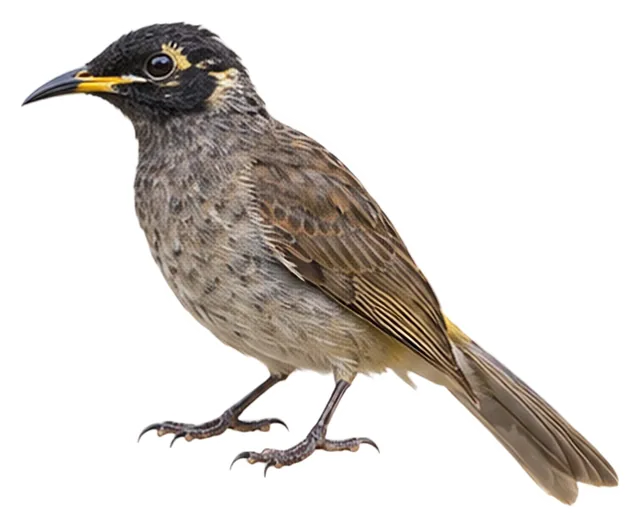
Bridled Honeyeater
Bolemoreus frenatus (Ramsay, EP, 1874)
34 gWeight
The bridled honeyeater (Bolemoreus frenatus) is a species of bird in the family Meliphagidae with distinctive rein-like markings on its face that is endemic to northeastern Queensland.
Busiest months: October · Most records: Australia
Where and when it's recorded

Bridled Honeyeater has been recorded at 15 of the 8,171 birding hotspots we track, in 1 country or region.
Records by month Southern Hemisphere
Where it's recorded most
- Mount Hypipamee National ParkAustralia863 records
- Kingfisher Park Birdwatchers LodgeAustralia310 records
- Hasties Swamp National ParkAustralia283 records
More places
- Abattoir Swamp, JulattenAustralia270 records
- Crater Lakes National Park – Lake EachamAustralia220 records
- Kingfisher Park Birdwatchers Lodge – Morning WalkAustralia200 records
- Crater Lakes National Park – Lake BarrineAustralia197 records
- JulattenAustralia191 records
- Crater Lakes National Park – Chambers Rainforest LodgeAustralia117 records
- Daintree Village Boat CruiseAustralia82 records
Countries and regions with the most records
eBird records via GBIF up to 2024-12-31. A record means someone listed it; more records partly mean more birders, not more birds.
About
The bridled honeyeater (Bolemoreus frenatus) is a species of bird in the family Meliphagidae with distinctive rein-like markings on its face that is endemic to northeastern Queensland. It is found in subtropical or tropical moist upland forests and subtropical or tropical rainforests, usually above 300 meters. In winter, it descends to lower forests including mangroves, and can sometimes be seen in more open habitats.
Excerpt from Wikipedia, CC BY-SA 4.0 · authors · Read more on Wikipedia
Questions
How big is the Bridled Honeyeater?
The Bridled Honeyeater weighs around 34 g.
Where does the Bridled Honeyeater live?
Its breeding range: Australasia: southeastern Cape York Peninsula, northeastern Queensland (northeastern Australia). It is most often recorded in Australia.
When is the best time to see the Bridled Honeyeater?
At the hotspots we track, it is recorded most in October (Southern Hemisphere).
Is the Bridled Honeyeater endangered?
The IUCN Red List classifies the Bridled Honeyeater as Least Concern.
What does the Bridled Honeyeater eat?
Main food: Omnivore.
What family is the Bridled Honeyeater in?
It belongs to the family Honeyeaters (Meliphagidae), order Passerines (Passeriformes).
At a glance
- Weight
- 34 g
- Habitat
- Forest
- Diet
- Omnivore
- Lifestyle
- Perches in trees
- Migration
- Resident (barely migrates)
- Conservation
- Least Concern
More measurements
- Wing
- 100 mm
- Tail
- 84 mm
- Bill
- 26 mm
- Tarsus
- 24 mm
Averages from the AVONET dataset; length from field guides where available.
Range
Australasia: southeastern Cape York Peninsula, northeastern Queensland (northeastern Australia)
Breeding range, IOC World Bird List 15.2
Classification
- Order
- Passerines Passeriformes
- Family
- Honeyeaters Meliphagidae
- Genus
- Bolemoreus
Other birds in the genus Bolemoreus
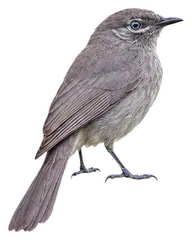 Eungella HoneyeaterBolemoreus hindwoodi
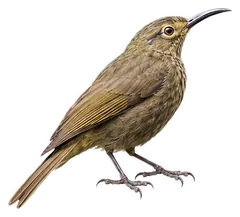 Dark-eared MyzaMyza celebensis
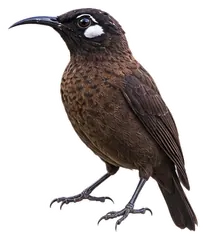 White-eared MyzaMyza sarasinorum
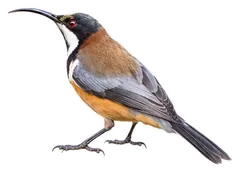 Eastern SpinebillAcanthorhynchus tenuirostris
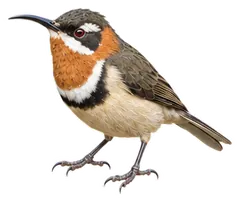 Western SpinebillAcanthorhynchus superciliosus
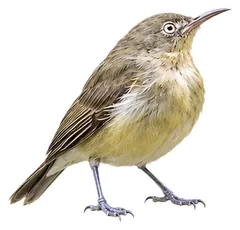 Green-backed HoneyeaterGlycichaera fallax
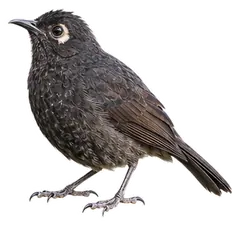 Sooty HoneyeaterMelionyx fuscus
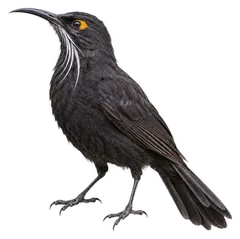 Long-bearded HoneyeaterMelionyx princeps
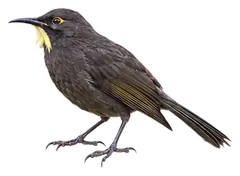 Short-bearded HoneyeaterMelionyx nouhuysi
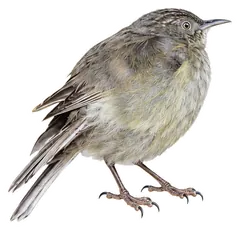 Leaden HoneyeaterPtiloprora plumbea
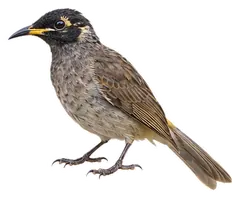
Download illustration
Free to use with credit: “Illustration: Bird Album (birdalbum.com)”. Drawn by AI from a reference photo by matthewkwan. ↗
Heard it but can't see it? Mingji identifies birds by sound and photo, on your phone.
In other languages
- EnglishBridled Honeyeater
- 简体中文暗喉吸蜜鸟
- 繁體中文韁紋吸蜜鳥
- 日本語キスジミツスイ
- DeutschBuntschnabel-Honigfresser
- FrançaisMéliphage bridé
- EspañolMielero embridado
- Portuguêspapa-mel-frenado
- ItalianoSucciamiele dalle redini
- NederlandsBontbekhoningeter
- РусскийПестроклювый медосос
- Svenskaglasögonhonungsfågel
- DanskBrillehonningæder
- Polskikantarowczyk duży