 Bird Album
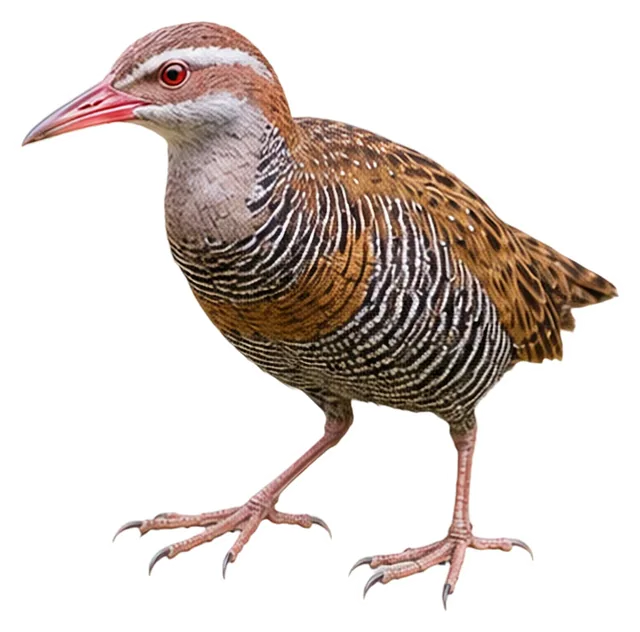
Buff-banded Rail
Gallirallus philippensis (Linnaeus, 1766)
206 gWeight
The buff-banded rail (Gallirallus philippensis) is a distinctively coloured, highly dispersive, medium-sized rail of the rail family, Rallidae.
Busiest months: October–November · Most records: Australia, New Zealand, Philippines
Where and when it's recorded
Busiest months: October–November · Most records: Australia, New Zealand, Philippines

Buff-banded Rail has been recorded at 352 of the 8,276 birding hotspots we track, in 17 countries and regions.
Records by month Southern Hemisphere
Where it's recorded most
- Western Treatment PlantAustralia2,004 records
- Herdsman LakeAustralia1,249 records
- Oxley Creek CommonAustralia1,032 records
More places
- Banyule Flats ReserveAustralia990 records
- Kakadu BeachAustralia817 records
- Dowse LagoonAustralia789 records
- Hasties Swamp National ParkAustralia551 records
- Sydney ParkAustralia488 records
- Sandy Camp Road WetlandsAustralia450 records
- Boyters Lane, JerseyvilleAustralia447 records
Countries and regions with the most records
eBird records via GBIF up to 2024-12-31. A record means someone listed it; more records partly mean more birders, not more birds.
About
The buff-banded rail (Gallirallus philippensis) is a distinctively coloured, highly dispersive, medium-sized rail of the rail family, Rallidae. This species comprises several subspecies found throughout much of Australasia and the south-west Pacific region, including the Philippines (where it is known as tikling), New Guinea, Australia, New Zealand (where it is known as the banded rail, or moho-pererū in Māori), and numerous smaller islands, covering a range of latitudes from the tropics to the subantarctic. The species was formerly placed in the genus Hypotaenidia.
Excerpt from Wikipedia, CC BY-SA 4.0 · authors · Read more on Wikipedia
Questions
How big is the Buff-banded Rail?
The Buff-banded Rail weighs around 206 g.
Where does the Buff-banded Rail live?
Its breeding range: Australasia, Pacific Ocean: widespread, also Philippines. It is most often recorded in Australia, New Zealand and Philippines.
When is the best time to see the Buff-banded Rail?
At the hotspots we track, it is recorded most in October and November (Southern Hemisphere).
Is the Buff-banded Rail endangered?
The IUCN Red List classifies the Buff-banded Rail as Least Concern.
What does the Buff-banded Rail eat?
Main food: Omnivore.
What family is the Buff-banded Rail in?
It belongs to the family Rails, Crakes & Coots (Rallidae), order Gruiformes.
At a glance
- Weight
- 206 g
- Habitat
- Wetland
- Diet
- Omnivore
- Lifestyle
- Active on the ground
- Migration
- Resident (barely migrates)
- Conservation
- Least Concern
More measurements
- Wing
- 142 mm
- Tail
- 67 mm
- Bill
- 32 mm
- Tarsus
- 43 mm
Averages from the AVONET dataset; length from field guides where available.
Range
Australasia, Pacific Ocean: widespread, also Philippines
Breeding range, IOC World Bird List 15.2
Classification
- Order
- Gruiformes
- Family
- Rails, Crakes & Coots Rallidae
- Genus
- Gallirallus
Other birds in the genus Gallirallus
 Calayan RailGallirallus calayanensis
 Invisible RailGallirallus wallacii
 WekaGallirallus australis
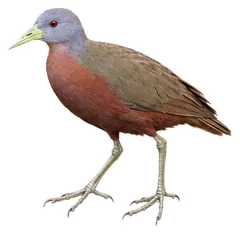 Chestnut RailGallirallus castaneoventris
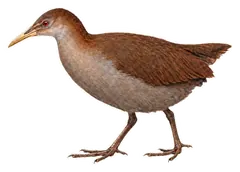 New Caledonian RailGallirallus lafresnayanus
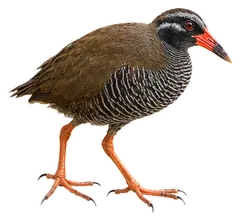 Okinawa RailGallirallus okinawae
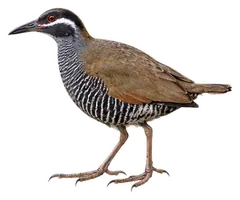 Barred RailGallirallus torquatus
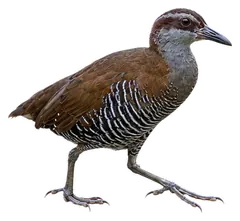 Guam RailGallirallus owstoni
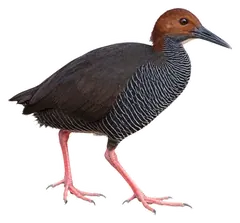 Pink-legged RailGallirallus insignis
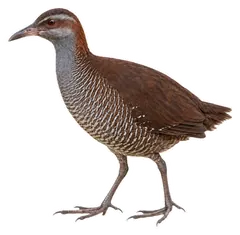 Roviana RailGallirallus rovianae
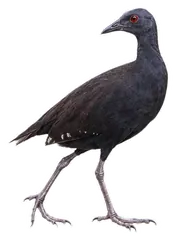 Woodford's RailGallirallus woodfordi
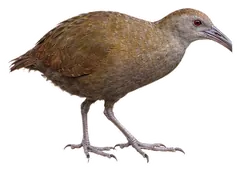 Lord Howe WoodhenGallirallus sylvestris
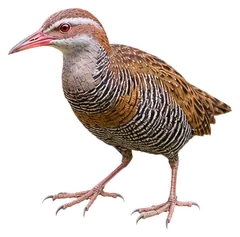
Download illustration
Free to use with credit: “Illustration: Bird Album (birdalbum.com)”. Drawn by AI from a reference photo by Leo. ↗
Heard it but can't see it? Mingji identifies birds by sound and photo, on your phone.