 Bird Album
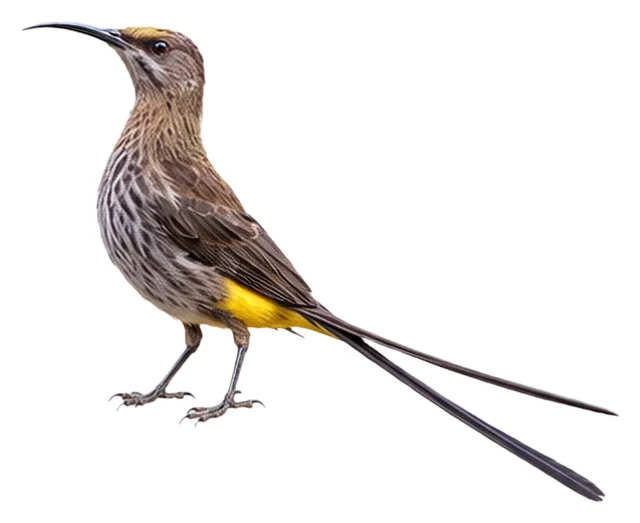
Cape Sugarbird
Promerops cafer (Linnaeus, 1758)
35 gWeight
The Cape sugarbird (Promerops cafer) is one of the eight bird species endemic to the Fynbos biome of the Western Cape and Eastern Cape provinces of South Africa.
Busiest months: September–November · Most records: South Africa
Where and when it's recorded

Cape Sugarbird has been recorded at 17 of the 8,171 birding hotspots we track, in 1 country or region.
Records by month Southern Hemisphere
Where it's recorded most
- Kirstenbosch Botanical GardenSouth Africa2,106 records
- Rooi-ElsSouth Africa1,179 records
- Harold Porter Botanical GardensSouth Africa610 records
More places
- Table Mt. NP – Cape Point SectionSouth Africa355 records
- De Hoop Nature ReserveSouth Africa209 records
- Table Mt. NP – Cape of Good HopeSouth Africa141 records
- Boulders BeachSouth Africa101 records
- Stony Point – Penguin ColonySouth Africa73 records
- West Coast NPSouth Africa10 records
- Rondevlei NRSouth Africa8 records
Countries and regions with the most records
eBird records via GBIF up to 2024-12-31. A record means someone listed it; more records partly mean more birders, not more birds.
About
The Cape sugarbird (Promerops cafer) is one of the eight bird species endemic to the Fynbos biome of the Western Cape and Eastern Cape provinces of South Africa.
Excerpt from Wikipedia, CC BY-SA 4.0 · authors · Read more on Wikipedia
Questions
How big is the Cape Sugarbird?
The Cape Sugarbird weighs around 35 g.
Where does the Cape Sugarbird live?
Its breeding range: Africa: South Africa. It is most often recorded in South Africa.
When is the best time to see the Cape Sugarbird?
At the hotspots we track, it is recorded most in September, October and November (Southern Hemisphere).
Is the Cape Sugarbird endangered?
The IUCN Red List classifies the Cape Sugarbird as Least Concern.
What does the Cape Sugarbird eat?
Main food: Nectar.
What family is the Cape Sugarbird in?
It belongs to the family Sugarbirds (Promeropidae), order Passerines (Passeriformes).
At a glance
- Weight
- 35 g
- Habitat
- Shrubland
- Diet
- Nectar
- Lifestyle
- Perches in trees
- Migration
- Partial migrant
- Conservation
- Least Concern
More measurements
- Wing
- 94 mm
- Tail
- 284 mm
- Bill
- 37 mm
- Tarsus
- 24 mm
Averages from the AVONET dataset; length from field guides where available.
Range
Africa: South Africa
Breeding range, IOC World Bird List 15.2
Classification
- Order
- Passerines Passeriformes
- Family
- Sugarbirds Promeropidae
- Genus
- Promerops
Other birds in the genus Promerops
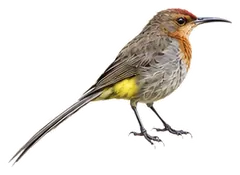 Gurney's SugarbirdPromerops gurneyi
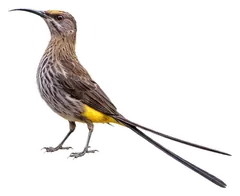
Download illustration
Free to use with credit: “Illustration: Bird Album (birdalbum.com)”. Drawn by AI from a reference photo by Philip Hoekstra. ↗
Heard it but can't see it? Mingji identifies birds by sound and photo, on your phone.
In other languages
- EnglishCape Sugarbird
- 简体中文长尾食蜜鸟
- 繁體中文南非食蜜鳥
- 日本語オナガミツスイ
- DeutschKaphonigvogel
- FrançaisPromérops du Cap
- EspañolMielero abejaruco de El Cabo
- Portuguêspapa-açúcar-do-cabo
- ItalianoZuccheriere del Capo
- NederlandsKaapse Suikervogel
- РусскийКапская сахарная птица
- Svenskakapsockerfågel
- DanskKapsukkerfugl
- Polskidudkowiec kafryjski