 Bird Album
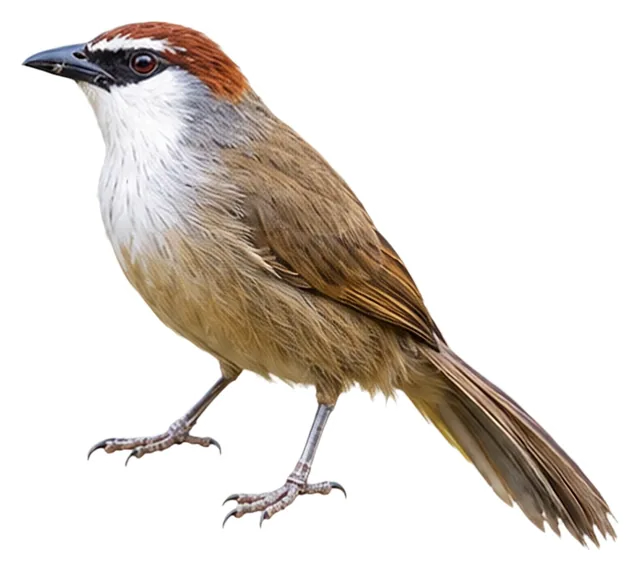
Chestnut-capped Babbler
Timalia pileata Horsfield, 1821
≈15 cmLength16 gWeight
This brown bird has a chestnut crown, black mask, white forehead and white supercilium.
Busiest months: February–March · Most records: Thailand, Cambodia, India
How to identify
Field marks
- Chestnut crown
- Black mask
- White forehead and supercilium
- Thick black bill and a rather long, wedge-shaped tail
Male, female and young
Sexes have similar plumage; male is slightly larger, with a red iris, while female has a black iris.
Where and when it's recorded

Chestnut-capped Babbler has been recorded at 211 of the 8,171 birding hotspots we track, in 10 countries and regions.
Records by month Northern Hemisphere
Where it's recorded most
- Khon Kaen University – WTPThailand423 records
- Maguri BeelIndia375 records
- Hun Sen BoulevardCambodia345 records
More places
- Nam Kham Nature ReserveThailand297 records
- TmatboeyCambodia269 records
- Kaziranga NP & Surroundings – Central RangeIndia244 records
- Chitwan National ParkNepal191 records
- Wat Champouh K'aekCambodia189 records
- Phnom Krom – rice fieldsCambodia188 records
- Kaziranga NP & SurroundingsIndia175 records
Countries and regions with the most records
eBird records via GBIF up to 2024-12-31. A record means someone listed it; more records partly mean more birders, not more birds.
About
The chestnut-capped babbler (Timalia pileata) is a passerine bird of the family Timaliidae. It is monotypic within the genus Timalia.
Excerpt from Wikipedia, CC BY-SA 4.0 · authors · Read more on Wikipedia
Questions
How big is the Chestnut-capped Babbler?
The Chestnut-capped Babbler is about ≈15 cm long and weighs around 16 g.
Where does the Chestnut-capped Babbler live?
Its breeding range: Oriental: Nepal through Southeast Asia; Java. It is most often recorded in Thailand, Cambodia and India.
When is the best time to see the Chestnut-capped Babbler?
At the hotspots we track, it is recorded most in February and March (Northern Hemisphere).
Is the Chestnut-capped Babbler endangered?
The IUCN Red List classifies the Chestnut-capped Babbler as Least Concern.
What does the Chestnut-capped Babbler eat?
Main food: Insects & other invertebrates.
What family is the Chestnut-capped Babbler in?
It belongs to the family Babblers, Scimitar Babblers (Timaliidae), order Passerines (Passeriformes).
At a glance
- Length
- ≈15 cm
- Weight
- 16 g
- Habitat
- Shrubland
- Diet
- Insects & other invertebrates
- Lifestyle
- Perches in trees
- Migration
- Resident (barely migrates)
- Conservation
- Least Concern
More measurements
- Wing
- 66 mm
- Tail
- 75 mm
- Bill
- 16 mm
- Tarsus
- 22 mm
Averages from the AVONET dataset; length from field guides where available.
Range
Oriental: Nepal through Southeast Asia; Java
Breeding range, IOC World Bird List 15.2
Subspecies · 1
- Timalia pileata smithi e Myanmar, nw Thailand and s China to n, c Indochina
Classification
- Order
- Passerines Passeriformes
- Family
- Babblers, Scimitar Babblers Timaliidae
- Genus
- Timalia
More from the family Babblers, Scimitar Babblers
 Tawny-bellied BabblerDumetia hyperythra
 Dark-fronted BabblerDumetia atriceps
 Grey-faced Tit-BabblerMixornis kelleyi
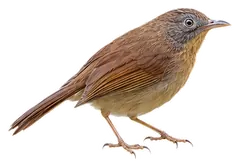 Grey-cheeked Tit-BabblerMixornis flavicollis
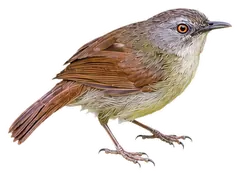 Kangean Tit-BabblerMixornis prillwitzi
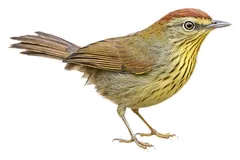 Pin-striped Tit-BabblerMixornis gularis
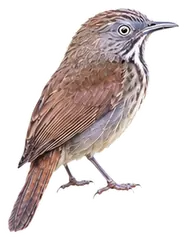 Bold-striped Tit-BabblerMixornis bornensis
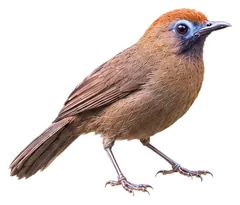 Fluffy-backed Tit-BabblerMacronus ptilosus
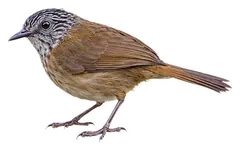 Brown Tit-BabblerMacronus striaticeps
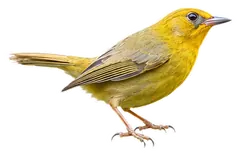 Golden BabblerCyanoderma chrysaeum
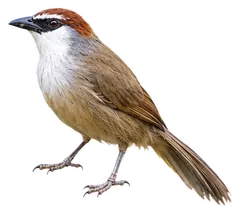
Download illustration
Free to use with credit: “Illustration: Bird Album (birdalbum.com)”. Drawn by AI from a reference photo by peterchristiaen. ↗
Heard it but can't see it? Mingji identifies birds by sound and photo, on your phone.
In other languages
- EnglishChestnut-capped Babbler
- 简体中文红顶鹛
- 繁體中文紅頂鶥
- 日本語アカガシラチメドリ
- DeutschRotkappentimalie
- FrançaisTimalie coiffée
- EspañolTimalí capirotado
- Portuguêstagarela-de-barrete-castanho
- ItalianoGarrulo pileato
- NederlandsRoodkaptimalia
- РусскийКрасношапочная тимелия
- Svenskakastanjekronad timalia
- DanskRødisset Timalie
- Polskitymalia