 Bird Album
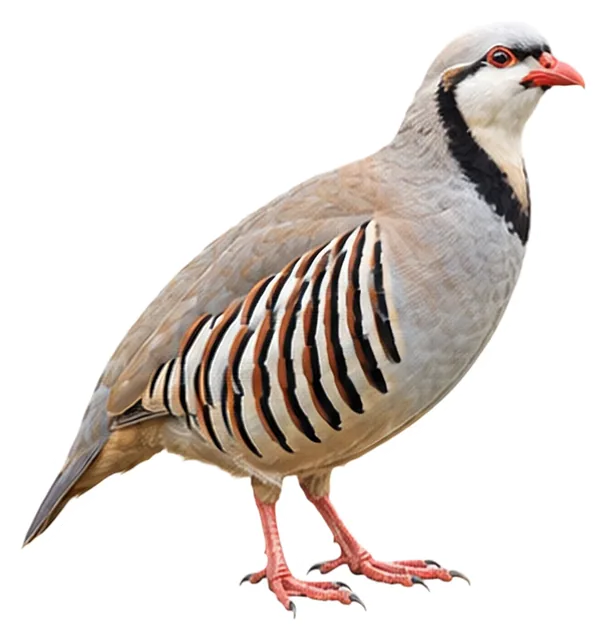
Chukar Partridge
Alectoris chukar (Gray, JE, 1830)
32–35 cmLength51 cmWingspan502 gWeight
It has a black band forming a collar around a white throat, a red bill and legs, and black-and-white stripes on the flanks.
Busiest months: March–April and September · Most records: Israel, United Arab Emirates, Palestinian Territories
How to identify
Field marks
- Black band runs through the eye and forms a collar around the white throat
- Flanks with black-and-white barring
- Bill coral-red; legs red
- Back pale brown; breast gray; belly buff
Male, female and young
Sexes similar, but the female is slightly smaller and lacks spurs.
Voice
A noisy “chuck-chuck-chukar-chukar”.
Where and when it's recorded

Chukar Partridge has been recorded at 181 of the 8,171 birding hotspots we track, in 32 countries and regions.
Records by month Northern Hemisphere
Where it's recorded most
- Private estate near Green MubazzarahUnited Arab Emirates2,857 records
- Gazelle ValleyIsrael2,569 records
- Hatzuk Beach TLVIsrael898 records
More places
- Antikythira Bird ObservatoryGreece658 records
- Jerusalem Bird ObservatoryIsrael639 records
- Yeruham LakeIsrael452 records
- Mt. KabirPalestinian Territories445 records
- Hulda ReservoirIsrael362 records
- Kfar AdumimPalestinian Territories334 records
- Green MubazzarahUnited Arab Emirates325 records
Countries and regions with the most records
eBird records via GBIF up to 2024-12-31. A record means someone listed it; more records partly mean more birders, not more birds.
About
The chukar partridge (Alectoris chukar), or simply chukar, is a Palearctic upland gamebird in the pheasant family Phasianidae. It has been considered to form a superspecies complex along with the rock partridge, Philby's partridge and Przevalski's partridge and treated in the past as conspecific particularly with the first.
Excerpt from Wikipedia, CC BY-SA 4.0 · authors · Read more on Wikipedia
Questions
How big is the Chukar Partridge?
The Chukar Partridge is about 32–35 cm long, with a wingspan of 51 cm and weighs around 502 g.
Where does the Chukar Partridge live?
Its breeding range: Palearctic: southern. It is most often recorded in Israel, United Arab Emirates and Palestinian Territories.
When is the best time to see the Chukar Partridge?
At the hotspots we track, it is recorded most in March, April and September (Northern Hemisphere).
Is the Chukar Partridge endangered?
The IUCN Red List classifies the Chukar Partridge as Least Concern.
What does the Chukar Partridge eat?
Main food: Seeds.
What family is the Chukar Partridge in?
It belongs to the family Pheasants & Allies (Phasianidae), order Galliformes.
At a glance
- Length
- 32–35 cm
- Wingspan
- 51 cm
- Weight
- 502 g
- Habitat
- Shrubland
- Diet
- Seeds
- Lifestyle
- Active on the ground
- Migration
- Resident (barely migrates)
- Conservation
- Least Concern
More measurements
- Wing
- 154 mm
- Tail
- 82 mm
- Bill
- 22 mm
- Tarsus
- 40 mm
Averages from the AVONET dataset; length from field guides where available.
Range
Palearctic: southern
Breeding range, IOC World Bird List 15.2
Subspecies · 6
- Alectoris chukar falki w Uzbekistan to nc Afghanistan and w China
- Alectoris chukar dzungarica Tien Shan Mts. (e Kazakhstan, w China) to nw Mongolia
- Alectoris chukar pallida w Xinjiang (w China)
- Alectoris chukar pallescens ne Afghanistan to w Tibet
- Alectoris chukar potanini w Mongolia and nw China
- Alectoris chukar pubescens ne Xinjiang (w China) to sw Mongolia and n Ningxia (c China)
Classification
- Order
- Galliformes
- Family
- Pheasants & Allies Phasianidae
- Genus
- Alectoris
Other birds in the genus Alectoris
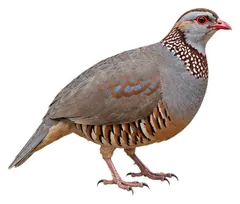 Barbary PartridgeAlectoris barbara
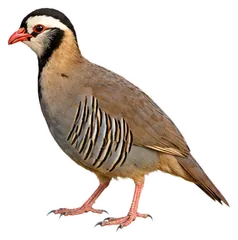 Arabian PartridgeAlectoris melanocephala
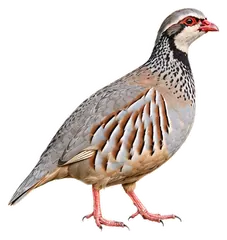 Red-legged PartridgeAlectoris rufa
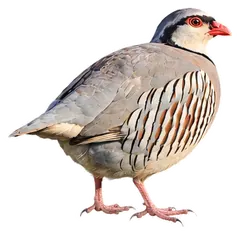 Rock PartridgeAlectoris graeca
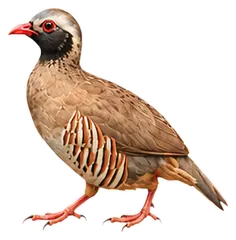 Philby's PartridgeAlectoris philbyi
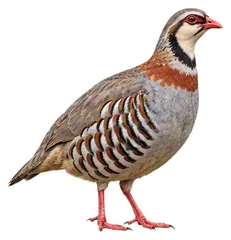 Przevalski's PartridgeAlectoris magna
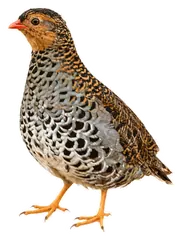 Udzungwa Forest PartridgeXenoperdix udzungwensis
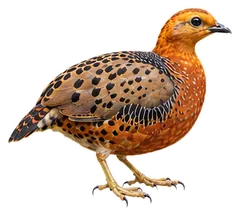 Ferruginous PartridgeCaloperdix oculeus
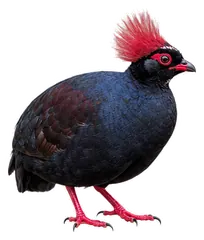 Crested PartridgeRollulus rouloul
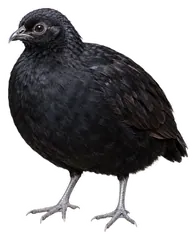 Black PartridgeMelanoperdix niger
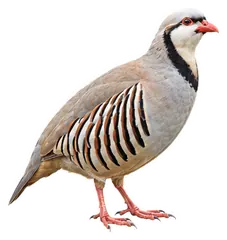
Download illustration
Free to use with credit: “Illustration: Bird Album (birdalbum.com)”. Drawn by AI from a reference photo by Olaf Oliviero Riemer. ↗

Heard it but can't see it? Mingji identifies birds by sound and photo, on your phone.