 Bird Album
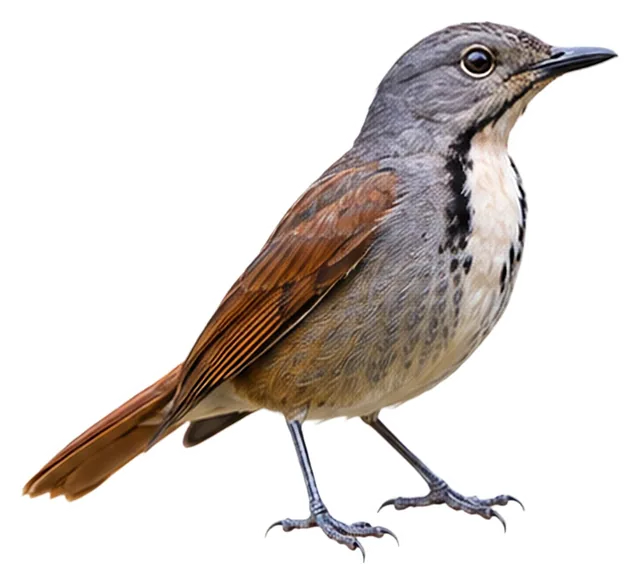
Collared Palm Thrush
Cichladusa arquata Peters, W, 1863
34 gWeight
The collared palm thrush (Cichladusa arquata) is a species of bird in the family Muscicapidae.
Busiest months: October–November · Most records: Zambia, Malawi, Mozambique
Where and when it's recorded

Collared Palm Thrush has been recorded at 81 of the 8,171 birding hotspots we track, in 10 countries and regions.
Records by month Southern Hemisphere
Where it's recorded most
- Liwonde National Park – MvuuMalawi216 records
- Liwonde National ParkMalawi160 records
- Gorongosa NP – Chitengo CampMozambique154 records
More places
- Zambezi River near Victoria FallsZimbabwe151 records
- Chobe Safari LodgeBotswana127 records
- Mosi-oa-Tunya NPZambia123 records
- Cresta Mowana LodgeBotswana87 records
- Lake Manyara NPTanzania70 records
- Mikumi NPTanzania50 records
- Zambezi river cruiseZimbabwe47 records
Countries and regions with the most records
eBird records via GBIF up to 2024-12-31. A record means someone listed it; more records partly mean more birders, not more birds.
About
The collared palm thrush (Cichladusa arquata) is a species of bird in the family Muscicapidae. It is found in Botswana, Burundi, Democratic Republic of the Congo, Kenya, Malawi, Mozambique, Rwanda, Tanzania, Uganda, Zambia, and Zimbabwe. Its natural habitats are dry savannah and subtropical or tropical moist shrubland.
Excerpt from Wikipedia, CC BY-SA 4.0 · authors · Read more on Wikipedia
Questions
How big is the Collared Palm Thrush?
The Collared Palm Thrush weighs around 34 g.
Where does the Collared Palm Thrush live?
Its breeding range: Africa: central DR Congo, Uganda and Kenya to northeastern South Africa. It is most often recorded in Zambia, Malawi and Mozambique.
When is the best time to see the Collared Palm Thrush?
At the hotspots we track, it is recorded most in October and November (Southern Hemisphere).
Is the Collared Palm Thrush endangered?
The IUCN Red List classifies the Collared Palm Thrush as Least Concern.
What does the Collared Palm Thrush eat?
Main food: Insects & other invertebrates.
What family is the Collared Palm Thrush in?
It belongs to the family Chats, Old World Flycatchers (Muscicapidae), order Passerines (Passeriformes).
At a glance
- Weight
- 34 g
- Habitat
- Shrubland
- Diet
- Insects & other invertebrates
- Lifestyle
- Active on the ground
- Migration
- Resident (barely migrates)
- Conservation
- Least Concern
More measurements
- Wing
- 87 mm
- Tail
- 89 mm
- Bill
- 20 mm
- Tarsus
- 26 mm
Averages from the AVONET dataset; length from field guides where available.
Range
Africa: central DR Congo, Uganda and Kenya to northeastern South Africa
Breeding range, IOC World Bird List 15.2
Classification
- Order
- Passerines Passeriformes
- Family
- Chats, Old World Flycatchers Muscicapidae
- Genus
- Cichladusa
Other birds in the genus Cichladusa
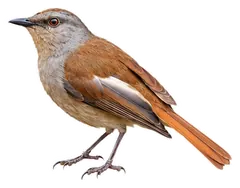 Rufous-tailed Palm ThrushCichladusa ruficauda
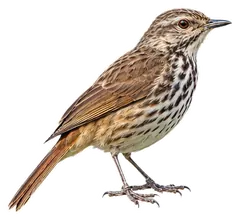 Spotted Palm ThrushCichladusa guttata
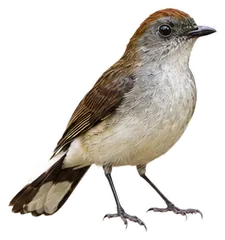 White-tailed AletheAlethe diademata
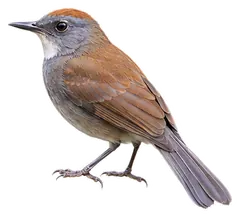 Fire-crested AletheAlethe castanea
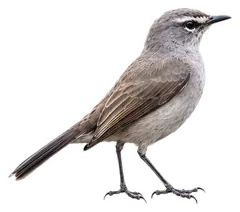 Karoo Scrub RobinTychaedon coryphoeus
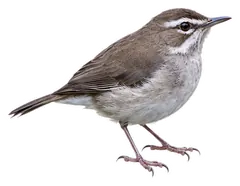 Brown Scrub RobinTychaedon signata
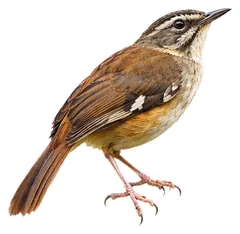 Forest Scrub RobinTychaedon leucosticta
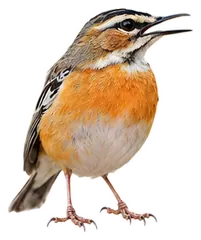 Bearded Scrub RobinTychaedon quadrivirgata
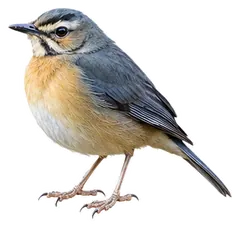 Miombo Scrub RobinTychaedon barbata
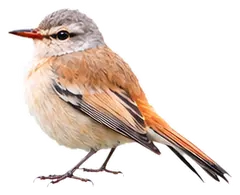 Kalahari Scrub RobinCercotrichas paena
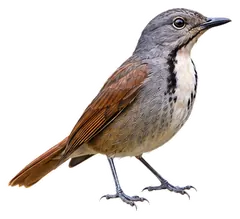
Download illustration
Free to use with credit: “Illustration: Bird Album (birdalbum.com)”. Drawn by AI from a reference photo by Louis Fournier. ↗
Heard it but can't see it? Mingji identifies birds by sound and photo, on your phone.
In other languages
- EnglishCollared Palm Thrush
- 简体中文晨鸫
- 繁體中文晨鶇
- 日本語アサナキヒタキ
- DeutschMorgenrötel
- FrançaisCichladuse à collier
- EspañolZorzal palmero acollarado
- Portuguêstordo-das-palmeiras-de-colar
- ItalianoTordo delle palme dal collare
- NederlandsZambesipalmlijster
- РусскийОжереловая пальмара
- Svenskagulögd palmskvätta
- DanskGuløjet Palmedrossel
- Polskipalmodrozd tarczowy