 Bird Album
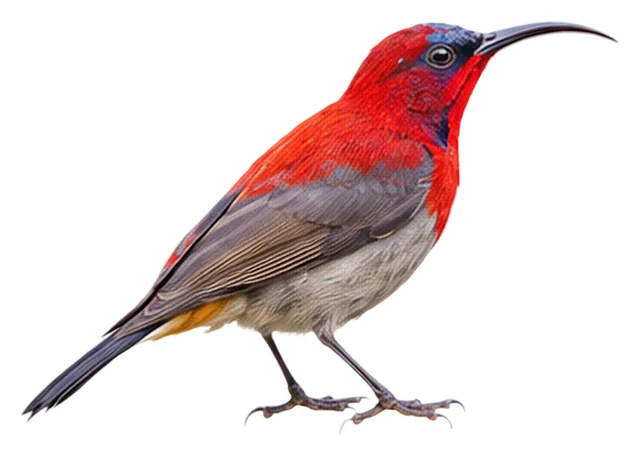
Crimson Sunbird
Aethopyga siparaja (Raffles, 1822)
≈11 cmLength6.7 gWeight
This sunbird occurs mainly in evergreen broadleaf forest, bamboo and small woods near villages.
Busiest months: February · Most records: Singapore, India, Malaysia
How to identify
Where and when it's recorded
Busiest months: February · Most records: Singapore, India, Malaysia

Crimson Sunbird has been recorded at 481 of the 8,276 birding hotspots we track, in 15 countries and regions.
Records by month Northern Hemisphere
Where it's recorded most
- Dairy Farm Nature ParkSingapore2,235 records
- Sepilok – Rainforest Discovery CenterMalaysia1,600 records
- Wildlife Institute of IndiaIndia1,360 records
More places
- Singapore Botanic GardensSingapore1,296 records
- Forest Research Institute (FRI), New Forest CampusIndia1,264 records
- Central Catchment Nature ReserveSingapore800 records
- Curzon Road, Dalanwala, DehradunIndia763 records
- Sungei Buloh Wetland ReserveSingapore724 records
- Pulau UbinSingapore662 records
- Xishuangbanna Tropical Botanical GardenChina585 records
Countries and regions with the most records
eBird records via GBIF up to 2024-12-31. A record means someone listed it; more records partly mean more birders, not more birds.
About
The crimson sunbird (Aethopyga siparaja) is a species of bird in the sunbird family which feed largely on nectar. They may also take insects, especially when feeding their young. Flight is fast and direct on their short wings.
Excerpt from Wikipedia, CC BY-SA 4.0 · authors · Read more on Wikipedia
Questions
How big is the Crimson Sunbird?
The Crimson Sunbird is about ≈11 cm long and weighs around 6.7 g.
Where does the Crimson Sunbird live?
Its breeding range: Oriental, Australasia: widespread, also Sulawesi. It is most often recorded in Singapore, India and Malaysia.
When is the best time to see the Crimson Sunbird?
At the hotspots we track, it is recorded most in February (Northern Hemisphere).
Is the Crimson Sunbird endangered?
The IUCN Red List classifies the Crimson Sunbird as Least Concern.
What does the Crimson Sunbird eat?
Main food: Nectar.
What family is the Crimson Sunbird in?
It belongs to the family Sunbirds (Nectariniidae), order Passerines (Passeriformes).
At a glance
- Length
- ≈11 cm
- Weight
- 6.7 g
- Habitat
- Forest
- Diet
- Nectar
- Lifestyle
- Perches in trees
- Migration
- Resident (barely migrates)
- Conservation
- Least Concern
More measurements
- Wing
- 50 mm
- Tail
- 38 mm
- Bill
- 19 mm
- Tarsus
- 13 mm
Averages from the AVONET dataset; length from field guides where available.
Range
Oriental, Australasia: widespread, also Sulawesi
Breeding range, IOC World Bird List 15.2
Subspecies · 2
- Aethopyga siparaja owstoni se China
- Aethopyga siparaja tonkinensis s China and ne Vietnam
Classification
- Order
- Passerines Passeriformes
- Family
- Sunbirds Nectariniidae
- Genus
- Aethopyga
Other birds in the genus Aethopyga
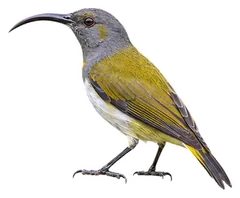 Grey-hooded SunbirdAethopyga primigenia
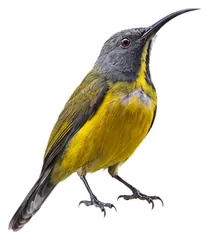 Apo SunbirdAethopyga boltoni
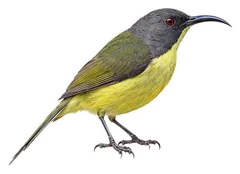 Tboli SunbirdAethopyga tibolii
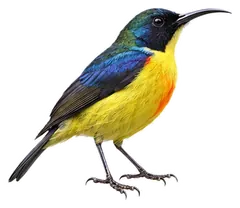 Lina's SunbirdAethopyga linaraborae
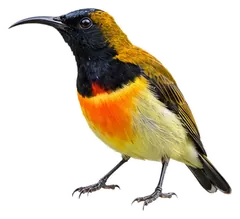 Flaming SunbirdAethopyga flagrans
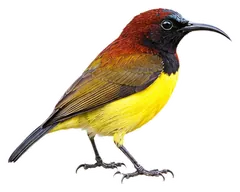 Maroon-naped SunbirdAethopyga guimarasensis
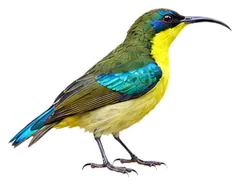 Metallic-winged SunbirdAethopyga pulcherrima
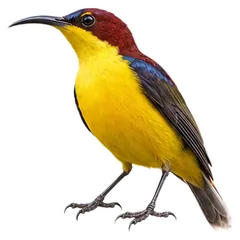 Elegant SunbirdAethopyga duyvenbodei
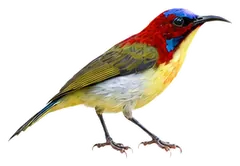 Lovely SunbirdAethopyga shelleyi
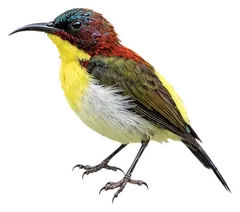 Handsome SunbirdAethopyga bella
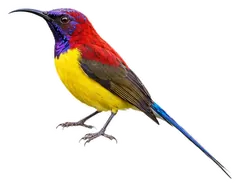 Mrs. Gould's SunbirdAethopyga gouldiae
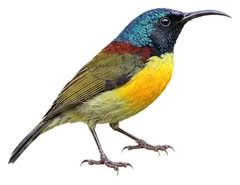 Green-tailed SunbirdAethopyga nipalensis
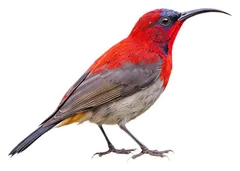
Download illustration
Free to use with credit: “Illustration: Bird Album (birdalbum.com)”. Drawn by AI from a reference photo by JJ Harrison. ↗

Heard it but can't see it? Mingji identifies birds by sound and photo, on your phone.
In other languages
- EnglishCrimson Sunbird
- 简体中文黄腰太阳鸟
- 繁體中文東方黃腰太陽鳥
- 日本語キゴシタイヨウチョウ
- DeutschKarmesinnektarvogel
- FrançaisSouimanga siparaja
- EspañolSuimanga siparaja
- Portuguêsnectarínia-carmim
- ItalianoNettarinia cremisi comune
- NederlandsGeelrughoningzuiger
- РусскийРубиновая нектарница
- Svenskakarmosinsolfågel
- DanskKarminsolfugl
- Polskikwiatownik szkarłatny