 Bird Album
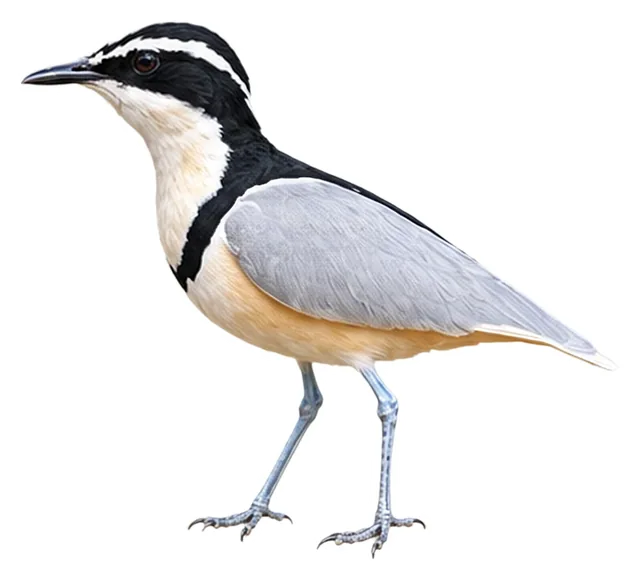
Egyptian Plover
Pluvianus aegyptius (Linnaeus, 1758)
19–21 cmLength82 gWeight
The Egyptian plover (Pluvianus aegyptius), also known as the crocodile bird, is a wader, the only member of the genus Pluvianus.
Busiest months: January–February · Most records: Senegal, Cameroon, Ethiopia
Where and when it's recorded

Egyptian Plover has been recorded at 51 of the 8,171 birding hotspots we track, in 19 countries and regions.
Records by month Northern Hemisphere
Where it's recorded most
- Campement de WassadouSenegal334 records
- Benoue NPCameroon71 records
- Gibe GorgeEthiopia42 records
More places
- PN du Niokolo-KobaSenegal31 records
- W National ParkNiger30 records
- Tiwai Island Wildlife SanctuarySierra Leone17 records
- Tuti IslandSudan13 records
- Tono Dam & vicinityGhana12 records
- White Volta – Nakambe-Nouhao confluence [Burkina Faso]Burkina Faso11 records
- Zakouma NPChad9 records
Countries and regions with the most records
eBird records via GBIF up to 2024-12-31. A record means someone listed it; more records partly mean more birders, not more birds.
About
The Egyptian plover (Pluvianus aegyptius), also known as the crocodile bird, is a wader, the only member of the genus Pluvianus. It occurs in a band across Sub-Saharan Africa from Senegal in the west to Ethiopia in the east and south to parts of the Democratic Republic of the Congo. Despite the name, it no longer occurs in Egypt.
Excerpt from Wikipedia, CC BY-SA 4.0 · authors · Read more on Wikipedia
Questions
How big is the Egyptian Plover?
The Egyptian Plover is about 19–21 cm long and weighs around 82 g.
Where does the Egyptian Plover live?
Its breeding range: Africa: Senegal and Gambia east to Ethiopia, south to far northern Angola, DR Congo and Sudan; formerly also Nile River, Egypt. It is most often recorded in Senegal, Cameroon and Ethiopia.
When is the best time to see the Egyptian Plover?
At the hotspots we track, it is recorded most in January and February (Northern Hemisphere).
Is the Egyptian Plover endangered?
The IUCN Red List classifies the Egyptian Plover as Least Concern.
What does the Egyptian Plover eat?
Main food: Fish, shrimp & shellfish.
What family is the Egyptian Plover in?
It belongs to the family Egyptian Plover (Pluvianidae), order Charadriiformes.
At a glance
- Length
- 19–21 cm
- Weight
- 82 g
- Habitat
- Wetland
- Diet
- Fish, shrimp & shellfish
- Lifestyle
- Active on the ground
- Migration
- Partial migrant
- Conservation
- Least Concern
More measurements
- Wing
- 130 mm
- Tail
- 58 mm
- Bill
- 23 mm
- Tarsus
- 34 mm
Averages from the AVONET dataset; length from field guides where available.
Range
Africa: Senegal and Gambia east to Ethiopia, south to far northern Angola, DR Congo and Sudan; formerly also Nile River, Egypt
Breeding range, IOC World Bird List 15.2
Classification
- Order
- Charadriiformes
- Family
- Egyptian Plover Pluvianidae
- Genus
- Pluvianus
Download illustration
Free to use with credit: “Illustration: Bird Album (birdalbum.com)”. Drawn by AI from a reference photo by wimvz. ↗
Heard it but can't see it? Mingji identifies birds by sound and photo, on your phone.