 Bird Album
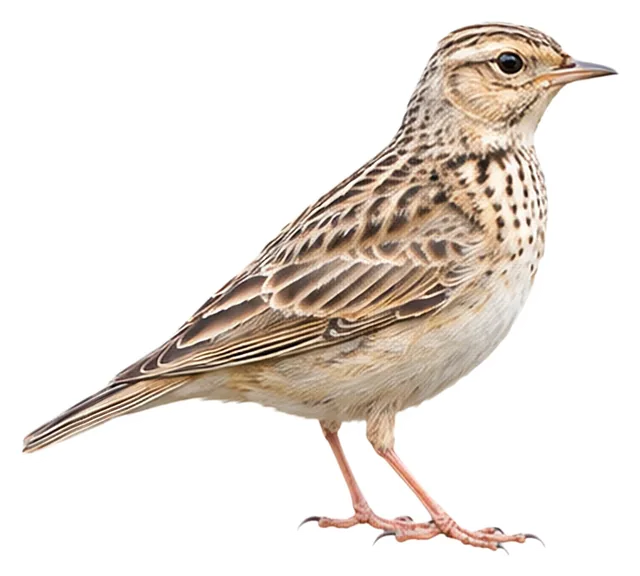
Eurasian Skylark
Alauda arvensis Linnaeus, 1758
15–19 cmLength35 cmWingspan37 gWeight
It is plain in appearance, and the male hovers high in the air while singing continuously for two or three minutes.
Busiest months: April–May and October · Most records: United Kingdom, Spain, New Zealand
Looks like Oriental Skylark
How to identify
Field marks
- Short crest on the crown, raised when alarmed
- Sandy-rufous or buff upperparts with blackish-brown streaks
- Rufous-white breast densely marked with blackish-brown, and white belly
- White edges to the tail and trailing edge of the wing, visible as it flies away
Male, female and young
Sexes similar in plumage.
Voice
Long, continuous, clear warbling, like bubbling water.
Similar species
Where and when it's recorded

Eurasian Skylark has been recorded at 1,960 of the 8,171 birding hotspots we track, in 87 countries and regions.
Records by month Northern Hemisphere
Where it's recorded most
- Western Treatment PlantAustralia6,936 records
- Titchwell Marsh RSPB ReserveUnited Kingdom3,693 records
- Wanstead FlatsUnited Kingdom2,624 records
More places
- Spurn Bird Observatory Recording AreaUnited Kingdom2,614 records
- Lezíria Grande de Vila Franca de Xira – área geralPortugal2,499 records
- Frampton Marsh RSPB ReserveUnited Kingdom2,288 records
- Bempton Cliffs RSPB ReserveUnited Kingdom2,208 records
- Cley & Salthouse Marshes NWT NR – Cley Marshes including Hides and Visitor CentreUnited Kingdom2,199 records
- Rainham Marshes RSPB Reserve, SSSI and LNRUnited Kingdom2,147 records
- East Tilbury River and MarshesUnited Kingdom1,983 records
Countries and regions with the most records
eBird records via GBIF up to 2024-12-31. A record means someone listed it; more records partly mean more birders, not more birds.
About
The Eurasian skylark (Alauda arvensis), commonly referred to in Europe as the lark, is a passerine bird in the lark family, Alaudidae. It is a widespread species found across Europe and the Palearctic with introduced populations in Australia, New Zealand, Canada, and on the Hawaiian Islands. It is a bird of open farmland and heath, known for the song of the male, which is delivered in hovering flight from heights of 50 to 100 metres (160 to 330 ft).
Excerpt from Wikipedia, CC BY-SA 4.0 · authors · Read more on Wikipedia
Questions
How big is the Eurasian Skylark?
The Eurasian Skylark is about 15–19 cm long, with a wingspan of 35 cm and weighs around 37 g.
Where does the Eurasian Skylark live?
Its breeding range: Palearctic: widespread. It is most often recorded in United Kingdom, Spain and New Zealand.
When is the best time to see the Eurasian Skylark?
At the hotspots we track, it is recorded most in April, May and October (Northern Hemisphere).
Is the Eurasian Skylark endangered?
The IUCN Red List classifies the Eurasian Skylark as Least Concern.
What does the Eurasian Skylark eat?
Main food: Omnivore.
What family is the Eurasian Skylark in?
It belongs to the family Larks (Alaudidae), order Passerines (Passeriformes).
At a glance
- Length
- 15–19 cm
- Wingspan
- 35 cm
- Weight
- 37 g
- Habitat
- Grassland
- Diet
- Omnivore
- Lifestyle
- Active on the ground
- Migration
- Partial migrant
- Conservation
- Least Concern
More measurements
- Wing
- 107 mm
- Tail
- 68 mm
- Bill
- 15 mm
- Tarsus
- 24 mm
Averages from the AVONET dataset; length from field guides where available.
Range
Palearctic: widespread
Breeding range, IOC World Bird List 15.2
Subspecies · 4
- Alauda arvensis dulcivox se European Russia and w Siberia to nw China and sw Mongolia
- Alauda arvensis kiborti s Siberia, n, e Mongolia and ne China | non-breeding: to China
- Alauda arvensis intermedia nc Siberia to ne China and Korean Pen. | non-breeding: to e, se Asia
- Alauda arvensis pekinensis ne Siberia, Kamchatka Pen. and Kuril Is. | non-breeding: to Japan and e China
Classification
- Order
- Passerines Passeriformes
- Family
- Larks Alaudidae
- Genus
- Alauda
Other birds in the genus Alauda
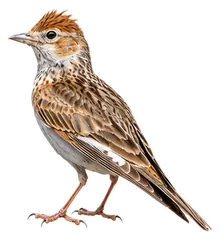 White-winged LarkAlauda leucoptera
 Raso LarkAlauda razae
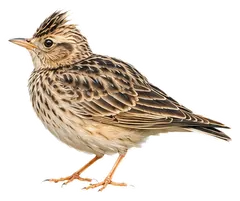 Oriental SkylarkAlauda gulgula
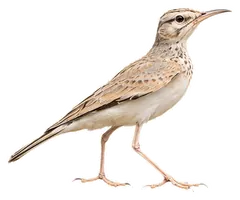 Greater Hoopoe-LarkAlaemon alaudipes
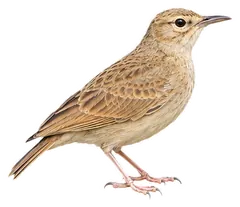 Lesser Hoopoe-LarkAlaemon hamertoni
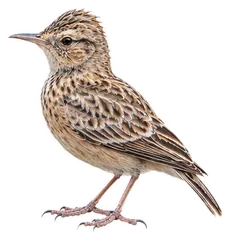 Beesley's LarkChersomanes beesleyi
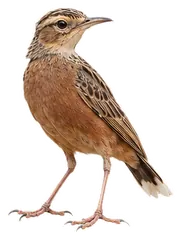 Spike-heeled LarkChersomanes albofasciata
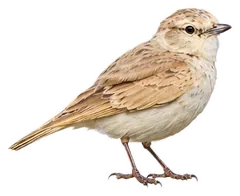 Gray's LarkAmmomanopsis grayi
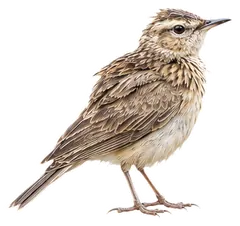 Short-clawed LarkCerthilauda chuana
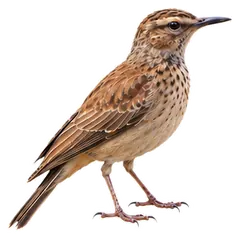 Karoo Long-billed LarkCerthilauda subcoronata
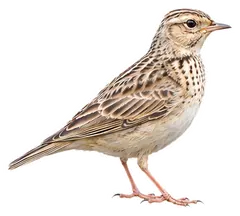
Download illustration
Free to use with credit: “Illustration: Bird Album (birdalbum.com)”. Drawn by AI from a reference photo by User:Diliff. ↗

Heard it but can't see it? Mingji identifies birds by sound and photo, on your phone.