 Bird Album
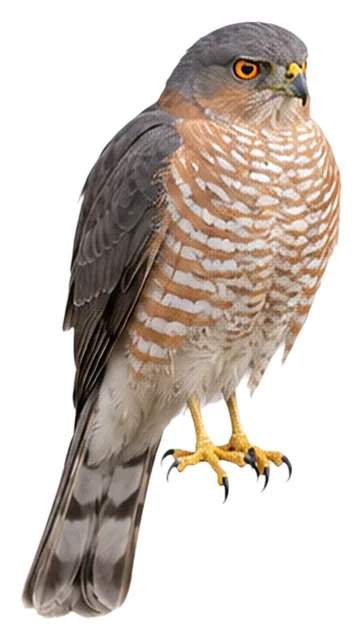
Eurasian Sparrowhawk
Accipiter nisus (Linnaeus, 1758)
35–41 cmLength67 cmWingspan221 gWeight
This small raptor has short, broad wings and a long tail, with the female noticeably larger than the male.
Busiest months: September–October · Most records: United Kingdom, Spain, China
Looks like Eurasian Goshawk, Besra, Shikra
How to identify
Field marks
- Male has slate-gray upperparts, sometimes bluish
- Male has fine red barring on underparts, appearing orangish at a distance
- Female has dark brown or gray-brown upperparts and rufous barring on underparts
- Wings short and broad; tail long and square, with a straight tip
Male, female and young
Female up to a quarter larger than male; male has blue-gray upperparts, while female and juvenile have rufous upperparts.
Similar species
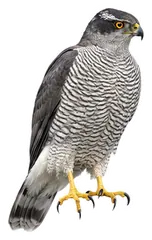
Eurasian Sparrowhawk is smaller and more slender, with shorter wings, a square, straight-ended tail and faster wingbeats.
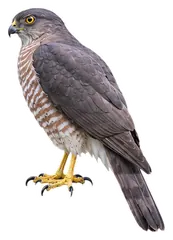
An easily confused species in China, but the melaschistos subspecies of Eurasian Sparrowhawk is much larger.
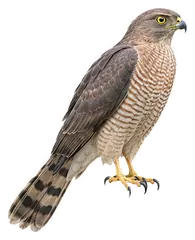
Eurasian Sparrowhawk is larger than Shikra and has a different call.
Where and when it's recorded
Busiest months: September–October · Most records: United Kingdom, Spain, China

Eurasian Sparrowhawk has been recorded at 2,614 of the 8,276 birding hotspots we track, in 95 countries and regions.
Records by month Northern Hemisphere
Where it's recorded most
- Algeciras – Observatorio de AlgarroboSpain4,650 records
- Observatorio de CazallaSpain3,961 records
- LindusSpain2,885 records
More places
- Amwell HMWT NRUnited Kingdom2,857 records
- International Birding and Research Center Eilat (IBRCE)Israel2,274 records
- Spurn Bird Observatory Recording AreaUnited Kingdom2,094 records
- Beddington FarmlandsUnited Kingdom1,800 records
- Jerusalem Bird ObservatoryIsrael1,628 records
- PN Sudoeste Alentejano e Costa Vicentina – CabranosaPortugal1,623 records
- Rutland WaterUnited Kingdom1,560 records
Countries and regions with the most records
eBird records via GBIF up to 2024-12-31. A record means someone listed it; more records partly mean more birders, not more birds.
About
The Eurasian sparrowhawk (Accipiter nisus), also known as the northern sparrowhawk or simply the sparrowhawk, is a small bird of prey in the family Accipitridae. Adult male Eurasian sparrowhawks have bluish grey upperparts and orange-barred underparts; females and juveniles are brown above with brown barring below. The female is up to 25% larger than the male – one of the greatest size differences between the sexes in any bird species.
Excerpt from Wikipedia, CC BY-SA 4.0 · authors · Read more on Wikipedia
Questions
How big is the Eurasian Sparrowhawk?
The Eurasian Sparrowhawk is about 35–41 cm long, with a wingspan of 67 cm and weighs around 221 g.
Where does the Eurasian Sparrowhawk live?
Its breeding range: Palearctic: widespread. It is most often recorded in United Kingdom, Spain and China.
When is the best time to see the Eurasian Sparrowhawk?
At the hotspots we track, it is recorded most in September and October (Northern Hemisphere).
Is the Eurasian Sparrowhawk endangered?
The IUCN Red List classifies the Eurasian Sparrowhawk as Least Concern.
What does the Eurasian Sparrowhawk eat?
Main food: Vertebrate prey.
What family is the Eurasian Sparrowhawk in?
It belongs to the family Kites, Hawks, Eagles (Accipitridae), order Accipitriformes.
At a glance
- Length
- 35–41 cm
- Wingspan
- 67 cm
- Weight
- 221 g
- Habitat
- Forest
- Diet
- Vertebrate prey
- Lifestyle
- Perches in trees
- Migration
- Partial migrant
- Conservation
- Least Concern
More measurements
- Wing
- 207 mm
- Tail
- 156 mm
- Bill
- 20 mm
- Tarsus
- 54 mm
Averages from the AVONET dataset; length from field guides where available.
Range
Palearctic: widespread
Breeding range, IOC World Bird List 15.2
Subspecies · 2
- Accipiter nisus nisosimilis nw Siberia to n China and Japan | non-breeding: sw, c, e Asia
- Accipiter nisus melaschistos e Afghanistan to sw China
Classification
- Order
- Accipitriformes
- Family
- Kites, Hawks, Eagles Accipitridae
- Genus
- Accipiter
Other birds in the genus Accipiter
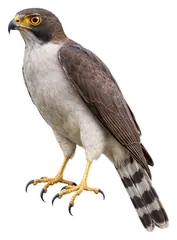 Grey-bellied HawkAccipiter poliogaster
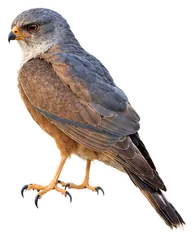 Ovambo SparrowhawkAccipiter ovampensis
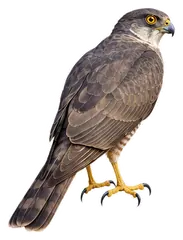 Madagascar SparrowhawkAccipiter madagascariensis
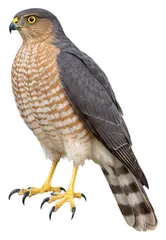 Sharp-shinned HawkAccipiter striatus
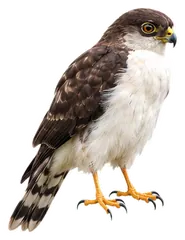 White-breasted HawkAccipiter chionogaster
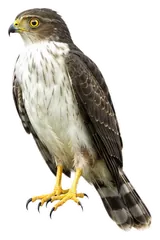 Plain-breasted HawkAccipiter ventralis
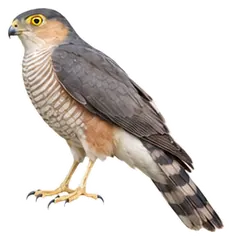 Rufous-thighed HawkAccipiter erythronemius
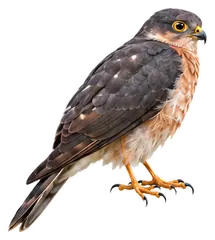 Rufous-breasted SparrowhawkAccipiter rufiventris
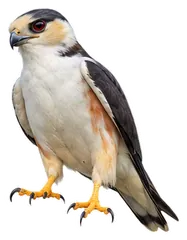 Pearl KiteGampsonyx swainsonii
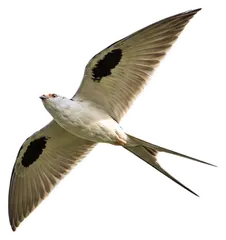 Scissor-tailed KiteChelictinia riocourii
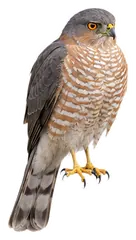
Download illustration
Free to use with credit: “Illustration: Bird Album (birdalbum.com)”. Drawn by AI from a reference photo by Dion Art. ↗

Heard it but can't see it? Mingji identifies birds by sound and photo, on your phone.