 Bird Album
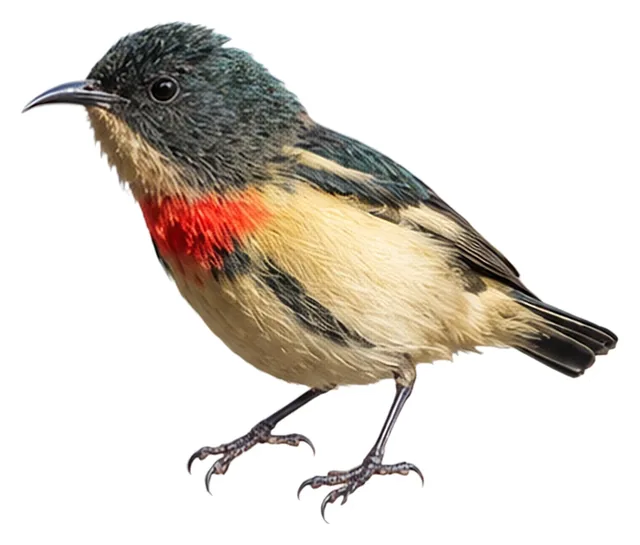
Fire-breasted Flowerpecker
Dicaeum ignipectus (Blyth, 1843)
7 cmLength5.7 gWeight
It is a tiny bird less than 7 cm long, the male with blue-black upperparts and a bright breast patch.
Busiest months: December–February · Most records: China, Thailand, Malaysia
How to identify
Field marks
- Male has bright blue-black upperparts
- Male has pale rufous underparts with a bright patch on the breast
- Male has a short black streak below the breast patch
- Bill short and dark
Male, female and young
Female duller, with dark olive upperparts and pale rufous underparts.
Voice
A grating call like scissors snipping, and a short “tsit”.
Where and when it's recorded

Fire-breasted Flowerpecker has been recorded at 453 of the 8,171 birding hotspots we track, in 12 countries and regions.
Records by month Northern Hemisphere
Where it's recorded most
- Nantou – Meifeng Highland Experimental Farm of NTUTaiwan (China)1,292 records
- Bukit FraserMalaysia927 records
- Tai Po Kau Nature ReserveHong Kong (China)619 records
More places
- Munsyari – Bheema WodeyarIndia564 records
- Khao Yai NPThailand510 records
- Khao Yai NP – headquarters vicinityThailand351 records
- Mt. Phulchowki - Lowest Few Miles of RoadNepal349 records
- Tai Lam Country ParkHong Kong (China)324 records
- Doi Inthanon NPThailand321 records
- SattalIndia294 records
Countries and regions with the most records
eBird records via GBIF up to 2024-12-31. A record means someone listed it; more records partly mean more birders, not more birds.
About
The fire-breasted flowerpecker (Dicaeum ignipectus) is a species of bird in the family Dicaeidae found in the Indian subcontinent and Southeast Asia. Like other flowerpeckers, this tiny bird feeds on fruits and plays an important role in the dispersal of fruiting plants. Unlike many other species in the genus, this species has marked sexual dimorphism with the male having contrasting upper and lower parts with a distinctive bright orange breast patch.
Excerpt from Wikipedia, CC BY-SA 4.0 · authors · Read more on Wikipedia
Questions
How big is the Fire-breasted Flowerpecker?
The Fire-breasted Flowerpecker is about 7 cm long and weighs around 5.7 g.
Where does the Fire-breasted Flowerpecker live?
Its breeding range: Oriental: Himalayas to eastern China, northern, central Indochina, Myanmar, northern Thailand, Myanmar, Malay Peninsula and Taiwan (China). It is most often recorded in China, Thailand and Malaysia.
When is the best time to see the Fire-breasted Flowerpecker?
At the hotspots we track, it is recorded most in January, February and December (Northern Hemisphere).
Is the Fire-breasted Flowerpecker endangered?
The IUCN Red List classifies the Fire-breasted Flowerpecker as Least Concern.
What does the Fire-breasted Flowerpecker eat?
Main food: Omnivore.
What family is the Fire-breasted Flowerpecker in?
It belongs to the family Flowerpeckers (Dicaeidae), order Passerines (Passeriformes).
At a glance
- Length
- 7 cm
- Weight
- 5.7 g
- Habitat
- Forest
- Diet
- Omnivore
- Lifestyle
- Perches in trees
- Migration
- Resident (barely migrates)
- Conservation
- Least Concern
More measurements
- Wing
- 47 mm
- Tail
- 25 mm
- Bill
- 9 mm
- Tarsus
- 12 mm
Averages from the AVONET dataset; length from field guides where available.
Range
Oriental: Himalayas to eastern China, northern, central Indochina, Myanmar, northern Thailand, Myanmar, Malay Peninsula and Taiwan (China)
Breeding range, IOC World Bird List 15.2
Subspecies · 2
- Dicaeum ignipectus ignipectus Himalayas to e China, n, c Indochina, n Thailand and Myanmar
- Dicaeum ignipectus formosum Taiwan (China)
Classification
- Order
- Passerines Passeriformes
- Family
- Flowerpeckers Dicaeidae
- Genus
- Dicaeum
Other birds in the genus Dicaeum
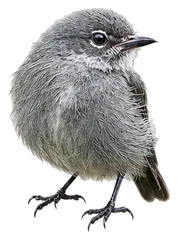 Spectacled FlowerpeckerDicaeum dayakorum
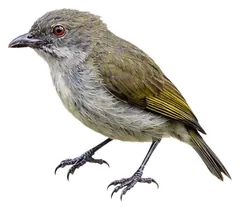 Golden-rumped FlowerpeckerDicaeum annae
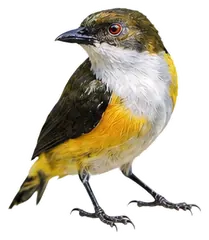 Yellow-sided FlowerpeckerDicaeum aureolimbatum
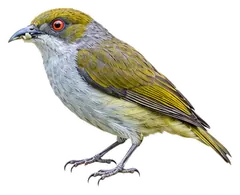 Olive-capped FlowerpeckerDicaeum nigrilore
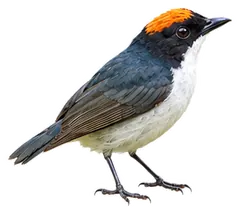 Yellow-crowned FlowerpeckerDicaeum anthonyi
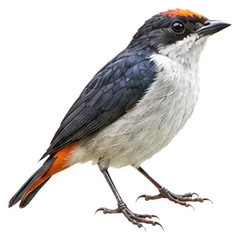 Flame-crowned FlowerpeckerDicaeum kampalili
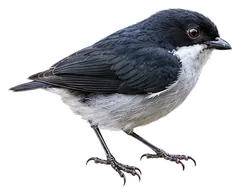 Bicolored FlowerpeckerDicaeum bicolor
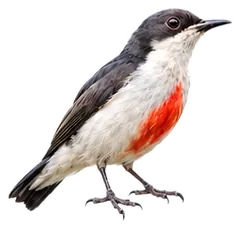 Red-keeled FlowerpeckerDicaeum australe
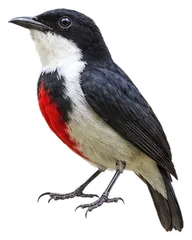 Black-belted FlowerpeckerDicaeum haematostictum
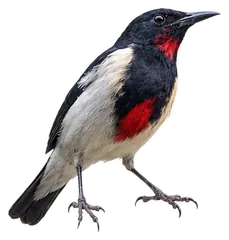 Scarlet-collared FlowerpeckerDicaeum retrocinctum
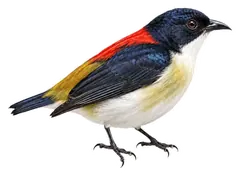 Cebu FlowerpeckerDicaeum quadricolor
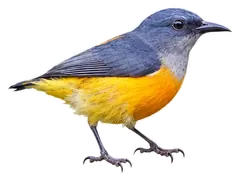 Orange-bellied FlowerpeckerDicaeum trigonostigma
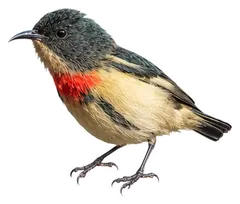
Download illustration
Free to use with credit: “Illustration: Bird Album (birdalbum.com)”. Drawn by AI from a reference photo by Charles J. Sharp. ↗

Heard it but can't see it? Mingji identifies birds by sound and photo, on your phone.
In other languages
- EnglishFire-breasted Flowerpecker
- 简体中文红胸啄花鸟
- 繁體中文紅胸啄花
- 日本語ハナドリ
- DeutschFeuerbrust-Mistelfresser
- FrançaisDicée à gorge feu
- EspañolPicaflores pechofuego
- Portuguêspica-flor-flamejante
- ItalianoBeccafiore pettoigneo
- NederlandsIndische Honingvogel
- РусскийАлогрудый цветоед
- Svenskaorientblomsterpickare
- DanskIldbryst Blomsterpikker
- Polskikwiatówka ognista