 Bird Album
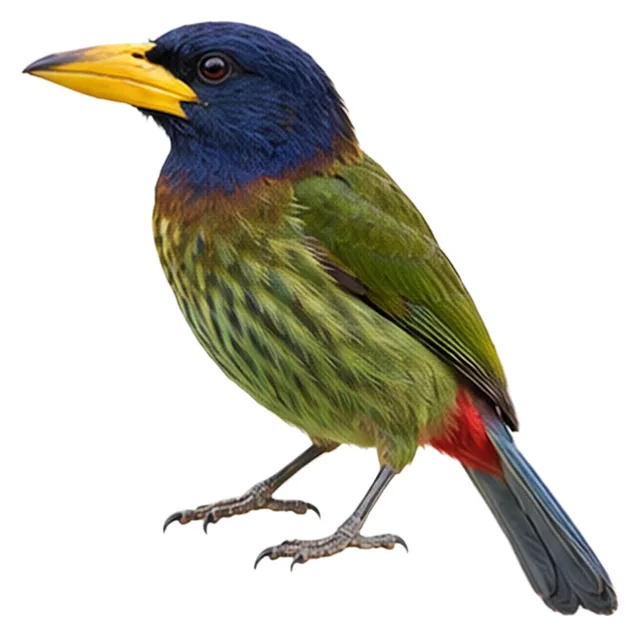
Great Barbet
Psilopogon virens (Boddaert, 1783)
32–35 cmLength202 gWeight
This green barbet has a blue head and a large yellow bill, and is the largest of its kind.
Busiest months: February–April · Most records: China, Thailand, India
How to identify
Field marks
- Blue head
- Large yellow bill
- Green body feathers with brown-green streaks on the belly
- Red vent (under the tail)
Voice
The male's extremely loud territorial call is “kay-oh”; the alarm call is a grating “keeab”, and it also gives a continuous “piou-piou-piou-piou”.
Where and when it's recorded

Great Barbet has been recorded at 431 of the 8,171 birding hotspots we track, in 9 countries and regions.
Records by month Northern Hemisphere
Where it's recorded most
- SattalIndia1,347 records
- Tai Po Kau Nature ReserveHong Kong (China)1,109 records
- Munsyari – Bheema WodeyarIndia1,010 records
More places
- Mahananda WLS – Rongtong and Shivakhola ForestIndia829 records
- Mahananda WLS – LatpancharIndia660 records
- Mt. Phulchowki - Lowest Few Miles of RoadNepal575 records
- Taksin Maharat NP – headquarters vicinityThailand560 records
- Sangla and AreaNepal544 records
- Doi Pha Hom Pok NP – Doi Lang (W), AKA Doi San JuThailand472 records
- PangotIndia469 records
Countries and regions with the most records
eBird records via GBIF up to 2024-12-31. A record means someone listed it; more records partly mean more birders, not more birds.
About
The great barbet (Psilopogon virens) is an Asian barbet native to the Indian sub-continent and Southeast Asia, where it inhabits forests up to 3,000 m (9,800 ft) altitude. It has been listed as Least Concern on the IUCN Red List since 2004 because of its wide distribution.
Excerpt from Wikipedia, CC BY-SA 4.0 · authors · Read more on Wikipedia
Questions
How big is the Great Barbet?
The Great Barbet is about 32–35 cm long and weighs around 202 g.
Where does the Great Barbet live?
Its breeding range: Oriental: northwestern India to southeastern China and Myanmar. It is most often recorded in China, Thailand and India.
When is the best time to see the Great Barbet?
At the hotspots we track, it is recorded most in February, March and April (Northern Hemisphere).
Is the Great Barbet endangered?
The IUCN Red List classifies the Great Barbet as Least Concern.
What does the Great Barbet eat?
Main food: Fruit.
What family is the Great Barbet in?
It belongs to the family Asian Barbets (Megalaimidae), order Piciformes.
At a glance
- Length
- 32–35 cm
- Weight
- 202 g
- Habitat
- Forest
- Diet
- Fruit
- Lifestyle
- Perches in trees
- Migration
- Resident (barely migrates)
- Conservation
- Least Concern
More measurements
- Wing
- 138 mm
- Tail
- 100 mm
- Bill
- 44 mm
- Tarsus
- 33 mm
Averages from the AVONET dataset; length from field guides where available.
Range
Oriental: northwestern India to southeastern China and Myanmar
Breeding range, IOC World Bird List 15.2
Subspecies · 3
- Psilopogon virens magnificus e Nepal to nw Myanmar and sc China
- Psilopogon virens clamator ne Assam (ne India) to ne Myanmar and sc China
- Psilopogon virens virens c, e Myanmar, n Thailand, n Laos and se China
Classification
- Order
- Piciformes
- Family
- Asian Barbets Megalaimidae
- Genus
- Psilopogon
Other birds in the genus Psilopogon
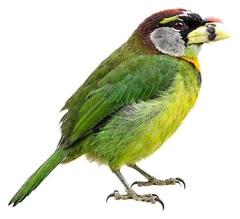 Fire-tufted BarbetPsilopogon pyrolophus
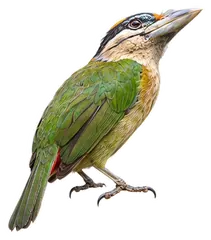 Red-vented BarbetPsilopogon lagrandieri
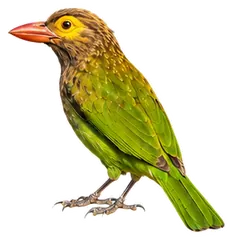 Brown-headed BarbetPsilopogon zeylanicus
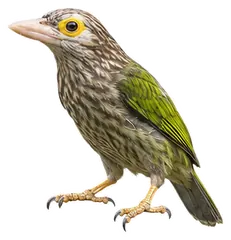 Lineated BarbetPsilopogon lineatus
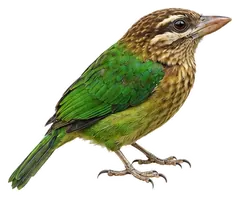 White-cheeked BarbetPsilopogon viridis
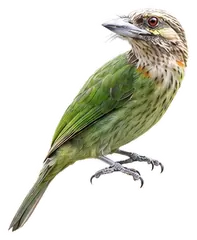 Green-eared BarbetPsilopogon faiostrictus
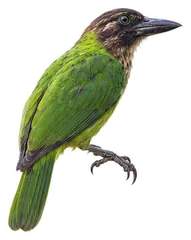 Brown-throated BarbetPsilopogon corvinus
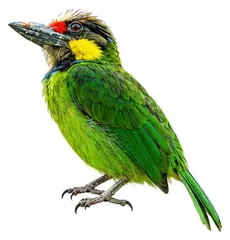 Golden-whiskered BarbetPsilopogon chrysopogon
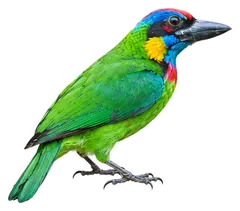 Red-crowned BarbetPsilopogon rafflesii
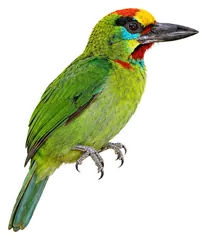 Red-throated BarbetPsilopogon mystacophanos
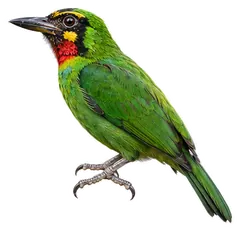 Black-banded BarbetPsilopogon javensis
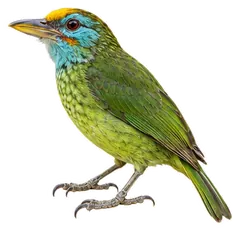 Yellow-fronted BarbetPsilopogon flavifrons
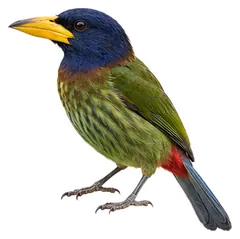
Download illustration
Free to use with credit: “Illustration: Bird Album (birdalbum.com)”. Drawn by AI from a reference photo by Creepanta. ↗

Heard it but can't see it? Mingji identifies birds by sound and photo, on your phone.