 Bird Album
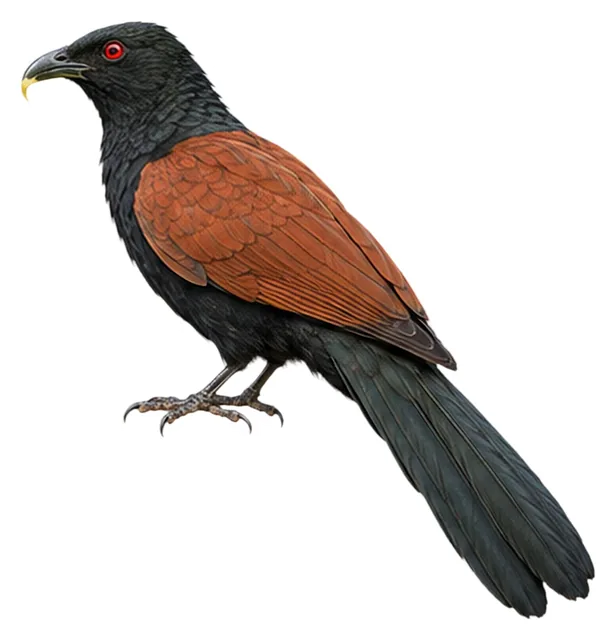
Greater Coucal
Centropus sinensis (Stephens, 1815)
≈48 cmLength281 gWeight
It is a large, crow-like cuckoo with a black body, chestnut-brown back and wings and a long tail, often clambering through vegetation.
Busiest months: February · Most records: India, Thailand, China
Looks like Lesser Coucal
How to identify
Field marks
- Head black; upper back and underparts black with a purple metallic gloss
- Back and wings chestnut-brown
- Eyes ruby-red
- Long tail; body length about 48 cm
Male, female and young
Sexes similar in plumage, but the female is slightly larger; juveniles are duller black, with spots on the crown and pale barring on the underparts and tail.
Voice
A low, booming “coop-coop-coop”, repeated with variations.
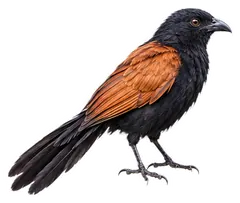
Similar species
Where and when it's recorded
Busiest months: February · Most records: India, Thailand, China

Greater Coucal has been recorded at 1,134 of the 8,276 birding hotspots we track, in 18 countries and regions.
Records by month Northern Hemisphere
Where it's recorded most
- GKVK CampusIndia14,354 records
- Bharatpur – Keoladeo Ghana NPIndia3,659 records
- Kanha NP – Mukki ZoneIndia3,533 records
More places
- Mai Po Nature ReserveHong Kong (China)3,507 records
- Fergusson College CampusIndia3,315 records
- Saul Kere / Sowl KereIndia2,987 records
- Salim Ali Centre for Ornithology and Natural HistoryIndia2,809 records
- Valley SchoolIndia2,452 records
- Thrissur Government Medical CollegeIndia2,366 records
- IIT BombayIndia2,256 records
Countries and regions with the most records
eBird records via GBIF up to 2024-12-31. A record means someone listed it; more records partly mean more birders, not more birds.
About
The greater coucal or crow pheasant (Centropus sinensis), is a large non-parasitic member of the cuckoo order of birds, the Cuculiformes. A widespread resident in the Indian subcontinent and Southeast Asia, it is divided into several subspecies, some being treated as full species. They are large, crow-like with a long tail and coppery brown wings and found in a wide range of habitats from jungle to cultivation and urban gardens.
Excerpt from Wikipedia, CC BY-SA 4.0 · authors · Read more on Wikipedia
Questions
How big is the Greater Coucal?
The Greater Coucal is about ≈48 cm long and weighs around 281 g.
Where does the Greater Coucal live?
Its breeding range: Oriental: Pakistan to southeastern China, southwestern Philippines and Greater Sundas. It is most often recorded in India, Thailand and China.
When is the best time to see the Greater Coucal?
At the hotspots we track, it is recorded most in February (Northern Hemisphere).
Is the Greater Coucal endangered?
The IUCN Red List classifies the Greater Coucal as Least Concern.
What does the Greater Coucal eat?
Main food: Vertebrate prey.
What family is the Greater Coucal in?
It belongs to the family Cuckoos (Cuculidae), order Cuculiformes.
At a glance
- Length
- ≈48 cm
- Weight
- 281 g
- Habitat
- Woodland
- Diet
- Vertebrate prey
- Lifestyle
- Active on the ground
- Migration
- Resident (barely migrates)
- Conservation
- Least Concern
More measurements
- Wing
- 212 mm
- Tail
- 261 mm
- Bill
- 47 mm
- Tarsus
- 56 mm
Averages from the AVONET dataset; length from field guides where available.
Range
Oriental: Pakistan to southeastern China, southwestern Philippines and Greater Sundas
Breeding range, IOC World Bird List 15.2
Subspecies · 1
- Centropus sinensis sinensis Pakistan through n India to se China
Classification
- Order
- Cuculiformes
- Family
- Cuckoos Cuculidae
- Genus
- Centropus
Other birds in the genus Centropus
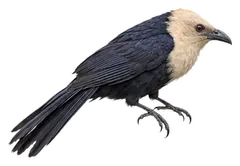 Buff-headed CoucalCentropus milo
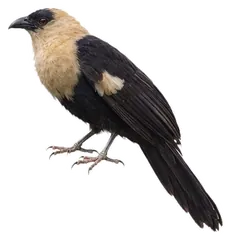 White-necked CoucalCentropus ateralbus
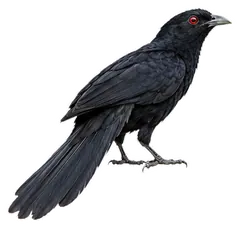 Ivory-billed CoucalCentropus menbeki
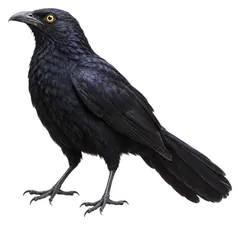 Biak CoucalCentropus chalybeus
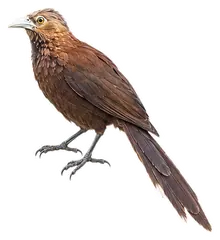 Rufous CoucalCentropus unirufus
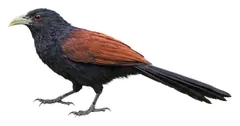 Green-billed CoucalCentropus chlororhynchos
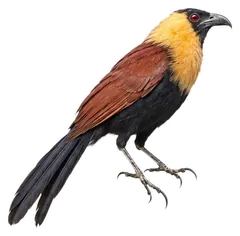 Black-faced CoucalCentropus melanops
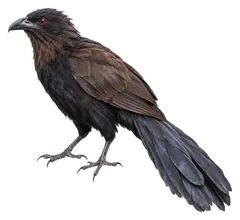 Black-hooded CoucalCentropus steerii
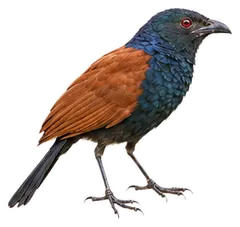 Short-toed CoucalCentropus rectunguis
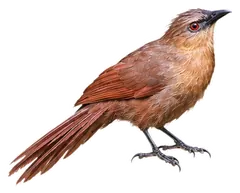 Bay CoucalCentropus celebensis
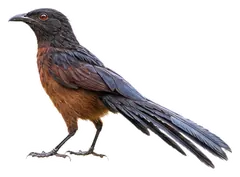 Gabon CoucalCentropus anselli
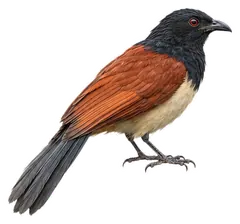 Black-throated CoucalCentropus leucogaster
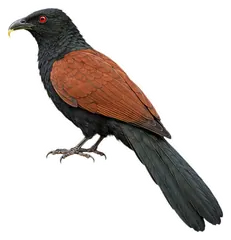
Download illustration
Free to use with credit: “Illustration: Bird Album (birdalbum.com)”. Drawn by AI from a reference photo by Davidvraju. ↗

Heard it but can't see it? Mingji identifies birds by sound and photo, on your phone.