 Bird Album
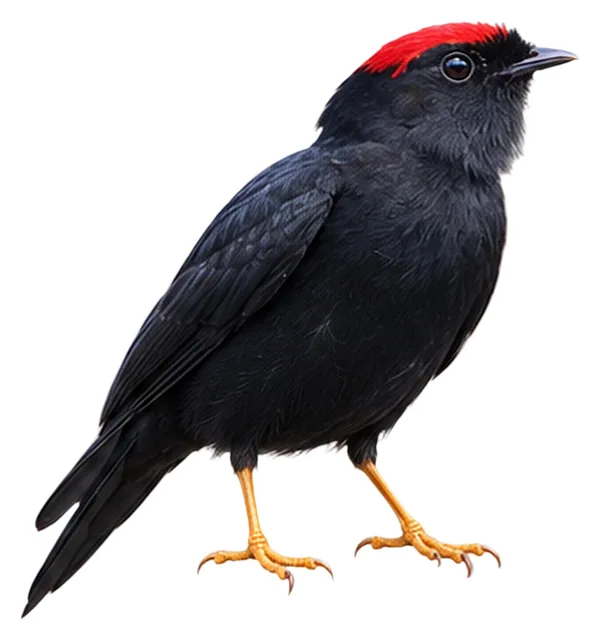
Lance-tailed Manakin
Chiroxiphia lanceolata (Wagler, 1830)
18 gWeight
The lance-tailed manakin (Chiroxiphia lanceolata) is a small passerine bird which breeds in tropical Central and South America from Costa Rica to northern Venezuela.
Busiest months: February–March · Most records: Panama, Venezuela, Colombia
Where and when it's recorded
Busiest months: February–March · Most records: Panama, Venezuela, Colombia

Lance-tailed Manakin has been recorded at 66 of the 8,276 birding hotspots we track, in 4 countries and regions.
Records by month Northern Hemisphere
Where it's recorded most
- Parque Natural MetropolitanoPanama1,592 records
- Agrícola CameliasColombia495 records
- Summit PondsPanama466 records
More places
- Carretera a Juan HombrónPanama432 records
- CaicaguanaVenezuela428 records
- Hacienda El Escobal, TolimaColombia364 records
- Parque Natural Metropolitano – Centro de VisitantesPanama363 records
- Cara IguanaPanama348 records
- Sierra de San Luis – Caserio de AcuriguaVenezuela316 records
- Posada Siete MaresVenezuela289 records
Countries and regions with the most records
eBird records via GBIF up to 2024-12-31. A record means someone listed it; more records partly mean more birders, not more birds.
About
The lance-tailed manakin (Chiroxiphia lanceolata) is a small passerine bird which breeds in tropical Central and South America from Costa Rica to northern Venezuela. This manakin is a fairly common bird of dry and moist deciduous forests, but not rainforest. It is a small, compact bird about 13 centimetres (5 in) long and similar to the blue-backed manakin, but both sexes have the two central tail feathers elongated to form a spike.
Excerpt from Wikipedia, CC BY-SA 4.0 · authors · Read more on Wikipedia
Questions
How big is the Lance-tailed Manakin?
The Lance-tailed Manakin weighs around 18 g.
Where does the Lance-tailed Manakin live?
Its breeding range: Middle America, South America: southwestern Costa Rica to northern Venezuela. It is most often recorded in Panama, Venezuela and Colombia.
When is the best time to see the Lance-tailed Manakin?
At the hotspots we track, it is recorded most in February and March (Northern Hemisphere).
Is the Lance-tailed Manakin endangered?
The IUCN Red List classifies the Lance-tailed Manakin as Least Concern.
What does the Lance-tailed Manakin eat?
Main food: Fruit.
What family is the Lance-tailed Manakin in?
It belongs to the family Manakins (Pipridae), order Passerines (Passeriformes).
At a glance
- Weight
- 18 g
- Habitat
- Woodland
- Diet
- Fruit
- Lifestyle
- Perches in trees
- Migration
- Resident (barely migrates)
- Conservation
- Least Concern
More measurements
- Wing
- 70 mm
- Tail
- 49 mm
- Bill
- 12 mm
- Tarsus
- 18 mm
Averages from the AVONET dataset; length from field guides where available.
Range
Middle America, South America: southwestern Costa Rica to northern Venezuela
Breeding range, IOC World Bird List 15.2
Classification
- Order
- Passerines Passeriformes
- Family
- Manakins Pipridae
- Genus
- Chiroxiphia
Other birds in the genus Chiroxiphia
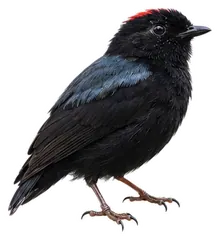 Yungas ManakinChiroxiphia boliviana
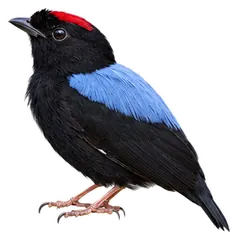 Blue-backed ManakinChiroxiphia pareola
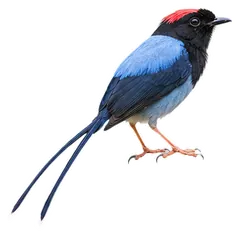 Long-tailed ManakinChiroxiphia linearis
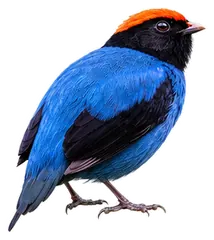 Blue ManakinChiroxiphia caudata
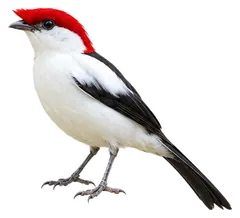 Araripe ManakinChiroxiphia bokermanni
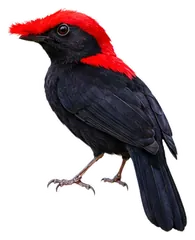 Helmeted ManakinChiroxiphia galeata
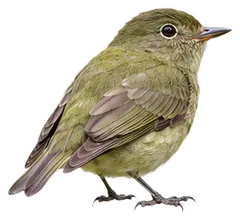 Dwarf Tyrant-ManakinTyranneutes stolzmanni
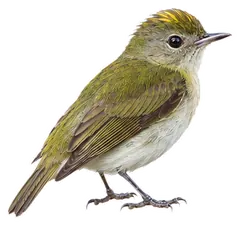 Tiny Tyrant-ManakinTyranneutes virescens
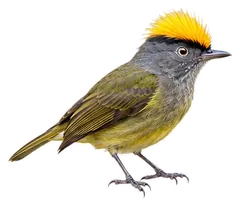 Saffron-crested Tyrant-ManakinNeopelma chrysocephalum
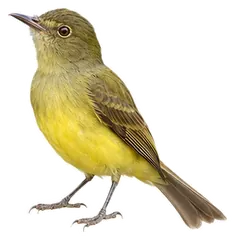 Sulphur-bellied Tyrant-ManakinNeopelma sulphureiventer
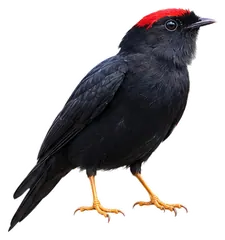
Download illustration
Free to use with credit: “Illustration: Bird Album (birdalbum.com)”. Drawn by AI from a reference photo by Aitor. ↗
Heard it but can't see it? Mingji identifies birds by sound and photo, on your phone.
In other languages
- EnglishLance-tailed Manakin
- 简体中文尖尾娇鹟
- 繁體中文尖尾侏儒鳥
- 日本語ハリオセアオマイコドリ
- DeutschLanzettschwanzpipra
- FrançaisManakin lancéolé
- EspañolSaltarín lanceolado
- Portuguêstangará-lanceolado
- ItalianoManachino lanceolato
- NederlandsLancetmanakin
- РусскийЛанцетохвостый манакин
- Svenskalansstjärtad manakin
- DanskLansehalemanakin
- Polskimodrogrzbiecik ostrosterny