 Bird Album
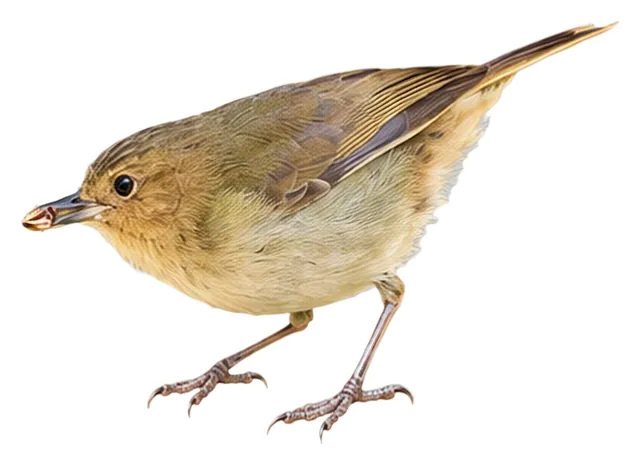
Large Scrubwren
Sericornis nouhuysi van Oort, 1909
17 gWeight
The large scrubwren (Sericornis nouhuysi) is a bird species.
Busiest months: July–August · Most records: Papua New Guinea, Indonesia
Where and when it's recorded

Large Scrubwren has been recorded at 18 of the 8,171 birding hotspots we track, in 2 countries and regions.
Records by month Southern Hemisphere
Where it's recorded most
- Kumul LodgePapua New Guinea518 records
- Ambua LodgePapua New Guinea100 records
- Minggre Birdwatching HomestayIndonesia99 records
More places
- Rondon Ridge LodgePapua New Guinea80 records
- Tari GapPapua New Guinea79 records
- Highlands Hwy – above Ambua Lodge to Tari GapPapua New Guinea73 records
- Rondon RidgePapua New Guinea65 records
- Arfak Mtns – German CampIndonesia60 records
- Tomba & Murmur Pass [2400-2800m]Papua New Guinea19 records
- Arfak Mtns – MaybriIndonesia16 records
Countries and regions with the most records
eBird records via GBIF up to 2024-12-31. A record means someone listed it; more records partly mean more birders, not more birds.
About
The large scrubwren (Sericornis nouhuysi) is a bird species. Placed in the family Pardalotidae in the Sibley-Ahlquist taxonomy, this has met with opposition and indeed is now known to be wrong; they rather belong to the independent family Acanthizidae.
Excerpt from Wikipedia, CC BY-SA 4.0 · authors · Read more on Wikipedia
Questions
How big is the Large Scrubwren?
The Large Scrubwren weighs around 17 g.
Where does the Large Scrubwren live?
Its breeding range: Australasia: montane New Guinea. It is most often recorded in Papua New Guinea and Indonesia.
When is the best time to see the Large Scrubwren?
At the hotspots we track, it is recorded most in July and August (Southern Hemisphere).
Is the Large Scrubwren endangered?
The IUCN Red List classifies the Large Scrubwren as Least Concern.
What does the Large Scrubwren eat?
Main food: Insects & other invertebrates.
What family is the Large Scrubwren in?
It belongs to the family Australasian Warblers (Acanthizidae), order Passerines (Passeriformes).
At a glance
- Weight
- 17 g
- Habitat
- Forest
- Diet
- Insects & other invertebrates
- Lifestyle
- Perches in trees
- Migration
- Resident (barely migrates)
- Conservation
- Least Concern
More measurements
- Wing
- 64 mm
- Tail
- 45 mm
- Bill
- 15 mm
- Tarsus
- 24 mm
Averages from the AVONET dataset; length from field guides where available.
Range
Australasia: montane New Guinea
Breeding range, IOC World Bird List 15.2
Classification
- Order
- Passerines Passeriformes
- Family
- Australasian Warblers Acanthizidae
- Genus
- Sericornis
Other birds in the genus Sericornis
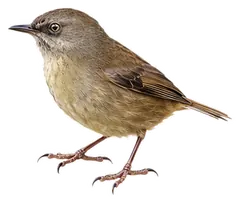 Tasmanian ScrubwrenSericornis humilis
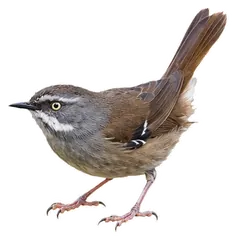 White-browed ScrubwrenSericornis frontalis
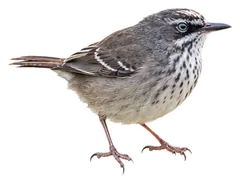 Spotted ScrubwrenSericornis maculatus
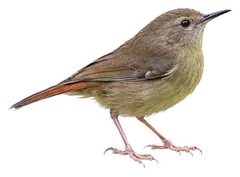 Atherton ScrubwrenSericornis keri
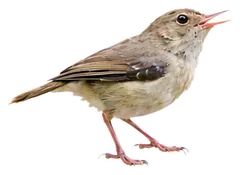 Tropical ScrubwrenSericornis beccarii
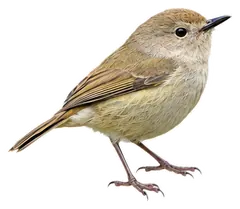 Large-billed ScrubwrenSericornis magnirostra
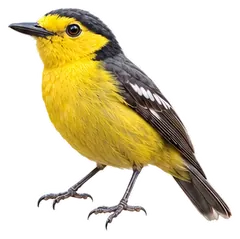 GoldenfacePachycare flavogriseum
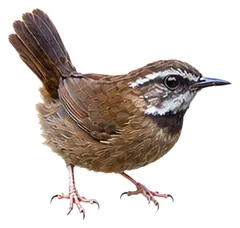 FernwrenOreoscopus gutturalis
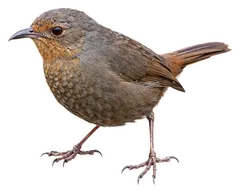 PilotbirdPycnoptilus floccosus
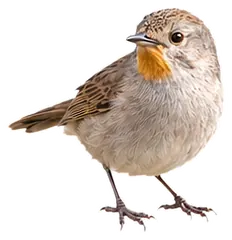 RedthroatPyrrholaemus brunneus
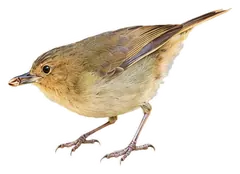
Download illustration
Free to use with credit: “Illustration: Bird Album (birdalbum.com)”. Drawn by AI from a reference photo by Charley Hesse. ↗
Heard it but can't see it? Mingji identifies birds by sound and photo, on your phone.