 Bird Album
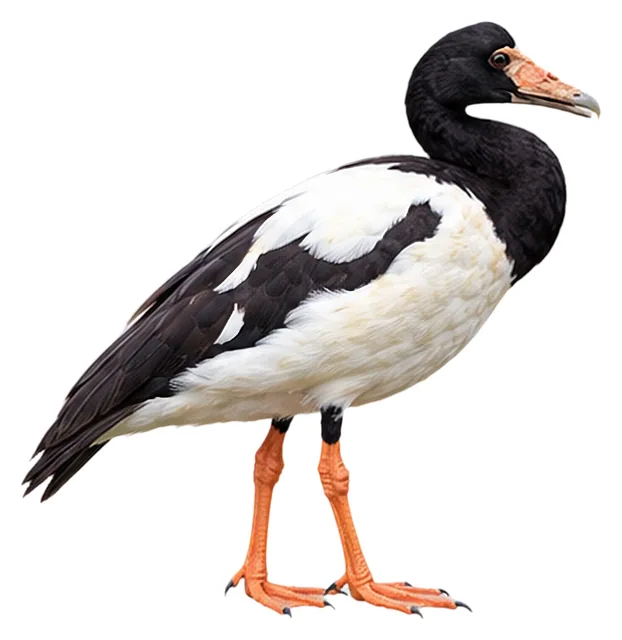
Magpie Goose
Anseranas semipalmata (Latham, 1798)
75–90 cmLength2.4 kgWeight
The magpie goose (Anseranas semipalmata) is the sole living representative species of the family Anseranatidae.
Busiest months: October–November · Most records: Australia, Papua New Guinea
Where and when it's recorded
Busiest months: October–November · Most records: Australia, Papua New Guinea

Magpie Goose has been recorded at 119 of the 8,276 birding hotspots we track, in 2 countries and regions.
Records by month Southern Hemisphere
Where it's recorded most
- Sandy Camp Road WetlandsAustralia2,832 records
- Townsville Town Common Conservation ParkAustralia2,667 records
- Hasties Swamp National ParkAustralia1,843 records
More places
- Serendip SanctuaryAustralia1,814 records
- Lake GalletlyAustralia1,509 records
- Fogg Dam Conservation ReserveAustralia1,441 records
- Kakadu National Park – Yellow WaterAustralia1,272 records
- Cairns Botanical Gardens and Centenary LakesAustralia1,166 records
- Tyto WetlandsAustralia1,111 records
- Dowse LagoonAustralia927 records
Countries and regions with the most records
eBird records via GBIF up to 2024-12-31. A record means someone listed it; more records partly mean more birders, not more birds.
About
The magpie goose (Anseranas semipalmata) is the sole living representative species of the family Anseranatidae. This waterbird is found in northern Australia and southern New Guinea. The species is not truly migratory but it sometimes travels large distances to find food and water, especially when not breeding, and is sometimes recorded outside its core range.
Excerpt from Wikipedia, CC BY-SA 4.0 · authors · Read more on Wikipedia
Questions
How big is the Magpie Goose?
The Magpie Goose is about 75–90 cm long and weighs around 2.4 kg.
Where does the Magpie Goose live?
Its breeding range: Australasia: Trans-Fly (south-central New Guinea) and northeastern Western Australia to southern Victoria (northern, eastern Australia). It is most often recorded in Australia and Papua New Guinea.
When is the best time to see the Magpie Goose?
At the hotspots we track, it is recorded most in October and November (Southern Hemisphere).
Is the Magpie Goose endangered?
The IUCN Red List classifies the Magpie Goose as Least Concern.
What does the Magpie Goose eat?
Main food: Omnivore.
What family is the Magpie Goose in?
It belongs to the family Magpie Goose (Anseranatidae), order Anseriformes.
At a glance
- Length
- 75–90 cm
- Weight
- 2.4 kg
- Habitat
- Wetland
- Diet
- Omnivore
- Lifestyle
- Active on the ground
- Migration
- Partial migrant
- Conservation
- Least Concern
More measurements
- Wing
- 406 mm
- Tail
- 148 mm
- Bill
- 86 mm
- Tarsus
- 87 mm
Averages from the AVONET dataset; length from field guides where available.
Range
Australasia: Trans-Fly (south-central New Guinea) and northeastern Western Australia to southern Victoria (northern, eastern Australia)
Breeding range, IOC World Bird List 15.2
Classification
- Order
- Anseriformes
- Family
- Magpie Goose Anseranatidae
- Genus
- Anseranas
Download illustration
Free to use with credit: “Illustration: Bird Album (birdalbum.com)”. Drawn by AI from a reference photo by Graham Winterflood. ↗
Heard it but can't see it? Mingji identifies birds by sound and photo, on your phone.