 Bird Album
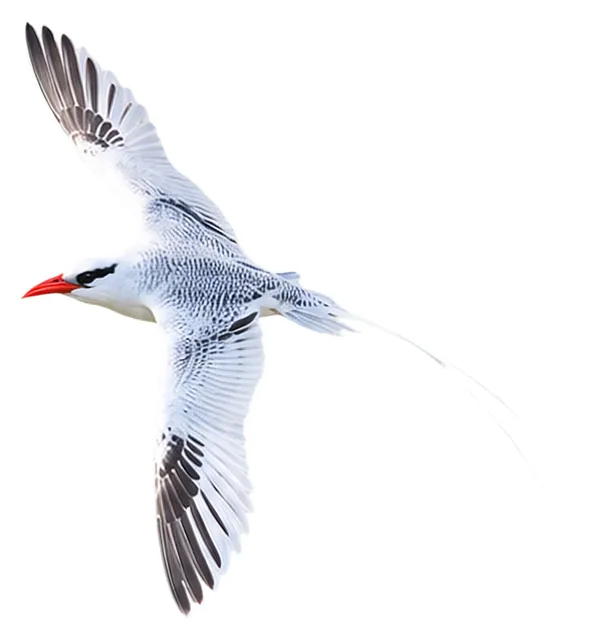
Red-billed Tropicbird
Phaethon aethereus Linnaeus, 1758
90–105 cmLength103 cmWingspan750 gWeight
The adult has white feathers, a black mask and a red or orange bill, usually with long tail feathers.
Most records: Trinidad & Tobago, Ecuador, St. Martin
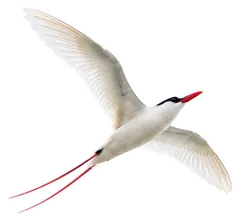
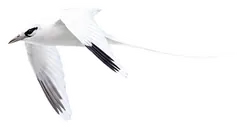
Looks like Red-tailed Tropicbird, White-tailed Tropicbird
How to identify
Field marks
- Bill usually red, orange-tinged in some subspecies
- White feathers, black wingtips and fine black barring on the back
- Black mask may extend to the sides of the nape
Male, female and young
Sexes similar; the male is usually larger, with tail streamers about 12 cm longer than the female's; juveniles lack streamers and have a mostly white crown.
Voice
A loud, grating “kreeeee-kreeeee-kri-kri-kri-kr”, usually given only near breeding sites.
Similar species
Where and when it's recorded
Most records: Trinidad & Tobago, Ecuador, St. Martin

Red-billed Tropicbird has been recorded at 127 of the 8,276 birding hotspots we track, in 39 countries and regions.
Records by month Northern Hemisphere
Where it's recorded most
- Española – Punta SuárezEcuador1,231 records
- Little Tobago IslandTrinidad & Tobago1,181 records
- North Curve - TintamarreSt. Martin504 records
More places
- Blue Waters InnTrinidad & Tobago339 records
- Rocher CréoleSt. Martin236 records
- Caye verteSt. Martin163 records
- Ilhéu RasoCape Verde107 records
- Pointe des ChateauxGuadeloupe84 records
- Great Bird IslandAntigua & Barbuda78 records
- Old Road BayMontserrat70 records
Countries and regions with the most records
eBird records via GBIF up to 2024-12-31. A record means someone listed it; more records partly mean more birders, not more birds.
About
The red-billed tropicbird (Phaethon aethereus) is a tropicbird, one of three closely related species of seabird of tropical oceans. Superficially resembling a tern in appearance, it has mostly white plumage with some black markings on the wings and back, a black mask and, as its common name suggests, a red bill. Most adults have tail streamers that are about two times their body length, with those in males being generally longer than those in females.
Excerpt from Wikipedia, CC BY-SA 4.0 · authors · Read more on Wikipedia
Questions
How big is the Red-billed Tropicbird?
The Red-billed Tropicbird is about 90–105 cm long, with a wingspan of 103 cm and weighs around 750 g.
Where does the Red-billed Tropicbird live?
Its breeding range: Tropical Oceans: tropical and subtropical islands off northwestern Africa, northern South Atlantic, Persian Gulf region, southeastern Vietnam, northwestern Mexico to Ecuador, and Caribbean. It is most often recorded in Trinidad & Tobago, Ecuador and St. Martin.
Is the Red-billed Tropicbird endangered?
The IUCN Red List classifies the Red-billed Tropicbird as Least Concern.
What does the Red-billed Tropicbird eat?
Main food: Fish, shrimp & shellfish.
What family is the Red-billed Tropicbird in?
It belongs to the family Tropicbirds (Phaethontidae), order Phaethontiformes.
At a glance
- Length
- 90–105 cm
- Wingspan
- 103 cm
- Weight
- 750 g
- Habitat
- Ocean
- Diet
- Fish, shrimp & shellfish
- Lifestyle
- Feeds in the air
- Migration
- Migratory
- Conservation
- Least Concern
More measurements
- Wing
- 309 mm
- Tail
- 100 mm
- Bill
- 66 mm
- Tarsus
- 29 mm
Averages from the AVONET dataset; length from field guides where available.
Range
Tropical Oceans: tropical and subtropical islands off northwestern Africa, northern South Atlantic, Persian Gulf region, southeastern Vietnam, northwestern Mexico to Ecuador, and Caribbean
Breeding range, IOC World Bird List 15.2
Classification
- Order
- Phaethontiformes
- Family
- Tropicbirds Phaethontidae
- Genus
- Phaethon
Other birds in the genus Phaethon
Download illustration
Free to use with credit: “Illustration: Bird Album (birdalbum.com)”. Drawn by AI from a reference photo by Paul Tavares. ↗
Heard it but can't see it? Mingji identifies birds by sound and photo, on your phone.
In other languages
- EnglishRed-billed Tropicbird
- 简体中文红嘴鹲
- 繁體中文紅嘴熱帶鳥
- 日本語アカハシネッタイチョウ
- DeutschRotschnabel-Tropikvogel
- FrançaisPhaéton à bec rouge
- EspañolRabijunco etéreo
- Portuguêsrabijunco-riscado
- ItalianoFetonte
- NederlandsRoodsnavelkeerkringvogel
- РусскийКрасноклювый фаэтон
- Svenskarödnäbbad tropikfågel
- DanskRødnæbbet Tropikfugl
- Polskifaeton białosterny