Shoebill
Balaeniceps rex Gould, 1850
≈130 cmLength230–260 cmWingspan5.9 kgWeight
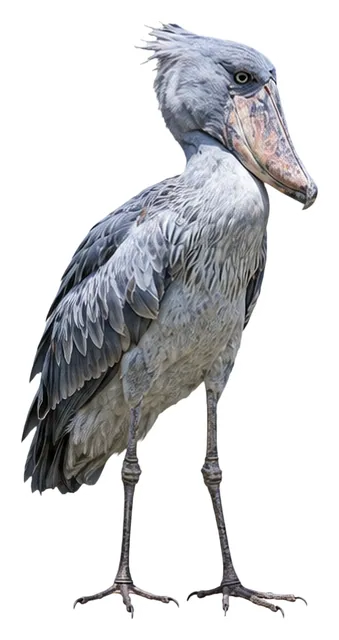
This large gray bird has a huge bill shaped like a wooden clog.
Busiest months: July · Most records: Uganda, Rwanda, Congo - Kinshasa
How to identify
Field marks
- Bill huge, rounded and thick, like a wooden clog
- Bill tip has a sharp hook
- Small crest at the back of the head can be raised
- Legs long and black; no webbing between the toes
Male, female and young
Male larger than female, with a longer bill; juvenile has darker plumage, with a rufous-brown tinge.
Voice
Usually quiet; often clatters the bill near the nest. Juvenile begging calls sound like hiccups.
Where and when it's recorded
Busiest months: July · Most records: Uganda, Rwanda, Congo - Kinshasa

Shoebill has been recorded at 27 of the 8,276 birding hotspots we track, in 5 countries and regions.
Records by month Northern Hemisphere
Where it's recorded most
- Mabamba SwampUganda1,194 records
- Mabamba Swamp – Main channelUganda460 records
- Murchison Falls NP – Boat trip Paraa to Victoria Nile DeltaUganda73 records
More places
- Ziwa Rhino SanctuaryUganda36 records
- Murchison Falls NP – North sideUganda31 records
- Lake Mburo NPUganda17 records
- Uganda Wildlife Education CentreUganda14 records
- Murchison Falls NP – Boat trip Paraa to Murchison FallsUganda11 records
- Murchison Falls NP – Nile RiverUganda10 records
- Entebbe Botanical GardenUganda7 records
Countries and regions with the most records
eBird records via GBIF up to 2024-12-31. A record means someone listed it; more records partly mean more birders, not more birds.
About
The shoebill (Balaeniceps rex), also known as the whale-headed stork, whalebill, and shoe-billed stork, is a large long-legged wading bird. It is named for its enormous, shoe-shaped bill. It has a somewhat stork-like overall form and was previously classified as a stork in the order Ciconiiformes, but genetic evidence has now placed it along with pelicans, herons, and its closest relative, the hamerkop, all in the order Pelecaniformes.
Excerpt from Wikipedia, CC BY-SA 4.0 · authors · Read more on Wikipedia
Questions
How big is the Shoebill?
The Shoebill is about ≈130 cm long, with a wingspan of 230–260 cm and weighs around 5.9 kg.
Where does the Shoebill live?
Its breeding range: Africa: southern Sudan, Uganda and southwestern Ethiopia to southeastern DR Congo and northern Zambia. It is most often recorded in Uganda, Rwanda and Congo - Kinshasa.
When is the best time to see the Shoebill?
At the hotspots we track, it is recorded most in July (Northern Hemisphere).
Is the Shoebill endangered?
The IUCN Red List classifies the Shoebill as Vulnerable.
What does the Shoebill eat?
Main food: Fish, shrimp & shellfish.
What family is the Shoebill in?
It belongs to the family Shoebill (Balaenicipitidae), order Pelecaniformes.
At a glance
- Length
- ≈130 cm
- Wingspan
- 230–260 cm
- Weight
- 5.9 kg
- Habitat
- Wetland
- Diet
- Fish, shrimp & shellfish
- Lifestyle
- Active on the ground
- Migration
- Resident (barely migrates)
- Conservation
- Vulnerable
More measurements
- Wing
- 642 mm
- Tail
- 282 mm
- Bill
- 203 mm
- Tarsus
- 244 mm
Averages from the AVONET dataset; length from field guides where available.
Range
Africa: southern Sudan, Uganda and southwestern Ethiopia to southeastern DR Congo and northern Zambia
Breeding range, IOC World Bird List 15.2
Classification
- Order
- Pelecaniformes
- Family
- Shoebill Balaenicipitidae
- Genus
- Balaeniceps
Download illustration
Free to use with credit: “Illustration: Bird Album (birdalbum.com)”. Drawn by AI from a reference photo by Justin Norton(jnorton / zeroexposure). ↗

Heard it but can't see it? Mingji identifies birds by sound and photo, on your phone.