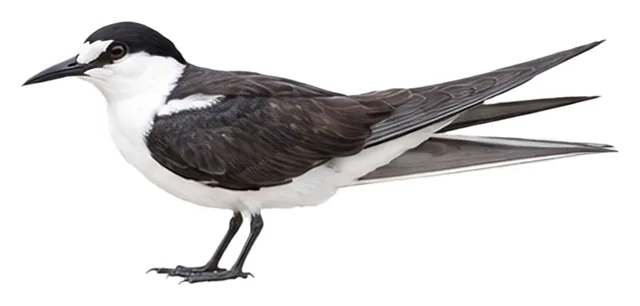
Sooty Tern
Onychoprion fuscatus (Linnaeus, 1766)
33–36 cmLength90 cmWingspan186 gWeight
It is an oceanic tern with a black back and white to pale gray belly, capable of staying in flight for several years.
Most records: U.S. Outlying Islands, Norfolk Island, United States
Looks like Bridled Tern
How to identify
Field marks
- Upperparts black; underparts white to pale gray
- Forehead white
- Tail forked and black with white outer edges
- Legs and bill black
Male, female and young
Juvenile has gray-black upperparts and underparts, with pale feather edges on the upperparts giving a scaly appearance.
Voice
A loud, grating call like “wide-a-wake”, also rendered “ker-wack-a-wack”; also gives a grating alarm call, “kvaark”.
Similar species
Where and when it's recorded
Most records: U.S. Outlying Islands, Norfolk Island, United States

Sooty Tern has been recorded at 265 of the 8,276 birding hotspots we track, in 72 countries and regions.
Records by month Northern Hemisphere
Where it's recorded most
- Midway Atoll – Water Catchment AreaU.S. Outlying Islands516 records
- Midway Atoll NWR – Eastern IslandU.S. Outlying Islands351 records
- Midway Atoll NWR – Sand IslandU.S. Outlying Islands290 records
More places
- Norfolk Island – Phillip IslandNorfolk Island187 records
- TetiaroaFrench Polynesia187 records
- Little Tobago IslandTrinidad & Tobago186 records
- Norfolk Island National Park – Captain Cook MemorialNorfolk Island182 records
- ArideSeychelles158 records
- Baby Beach at southern tipAruba158 records
- Bolsa Chica Ecological ReserveUnited States140 records
Countries and regions with the most records
eBird records via GBIF up to 2024-12-31. A record means someone listed it; more records partly mean more birders, not more birds.
About
The sooty tern (Onychoprion fuscatus) is a tern in the family Laridae. It is a seabird of the tropical oceans and can fly for years at a time, skimming the sea surface for food, and returning to land only to breed, on islands throughout the equatorial zone.
Excerpt from Wikipedia, CC BY-SA 4.0 · authors · Read more on Wikipedia
Questions
How big is the Sooty Tern?
The Sooty Tern is about 33–36 cm long, with a wingspan of 90 cm and weighs around 186 g.
Where does the Sooty Tern live?
Its breeding range: Tropical Oceans: widespread in all tropical and subtropical oceans. It is most often recorded in U.S. Outlying Islands, Norfolk Island and United States.
Is the Sooty Tern endangered?
The IUCN Red List classifies the Sooty Tern as Least Concern.
What does the Sooty Tern eat?
Main food: Fish, shrimp & shellfish.
What family is the Sooty Tern in?
It belongs to the family Gulls, Terns, Skimmers (Laridae), order Charadriiformes.
At a glance
- Length
- 33–36 cm
- Wingspan
- 90 cm
- Weight
- 186 g
- Habitat
- Ocean
- Diet
- Fish, shrimp & shellfish
- Lifestyle
- Feeds in the air
- Migration
- Partial migrant
- Conservation
- Least Concern
More measurements
- Wing
- 281 mm
- Tail
- 152 mm
- Bill
- 48 mm
- Tarsus
- 21 mm
Averages from the AVONET dataset; length from field guides where available.
Range
Tropical Oceans: widespread in all tropical and subtropical oceans
Breeding range, IOC World Bird List 15.2
Classification
- Order
- Charadriiformes
- Family
- Gulls, Terns, Skimmers Laridae
- Genus
- Onychoprion
Other birds in the genus Onychoprion
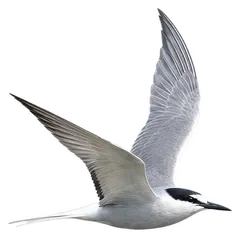 Aleutian TernOnychoprion aleuticus
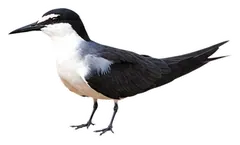 Bridled TernOnychoprion anaethetus
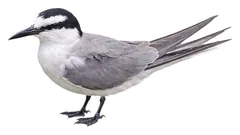 Spectacled TernOnychoprion lunatus
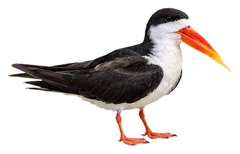 African SkimmerRynchops flavirostris
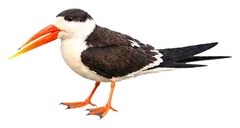 Indian SkimmerRynchops albicollis
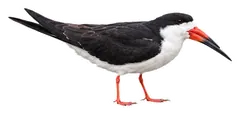 Black SkimmerRynchops niger
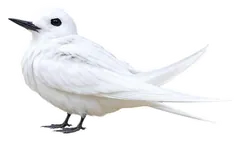 Atlantic White TernGygis alba
 Little White TernGygis microrhyncha
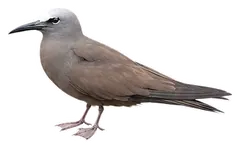 Brown NoddyAnous stolidus
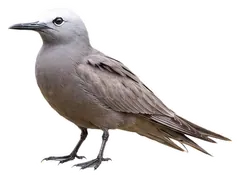 Lesser NoddyAnous tenuirostris
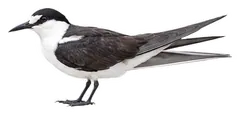
Download illustration
Free to use with credit: “Illustration: Bird Album (birdalbum.com)”. Drawn by AI from a reference photo by Judd Patterson. ↗
Heard it but can't see it? Mingji identifies birds by sound and photo, on your phone.