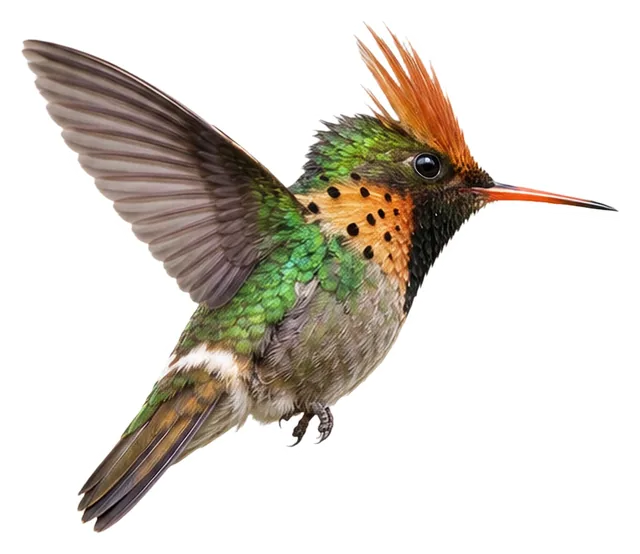
Tufted Coquette
Lophornis ornatus (Boddaert, 1783)
6.6 cmLength2.3 gWeight
The male has a small reddish-brown crest and ornamental feathers with black spots projecting from the sides of the neck.
Busiest months: December · Most records: Trinidad & Tobago, Suriname, Guyana
How to identify
Field marks
- Male has a reddish-brown crest on the crown
- Male has reddish-brown ornamental feathers with black spots on the sides of the neck
- Male has a single whitish band of feathers across the rump
- Bill short and straight, red with a black tip
Male, female and young
Female lacks the crest and ornamental feathers on the sides of the neck; underparts reddish-brown, paler on the belly.
Voice
A soft “chik” note while feeding.
Where and when it's recorded
Busiest months: December · Most records: Trinidad & Tobago, Suriname, Guyana

Tufted Coquette has been recorded at 45 of the 8,276 birding hotspots we track, in 5 countries and regions.
Records by month Northern Hemisphere
Where it's recorded most
- Asa Wright Nature CenterTrinidad & Tobago5,428 records
- Blanchisseuse RoadTrinidad & Tobago119 records
- Fredberg – Zintete LodgeSuriname74 records
More places
- Hacienda JacanaTrinidad & Tobago63 records
- Mount St. BenedictTrinidad & Tobago41 records
- Morne BleuTrinidad & Tobago40 records
- Las Lapas TraceTrinidad & Tobago39 records
- Aripo Savannah – Cumuto RoadTrinidad & Tobago35 records
- Atta Lodge / Iwokrama Canopy WalkwayGuyana28 records
- Brasso SecoTrinidad & Tobago27 records
Countries and regions with the most records
eBird records via GBIF up to 2024-12-31. A record means someone listed it; more records partly mean more birders, not more birds.
About
The tufted coquette (Lophornis ornatus) is a tiny hummingbird that breeds in eastern Venezuela, Trinidad, Guiana, and northern Brazil. It is an uncommon but widespread species, and appears to be a local or seasonal migrant, although its movements are not well understood.
Excerpt from Wikipedia, CC BY-SA 4.0 · authors · Read more on Wikipedia
Questions
How big is the Tufted Coquette?
The Tufted Coquette is about 6.6 cm long and weighs around 2.3 g.
Where does the Tufted Coquette live?
Its breeding range: South America: northern Venezuela and Trinidad; central Venezuela, the Guianas and northeastern Brazil. It is most often recorded in Trinidad & Tobago, Suriname and Guyana.
When is the best time to see the Tufted Coquette?
At the hotspots we track, it is recorded most in December (Northern Hemisphere).
Is the Tufted Coquette endangered?
The IUCN Red List classifies the Tufted Coquette as Least Concern.
What does the Tufted Coquette eat?
Main food: Omnivore.
What family is the Tufted Coquette in?
It belongs to the family Hummingbirds (Trochilidae), order Apodiformes.
At a glance
- Length
- 6.6 cm
- Weight
- 2.3 g
- Habitat
- Towns & farmland
- Diet
- Omnivore
- Lifestyle
- Feeds in the air
- Migration
- Resident (barely migrates)
- Conservation
- Least Concern
More measurements
- Wing
- 37 mm
- Tail
- 25 mm
- Bill
- 12 mm
- Tarsus
- 6 mm
Averages from the AVONET dataset; length from field guides where available.
Range
South America: northern Venezuela and Trinidad; central Venezuela, the Guianas and northeastern Brazil
Breeding range, IOC World Bird List 15.2
Classification
- Order
- Apodiformes
- Family
- Hummingbirds Trochilidae
- Genus
- Lophornis
Other birds in the genus Lophornis
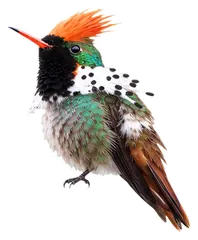 Dot-eared CoquetteLophornis gouldii
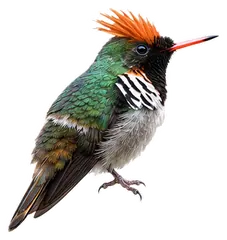 Frilled CoquetteLophornis magnificus
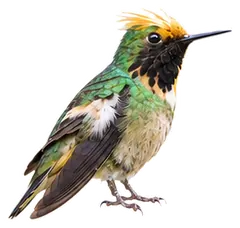 Short-crested CoquetteLophornis brachylophus
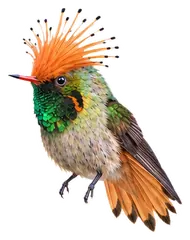 Rufous-crested CoquetteLophornis delattrei
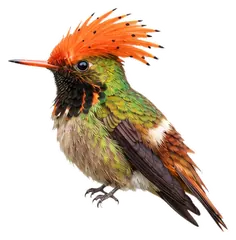 Spangled CoquetteLophornis stictolophus
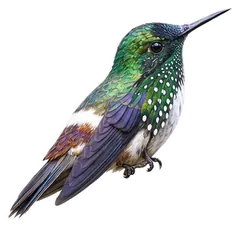 Festive CoquetteLophornis chalybeus
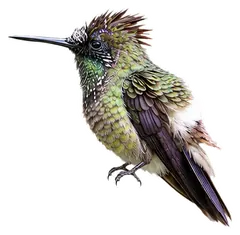 Butterfly CoquetteLophornis verreauxii
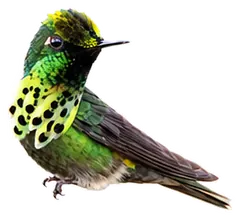 Peacock CoquetteLophornis pavoninus
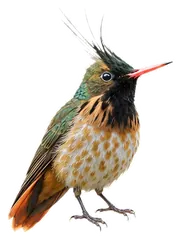 Black-crested CoquetteLophornis helenae
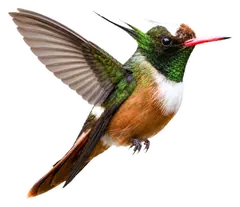 White-crested CoquetteLophornis adorabilis
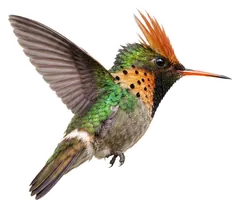
Download illustration
Free to use with credit: “Illustration: Bird Album (birdalbum.com)”. Drawn by AI from a reference photo by Mike's Birds. ↗
Heard it but can't see it? Mingji identifies birds by sound and photo, on your phone.