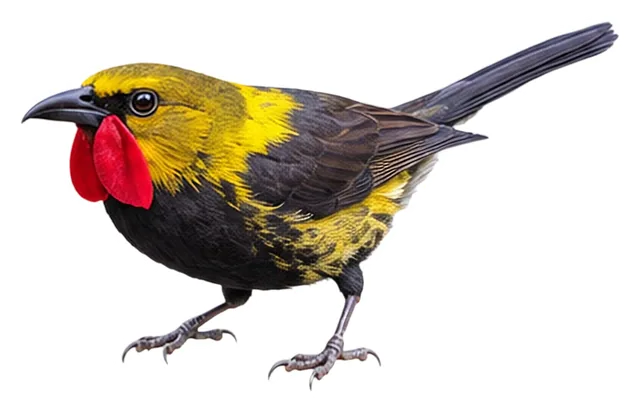
Wattled Ploughbill
Eulacestoma nigropectus De Vis, 1894
20 gWeight
The wattled ploughbill (Eulacestoma nigropectus) is a small bird from New Guinea.
Busiest months: July–August · Most records: Papua New Guinea
Where and when it's recorded
Busiest months: July–August · Most records: Papua New Guinea

Wattled Ploughbill has been recorded at 8 of the 8,276 birding hotspots we track, in 1 country or region.
Records by month Southern Hemisphere
Where it's recorded most
- Rondon RidgePapua New Guinea173 records
- Kumul LodgePapua New Guinea139 records
- Rondon Ridge LodgePapua New Guinea84 records
More places
- Highlands Hwy – above Ambua Lodge to Tari GapPapua New Guinea78 records
- Tomba & Murmur Pass [2400-2800m]Papua New Guinea54 records
- Ambua LodgePapua New Guinea41 records
- Tari GapPapua New Guinea33 records
- Mt Komonge RidgePapua New Guinea23 records
Countries and regions with the most records
eBird records via GBIF up to 2024-12-31. A record means someone listed it; more records partly mean more birders, not more birds.
About
The wattled ploughbill (Eulacestoma nigropectus) is a small bird from New Guinea. It is the only member of the monotypic genus Eulacestoma and family Eulacestomatidae. It is also known as the wattled shrike-tit or ploughshare tit.
Excerpt from Wikipedia, CC BY-SA 4.0 · authors · Read more on Wikipedia
Questions
How big is the Wattled Ploughbill?
The Wattled Ploughbill weighs around 20 g.
Where does the Wattled Ploughbill live?
Its breeding range: Australasia: montane west-central to southeastern New Guinea. It is most often recorded in Papua New Guinea.
When is the best time to see the Wattled Ploughbill?
At the hotspots we track, it is recorded most in July and August (Southern Hemisphere).
Is the Wattled Ploughbill endangered?
The IUCN Red List classifies the Wattled Ploughbill as Least Concern.
What does the Wattled Ploughbill eat?
Main food: Insects & other invertebrates.
What family is the Wattled Ploughbill in?
It belongs to the family Ploughbill (Eulacestomatidae), order Passerines (Passeriformes).
At a glance
- Weight
- 20 g
- Habitat
- Forest
- Diet
- Insects & other invertebrates
- Lifestyle
- Perches in trees
- Migration
- Resident (barely migrates)
- Conservation
- Least Concern
More measurements
- Wing
- 69 mm
- Tail
- 52 mm
- Bill
- 15 mm
- Tarsus
- 19 mm
Averages from the AVONET dataset; length from field guides where available.
Range
Australasia: montane west-central to southeastern New Guinea
Breeding range, IOC World Bird List 15.2
Classification
- Order
- Passerines Passeriformes
- Family
- Ploughbill Eulacestomatidae
- Genus
- Eulacestoma
Download illustration
Free to use with credit: “Illustration: Bird Album (birdalbum.com)”. Drawn by AI from a reference photo by Jim Moore (Maryland). ↗
Heard it but can't see it? Mingji identifies birds by sound and photo, on your phone.