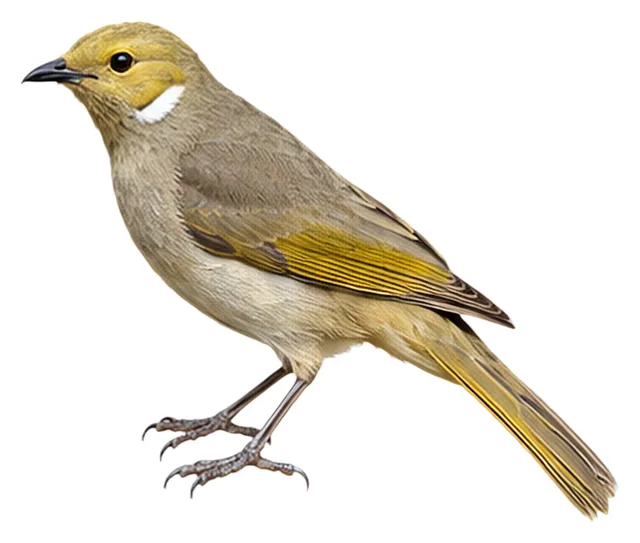
White-plumed Honeyeater
Ptilotula penicillata (Gould, 1837)
19 gWeight
The white-plumed honeyeater (Ptilotula penicillata, formerly Lichenostomus penicillatus) is a medium-sized passerine of the family Meliphagidae (honeyeaters) endemic to mainland Australia.
Busiest months: January and September–October · Most records: Australia
Where and when it's recorded
Busiest months: January and September–October · Most records: Australia

White-plumed Honeyeater has been recorded at 111 of the 8,276 birding hotspots we track, in 1 country or region.
Records by month Southern Hemisphere
Where it's recorded most
- Jerrabomberra Wetlands Nature ReserveAustralia5,300 records
- Royal ParkAustralia4,372 records
- Western Treatment PlantAustralia3,891 records
More places
- Bowra Wildlife SanctuaryAustralia3,708 records
- Serendip SanctuaryAustralia1,918 records
- Karkarook ParkAustralia1,912 records
- Albert ParkAustralia1,765 records
- Laratinga WetlandsAustralia1,628 records
- Gemmill Swamp Wildlife ReserveAustralia1,559 records
- Newport LakesAustralia1,474 records
Countries and regions with the most records
eBird records via GBIF up to 2024-12-31. A record means someone listed it; more records partly mean more birders, not more birds.
About
The white-plumed honeyeater (Ptilotula penicillata, formerly Lichenostomus penicillatus) is a medium-sized passerine of the family Meliphagidae (honeyeaters) endemic to mainland Australia. Its key identifying characteristics are a primarily olive-grey body and yellow face, a slightly down-curved bill and its white distal neck-plumes from which it takes its name. White-Plumed Honeyeaters exhibit a preference for woodlands and riparian areas and have a very strong association with River Red Gums.
Excerpt from Wikipedia, CC BY-SA 4.0 · authors · Read more on Wikipedia
Questions
How big is the White-plumed Honeyeater?
The White-plumed Honeyeater weighs around 19 g.
Where does the White-plumed Honeyeater live?
Its breeding range: Australasia: Australia (except northern, southwestern, Tasmania). It is most often recorded in Australia.
When is the best time to see the White-plumed Honeyeater?
At the hotspots we track, it is recorded most in January, September and October (Southern Hemisphere).
Is the White-plumed Honeyeater endangered?
The IUCN Red List classifies the White-plumed Honeyeater as Least Concern.
What does the White-plumed Honeyeater eat?
Main food: Omnivore.
What family is the White-plumed Honeyeater in?
It belongs to the family Honeyeaters (Meliphagidae), order Passerines (Passeriformes).
At a glance
- Weight
- 19 g
- Habitat
- Forest
- Diet
- Omnivore
- Lifestyle
- Perches in trees
- Migration
- Resident (barely migrates)
- Conservation
- Least Concern
More measurements
- Wing
- 79 mm
- Tail
- 70 mm
- Bill
- 16 mm
- Tarsus
- 20 mm
Averages from the AVONET dataset; length from field guides where available.
Range
Australasia: Australia (except northern, southwestern, Tasmania)
Breeding range, IOC World Bird List 15.2
Classification
- Order
- Passerines Passeriformes
- Family
- Honeyeaters Meliphagidae
- Genus
- Ptilotula
Other birds in the genus Ptilotula
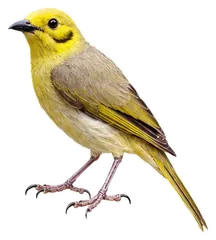 Yellow-tinted HoneyeaterPtilotula flavescens
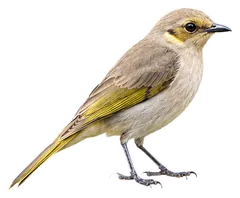 Fuscous HoneyeaterPtilotula fusca
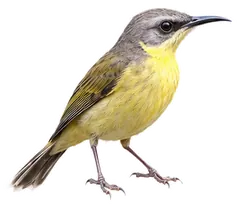 Grey-headed HoneyeaterPtilotula keartlandi
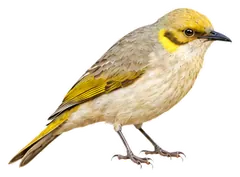 Grey-fronted HoneyeaterPtilotula plumula
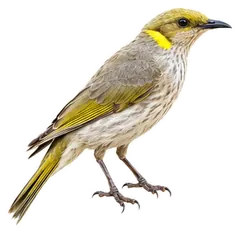 Yellow-plumed HoneyeaterPtilotula ornata
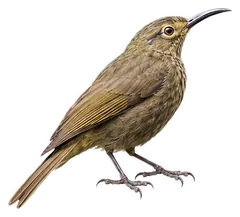 Dark-eared MyzaMyza celebensis
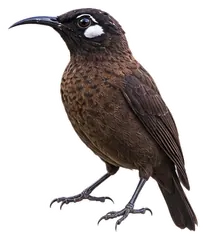 White-eared MyzaMyza sarasinorum
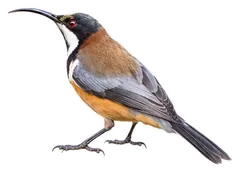 Eastern SpinebillAcanthorhynchus tenuirostris
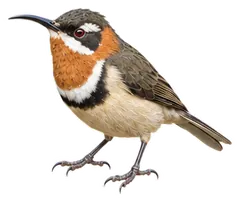 Western SpinebillAcanthorhynchus superciliosus
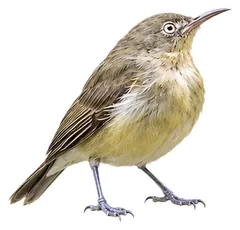 Green-backed HoneyeaterGlycichaera fallax
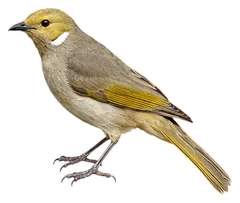
Download illustration
Free to use with credit: “Illustration: Bird Album (birdalbum.com)”. Drawn by AI from a reference photo by JJ Harrison. ↗
Heard it but can't see it? Mingji identifies birds by sound and photo, on your phone.
In other languages
- EnglishWhite-plumed Honeyeater
- 简体中文白痣吸蜜鸟
- 繁體中文白羽吸蜜鳥
- 日本語ミミジロコバシミツスイ
- DeutschWeißbürzel-Honigfresser
- FrançaisMéliphage serti
- EspañolMielero empenachado
- Portuguêspapa-mel-de-pluma-branca
- ItalianoSucciamiele piumebianche
- NederlandsWitpluimhoningeter
- РусскийСеро-жёлтый медосос
- Svenskavitplymad honungsfågel
- DanskHvidhalset Honningæder
- Polskizłotouch blady