 Bird Album
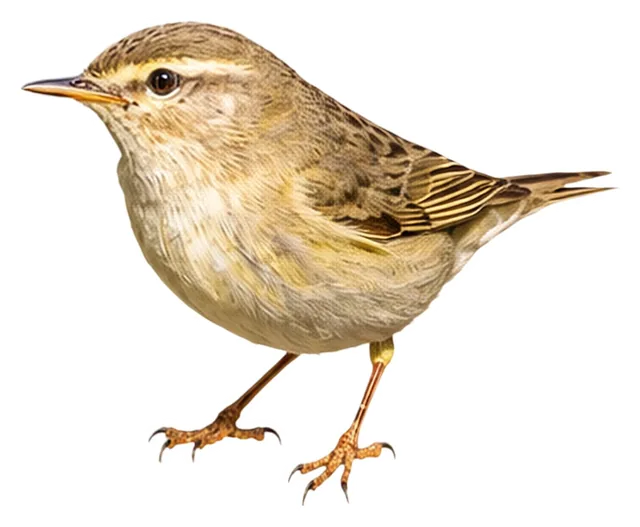
Willow Warbler
Phylloscopus trochilus (Linnaeus, 1758)
11–12 cmLength19 cmWingspan8.7 gWeight
This typical leaf warbler has green-rufous upperparts, grayish-white to yellow underparts and no wing patches.
Busiest months: April and September · Most records: United Kingdom, Spain, Portugal
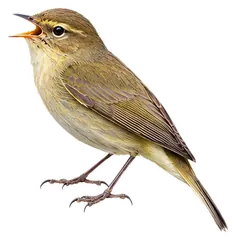
Looks like Common Chiffchaff
How to identify
Field marks
- Green-rufous upperparts and grayish-white to yellow underparts
- Wings plain green-rufous, without wing patches
- Legs and feet pale pinkish-yellow, compared with dark brown to black in Common Chiffchaff
- Bill longer and paler than in Common Chiffchaff
Male, female and young
Juveniles have a yellower belly than adults.
Voice
The song consists of simple, repeated descending whistles; the contact call is a two-syllable “hoo-eet”.
Similar species
Where and when it's recorded

Willow Warbler has been recorded at 1,869 of the 8,171 birding hotspots we track, in 126 countries and regions.
Records by month Northern Hemisphere
Where it's recorded most
- Jerusalem Bird ObservatoryIsrael1,953 records
- International Birding and Research Center Eilat (IBRCE)Israel1,845 records
- Elton ReservoirUnited Kingdom1,629 records
More places
- Spurn Bird Observatory Recording AreaUnited Kingdom1,503 records
- Aras Kuş Halkalama İstasyonuTürkiye1,440 records
- SkokholmUnited Kingdom1,264 records
- Brent ReservoirUnited Kingdom1,153 records
- Rutland WaterUnited Kingdom1,151 records
- PN Sudoeste Alentejano e Costa Vicentina – CabranosaPortugal1,122 records
- Minsmere RSPB ReserveUnited Kingdom961 records
Countries and regions with the most records
eBird records via GBIF up to 2024-12-31. A record means someone listed it; more records partly mean more birders, not more birds.
About
The willow warbler (Phylloscopus trochilus) is a very common and widespread leaf warbler which breeds throughout northern and temperate Europe and the Palearctic, from Ireland east to the Anadyr River basin in eastern Siberia. It is strongly migratory, with almost all of the population wintering in sub-Saharan Africa.
Excerpt from Wikipedia, CC BY-SA 4.0 · authors · Read more on Wikipedia
Questions
How big is the Willow Warbler?
The Willow Warbler is about 11–12 cm long, with a wingspan of 19 cm and weighs around 8.7 g.
Where does the Willow Warbler live?
Its breeding range: Palearctic: widespread. It is most often recorded in United Kingdom, Spain and Portugal.
When is the best time to see the Willow Warbler?
At the hotspots we track, it is recorded most in April and September (Northern Hemisphere).
Is the Willow Warbler endangered?
The IUCN Red List classifies the Willow Warbler as Least Concern.
What does the Willow Warbler eat?
Main food: Insects & other invertebrates.
What family is the Willow Warbler in?
It belongs to the family Leaf Warblers (Phylloscopidae), order Passerines (Passeriformes).
At a glance
- Length
- 11–12 cm
- Wingspan
- 19 cm
- Weight
- 8.7 g
- Habitat
- Forest
- Diet
- Insects & other invertebrates
- Lifestyle
- Perches in trees
- Migration
- Migratory
- Conservation
- Least Concern
More measurements
- Wing
- 66 mm
- Tail
- 52 mm
- Bill
- 13 mm
- Tarsus
- 19 mm
Averages from the AVONET dataset; length from field guides where available.
Range
Palearctic: widespread
Breeding range, IOC World Bird List 15.2
Classification
- Order
- Passerines Passeriformes
- Family
- Leaf Warblers Phylloscopidae
- Genus
- Phylloscopus
Other birds in the genus Phylloscopus
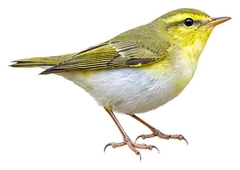 Wood WarblerPhylloscopus sibilatrix
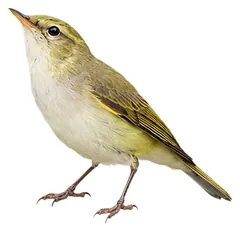 Western Bonelli's WarblerPhylloscopus bonelli
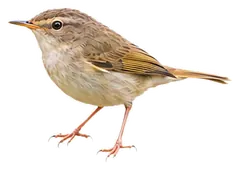 Eastern Bonelli's WarblerPhylloscopus orientalis
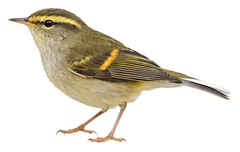 Buff-barred WarblerPhylloscopus pulcher
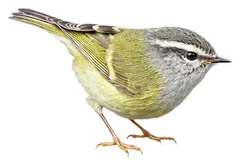 Ashy-throated WarblerPhylloscopus maculipennis
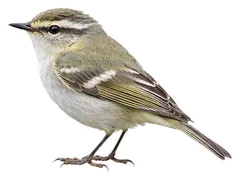 Hume's Leaf WarblerPhylloscopus humei
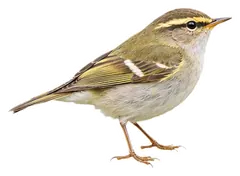 Yellow-browed WarblerPhylloscopus inornatus
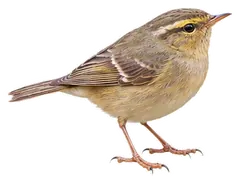 Brooks's Leaf WarblerPhylloscopus subviridis
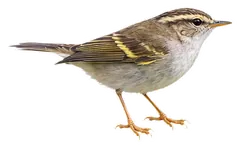 Chinese Leaf WarblerPhylloscopus yunnanensis
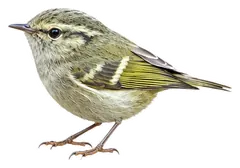 Lemon-rumped WarblerPhylloscopus chloronotus
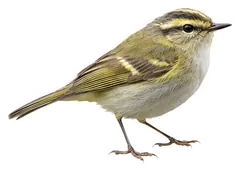 Sichuan Leaf WarblerPhylloscopus forresti
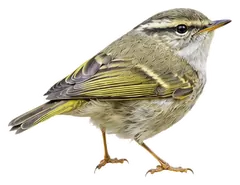 Gansu Leaf WarblerPhylloscopus kansuensis
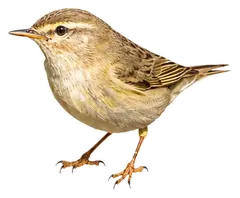
Download illustration
Free to use with credit: “Illustration: Bird Album (birdalbum.com)”. Drawn by AI from a reference photo by Александр. ↗
Heard it but can't see it? Mingji identifies birds by sound and photo, on your phone.