 Bird Album
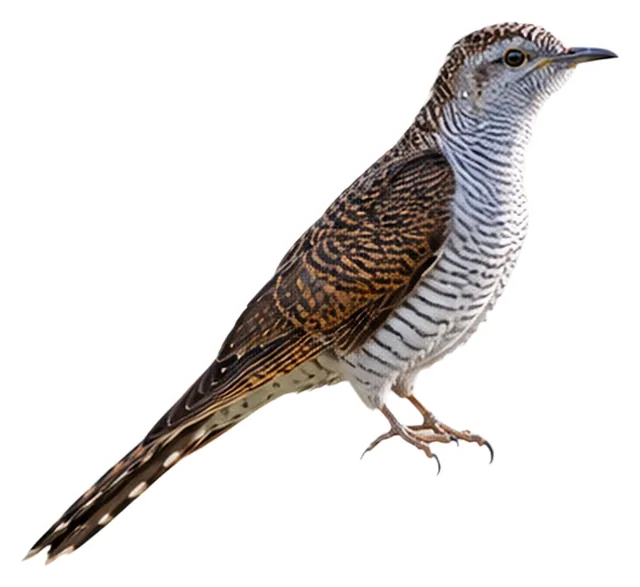
Banded Bay Cuckoo
Cacomantis sonneratii (Latham, 1790)
≈21 cmLength34 gWeight
It is a small cuckoo with dark barring on a rufous ground, a distinctive white supercilium and a long bill.
Busiest months: February–March · Most records: Thailand, India, Singapore
Looks like Plaintive Cuckoo
How to identify
Field marks
- Whitish supercilium with a dark eyestripe below
- Head and back rufous, with broad dark brown barring
- Bill long and slightly decurved
- Black band near the tail tip; feather tips white
Male, female and young
Sexes similar; juveniles have a pale lower mandible and white feather edges on the upperparts.
Voice
A high-pitched, four-note whistle, transcribed as “wee-ti wee-tee”, with each note falling in pitch.
Similar species
Where and when it's recorded

Banded Bay Cuckoo has been recorded at 457 of the 8,171 birding hotspots we track, in 15 countries and regions.
Records by month Northern Hemisphere
Where it's recorded most
- Mahidol University [Kanchanaburi Campus]Thailand834 records
- Kranji MarshSingapore476 records
- KattampallyIndia351 records
More places
- Kaeng Krachan NPThailand349 records
- TmatboeyCambodia345 records
- Kaeng Krachan NP – Baan Maka Nature LodgeThailand302 records
- Doi Pha Hom Pok NP – Doi Lang (W), AKA Doi San JuThailand300 records
- Thattekad Bird Sanctuary – UrulanthanniIndia279 records
- Doi Inthanon NP – Mae Ouam (Km 34.5)Thailand269 records
- Cat Tien NPVietnam268 records
Countries and regions with the most records
eBird records via GBIF up to 2024-12-31. A record means someone listed it; more records partly mean more birders, not more birds.
About
The banded bay cuckoo or bay-banded cuckoo (Cacomantis sonneratii) is a species of small cuckoo found in the Indian subcontinent and Southeast Asia. Like others in the genus they have round nostrils. They are usually founded in well-wooded areas mainly in the lower hills.
Excerpt from Wikipedia, CC BY-SA 4.0 · authors · Read more on Wikipedia
Questions
How big is the Banded Bay Cuckoo?
The Banded Bay Cuckoo is about ≈21 cm long and weighs around 34 g.
Where does the Banded Bay Cuckoo live?
Its breeding range: Oriental: India and Sri Lanka to southern China, Southeast Asia, Greater Sundas and Palawan (southwestern Philippines). It is most often recorded in Thailand, India and Singapore.
When is the best time to see the Banded Bay Cuckoo?
At the hotspots we track, it is recorded most in February and March (Northern Hemisphere).
Is the Banded Bay Cuckoo endangered?
The IUCN Red List classifies the Banded Bay Cuckoo as Least Concern.
What does the Banded Bay Cuckoo eat?
Main food: Insects & other invertebrates.
What family is the Banded Bay Cuckoo in?
It belongs to the family Cuckoos (Cuculidae), order Cuculiformes.
At a glance
- Length
- ≈21 cm
- Weight
- 34 g
- Habitat
- Forest
- Diet
- Insects & other invertebrates
- Lifestyle
- Perches in trees
- Migration
- Resident (barely migrates)
- Conservation
- Least Concern
More measurements
- Wing
- 107 mm
- Tail
- 96 mm
- Bill
- 24 mm
- Tarsus
- 15 mm
Averages from the AVONET dataset; length from field guides where available.
Range
Oriental: India and Sri Lanka to southern China, Southeast Asia, Greater Sundas and Palawan (southwestern Philippines)
Breeding range, IOC World Bird List 15.2
Classification
- Order
- Cuculiformes
- Family
- Cuckoos Cuculidae
- Genus
- Cacomantis
Other birds in the genus Cacomantis
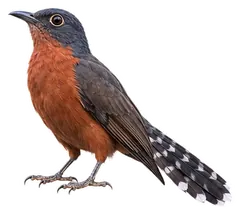 Chestnut-breasted CuckooCacomantis castaneiventris
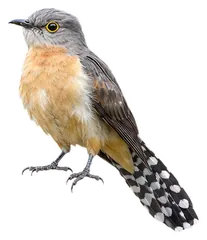 Fan-tailed CuckooCacomantis flabelliformis
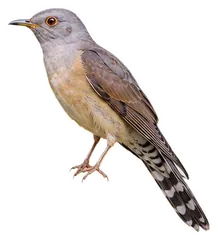 Plaintive CuckooCacomantis merulinus
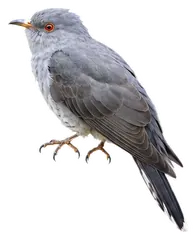 Grey-bellied CuckooCacomantis passerinus
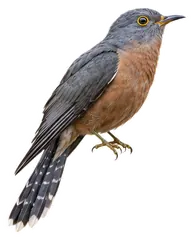 Sunda Brush CuckooCacomantis sepulcralis
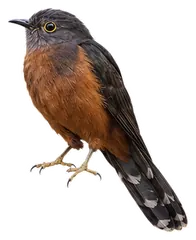 Sulawesi Brush CuckooCacomantis virescens
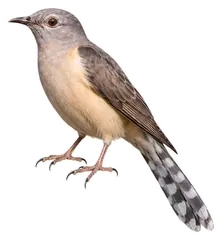 Sahul Brush CuckooCacomantis variolosus
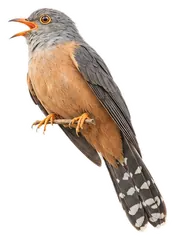 Manus Brush CuckooCacomantis blandus
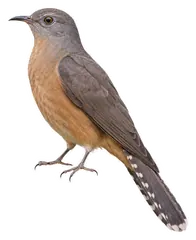 Solomons Brush CuckooCacomantis addendus
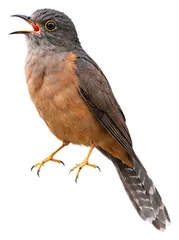 Moluccan Brush CuckooCacomantis aeruginosus
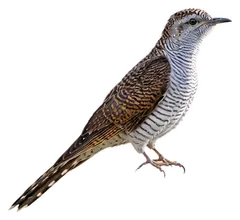
Download illustration
Free to use with credit: “Illustration: Bird Album (birdalbum.com)”. Drawn by AI from a reference photo by Pål A. Olsvik. ↗
Heard it but can't see it? Mingji identifies birds by sound and photo, on your phone.