 Bird Album
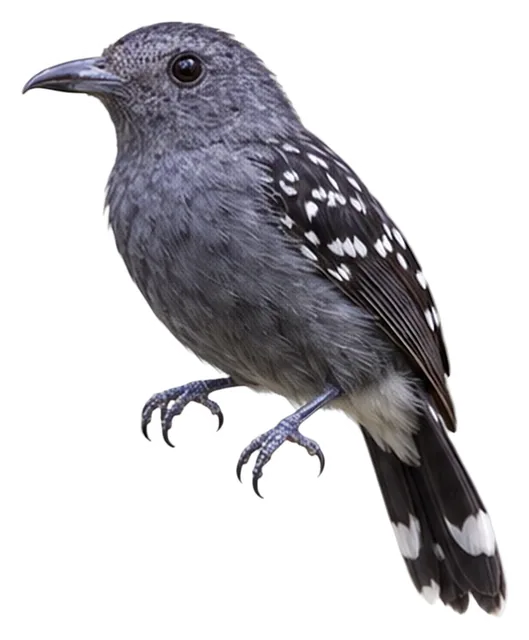
Black-crowned Antshrike
Thamnophilus atrinucha Salvin & Godman, 1892
14–15 cmLength24 gWeight
The black-crowned antshrike (Thamnophilus atrinucha) is a species of bird in subfamily Thamnophilinae of family Thamnophilidae, the "typical antbirds".
Busiest months: January–March and October · Most records: Panama, Costa Rica, Colombia
Where and when it's recorded
Busiest months: January–March and October · Most records: Panama, Costa Rica, Colombia

Black-crowned Antshrike has been recorded at 168 of the 8,276 birding hotspots we track, in 8 countries and regions.
Records by month Northern Hemisphere
Where it's recorded most
- Estación Biológica La Selva-OTSCosta Rica4,479 records
- Pipeline Road (Camino del Oleoducto)Panama3,397 records
- Canopy TowerPanama2,740 records
More places
- Panama Rainforest Discovery CenterPanama2,735 records
- Pipeline Road – Parque Nacional SoberaníaPanama2,484 records
- RN San Cipriano-EscalereteColombia1,831 records
- Tranquilo Bay Eco-Adventure LodgePanama1,797 records
- Pipeline RoadPanama1,758 records
- Semaphore Hill Road – Parque Nacional SoberaníaPanama1,428 records
- Veragua Rainforest ParkCosta Rica1,083 records
Countries and regions with the most records
eBird records via GBIF up to 2024-12-31. A record means someone listed it; more records partly mean more birders, not more birds.
About
The black-crowned antshrike (Thamnophilus atrinucha) is a species of bird in subfamily Thamnophilinae of family Thamnophilidae, the "typical antbirds". It is found in every Central American country except El Salvador and in Colombia, Ecuador, Peru, and Venezuela.
Excerpt from Wikipedia, CC BY-SA 4.0 · authors · Read more on Wikipedia
Questions
How big is the Black-crowned Antshrike?
The Black-crowned Antshrike is about 14–15 cm long and weighs around 24 g.
Where does the Black-crowned Antshrike live?
Its breeding range: Middle America, South America: southern Belize to northwestern Venezuela and northwestern Peru. It is most often recorded in Panama, Costa Rica and Colombia.
When is the best time to see the Black-crowned Antshrike?
At the hotspots we track, it is recorded most in January, February, March and October (Northern Hemisphere).
Is the Black-crowned Antshrike endangered?
The IUCN Red List classifies the Black-crowned Antshrike as Least Concern.
What does the Black-crowned Antshrike eat?
Main food: Insects & other invertebrates.
What family is the Black-crowned Antshrike in?
It belongs to the family Antbirds (Thamnophilidae), order Passerines (Passeriformes).
At a glance
- Length
- 14–15 cm
- Weight
- 24 g
- Habitat
- Forest
- Diet
- Insects & other invertebrates
- Lifestyle
- Perches in trees
- Migration
- Resident (barely migrates)
- Conservation
- Least Concern
More measurements
- Wing
- 68 mm
- Tail
- 56 mm
- Bill
- 19 mm
- Tarsus
- 22 mm
Averages from the AVONET dataset; length from field guides where available.
Range
Middle America, South America: southern Belize to northwestern Venezuela and northwestern Peru
Breeding range, IOC World Bird List 15.2
Classification
- Order
- Passerines Passeriformes
- Family
- Antbirds Thamnophilidae
- Genus
- Thamnophilus
Other birds in the genus Thamnophilus
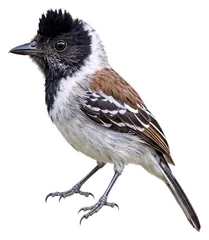 Collared AntshrikeThamnophilus bernardi
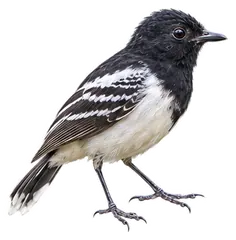 Black-backed AntshrikeThamnophilus melanonotus
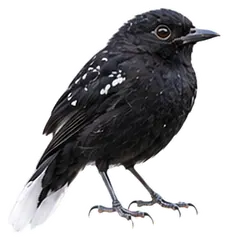 Band-tailed AntshrikeThamnophilus melanothorax
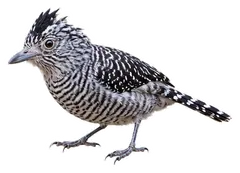 Barred AntshrikeThamnophilus doliatus
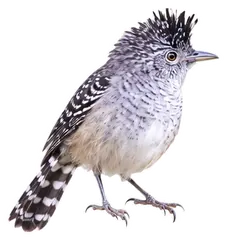 Chapman's AntshrikeThamnophilus zarumae
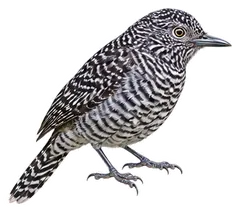 Bar-crested AntshrikeThamnophilus multistriatus
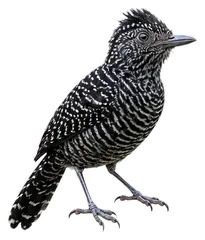 Lined AntshrikeThamnophilus tenuepunctatus
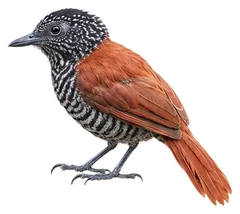 Chestnut-backed AntshrikeThamnophilus palliatus
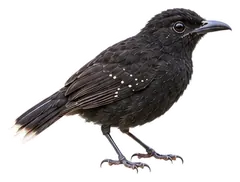 Black-hooded AntshrikeThamnophilus bridgesi
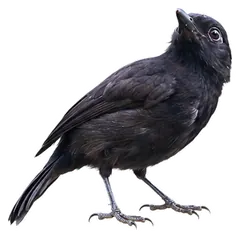 Black AntshrikeThamnophilus nigriceps
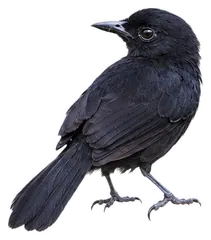 Cocha AntshrikeThamnophilus praecox
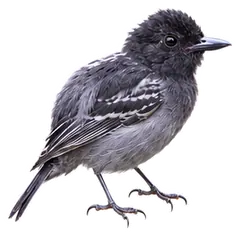 Blackish-grey AntshrikeThamnophilus nigrocinereus
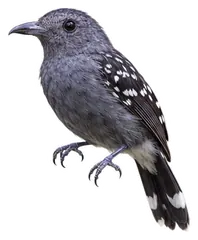
Download illustration
Free to use with credit: “Illustration: Bird Album (birdalbum.com)”. Drawn by AI from a reference photo by Dave Wendelken. ↗
Heard it but can't see it? Mingji identifies birds by sound and photo, on your phone.
In other languages
- EnglishBlack-crowned Antshrike
- 简体中文西蓝灰蚁鵙
- 繁體中文西方藍灰蟻鵙
- 日本語ニシハイイロアリモズ
- DeutschKolumbienameisenwürger
- FrançaisBatara à nuque noire
- EspañolBatará pizarroso occidental
- Portuguêschoca-de-chapéu-preto
- ItalianoAverla formichiera ardesia occidentale
- NederlandsWestelijke Gevlekte Mierklauwier
- РусскийПестрокрылый колючник
- Svenskasvartnackad myrtörnskata
- DanskVestlig Skifermyretornskade
- Polskichronka nizinna