 Bird Album
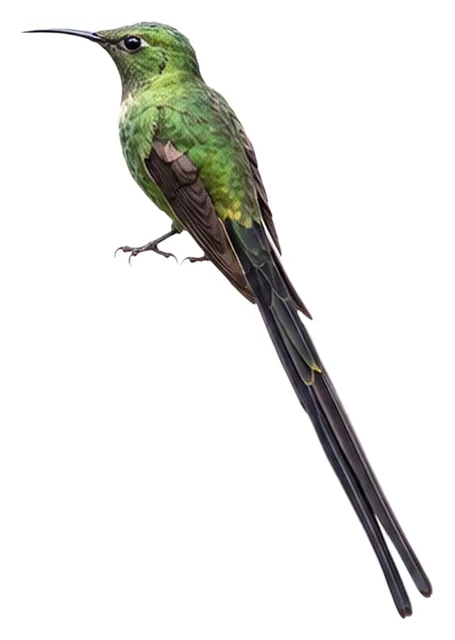
Black-tailed Trainbearer
Lesbia victoriae (Bourcier & Mulsant, 1846)
14 cmLength5 gWeight
The black-tailed trainbearer (Lesbia victoriae) is a species of hummingbird in the family Trochilidae.
Busiest months: February and October–November · Most records: Ecuador, Colombia, Peru
Where and when it's recorded
Busiest months: February and October–November · Most records: Ecuador, Colombia, Peru

Black-tailed Trainbearer has been recorded at 66 of the 8,276 birding hotspots we track, in 3 countries and regions.
Records by month Southern Hemisphere
Where it's recorded most
- Jardín Botánico de QuitoEcuador2,110 records
- Observatorio de ColibriesColombia1,849 records
- Tambo Cóndor Bird LodgeEcuador1,719 records
More places
- RFP Bosque Oriental de Bogotá – Cerro MonserrateColombia1,118 records
- Reserva Zuro LomaEcuador972 records
- Hostería San José de PuemboEcuador906 records
- Puembo Birding GardenEcuador654 records
- AntisanaEcuador617 records
- Humedal Lucre-HuacarpayPeru550 records
- Santuario de Colibríes – Ensifera CampPeru537 records
Countries and regions with the most records
eBird records via GBIF up to 2024-12-31. A record means someone listed it; more records partly mean more birders, not more birds.
About
The black-tailed trainbearer (Lesbia victoriae) is a species of hummingbird in the family Trochilidae. It is found between 2500 and 3800m in Colombia, Ecuador, and Peru. Its natural habitats are subtropical or tropical moist montane forest, subtropical or tropical high-altitude shrubland, and heavily degraded former forest.
Excerpt from Wikipedia, CC BY-SA 4.0 · authors · Read more on Wikipedia
Questions
How big is the Black-tailed Trainbearer?
The Black-tailed Trainbearer is about 14 cm long and weighs around 5 g.
Where does the Black-tailed Trainbearer live?
Its breeding range: South America: northeastern Colombia to southeastern Peru. It is most often recorded in Ecuador, Colombia and Peru.
When is the best time to see the Black-tailed Trainbearer?
At the hotspots we track, it is recorded most in February, October and November (Southern Hemisphere).
Is the Black-tailed Trainbearer endangered?
The IUCN Red List classifies the Black-tailed Trainbearer as Least Concern.
What does the Black-tailed Trainbearer eat?
Main food: Nectar.
What family is the Black-tailed Trainbearer in?
It belongs to the family Hummingbirds (Trochilidae), order Apodiformes.
At a glance
- Length
- 14 cm
- Weight
- 5 g
- Habitat
- Shrubland
- Diet
- Nectar
- Lifestyle
- Feeds in the air
- Migration
- Resident (barely migrates)
- Conservation
- Least Concern
More measurements
- Wing
- 59 mm
- Tail
- 92 mm
- Bill
- 19 mm
- Tarsus
- 6 mm
Averages from the AVONET dataset; length from field guides where available.
Range
South America: northeastern Colombia to southeastern Peru
Breeding range, IOC World Bird List 15.2
Classification
- Order
- Apodiformes
- Family
- Hummingbirds Trochilidae
- Genus
- Lesbia
Other birds in the genus Lesbia
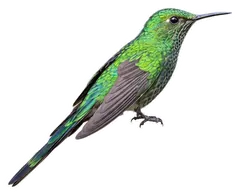 Green-tailed TrainbearerLesbia nuna
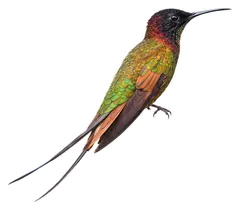 Crimson TopazTopaza pella
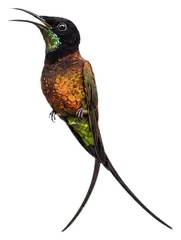 Fiery TopazTopaza pyra
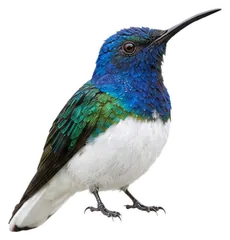 White-necked JacobinFlorisuga mellivora
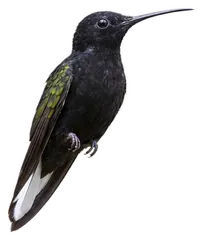 Black JacobinFlorisuga fusca
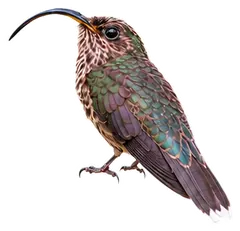 White-tipped SicklebillEutoxeres aquila
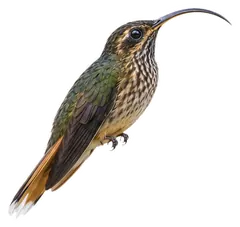 Buff-tailed SicklebillEutoxeres condamini
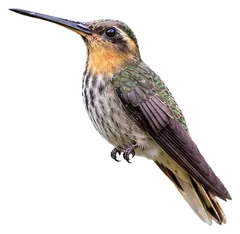 Saw-billed HermitRamphodon naevius
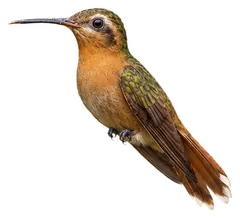 Hook-billed HermitGlaucis dohrnii
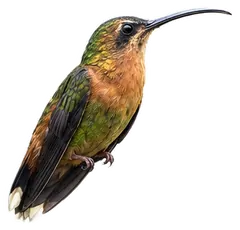 Bronzy HermitGlaucis aeneus
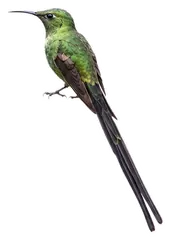
Download illustration
Free to use with credit: “Illustration: Bird Album (birdalbum.com)”. Drawn by AI from reference photos. ↗
Heard it but can't see it? Mingji identifies birds by sound and photo, on your phone.
In other languages
- EnglishBlack-tailed Trainbearer
- 简体中文黑带尾蜂鸟
- 繁體中文黑帶尾蜂鳥
- 日本語ミドリフタオハチドリ
- DeutschSchwarzschwanzsylphe
- FrançaisPorte-traîne lesbie
- EspañolColibrí colilargo mayor
- Portuguêsbeija-flor-de-longa-cauda-preta
- ItalianoPaggetto codanera
- NederlandsZwartstaartkomeetkolibrie
- РусскийЧернохвостая комета
- Svenskasvartstjärtad släpkolibri
- DanskSorthalet Slæbbærer
- Polskipaziak czarnosterny