 Bird Album
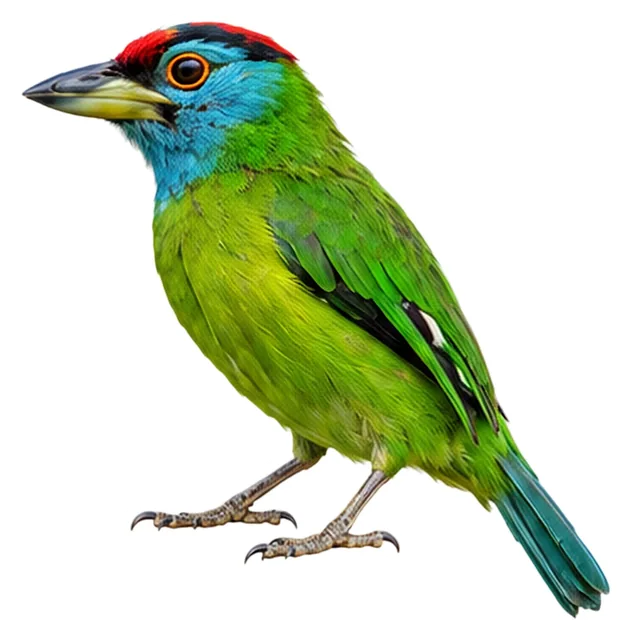
Blue-throated Barbet
Psilopogon asiaticus (Latham, 1790)
≈23 cmLength90 gWeight
This green barbet is hard to spot in the canopy and is often located by its loud, persistent calls.
Busiest months: February–April · Most records: India, Thailand, Nepal
How to identify
Field marks
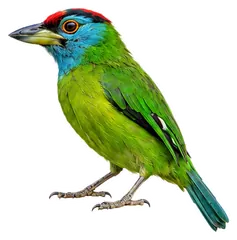
- Bright red forehead and a single black band across the crown
- Pale blue sides of the face, chin and upper neck
- Red patch at the base of the blue area on the side of the neck
- Green body, stout build and short tail
Male, female and young
Sexes similar, with the female slightly heavier. Juveniles are duller; red may be tinged orange, and black may be bluish-black or dull.
Voice
Groups of syllables such as “took-a-rook”, “pu-ku-ruk” and “kut-ru-uk”, repeated 90–105 times per minute.
Where and when it's recorded

Blue-throated Barbet has been recorded at 318 of the 8,171 birding hotspots we track, in 10 countries and regions.
Records by month Northern Hemisphere
Where it's recorded most
- Rabindra SarovarIndia2,268 records
- Sangla and AreaNepal927 records
- Taksin Maharat NP – headquarters vicinityThailand871 records
More places
- SattalIndia844 records
- Mahananda WLS – Rongtong and Shivakhola ForestIndia837 records
- Chiang Dao Wildlife Sanctuary – Wat Tham Pha PlongThailand792 records
- Garbhanga Reserve ForestIndia759 records
- Xishuangbanna Tropical Botanical GardenChina692 records
- Nameri National Park & SurroundingsIndia661 records
- Kaeng Krachan NP – Panoen Thung (upper elevation) vicinityThailand651 records
Countries and regions with the most records
eBird records via GBIF up to 2024-12-31. A record means someone listed it; more records partly mean more birders, not more birds.
About
The blue-throated barbet (Psilopogon asiaticus) is a green Asian barbet native to the foothills of the Himalayas and Southeast Asia. It inhabits lowland and montane forests at elevations of 200–2,000 m (660–6,560 ft), frequenting fruiting trees. Due to its green colour, it is difficult to spot but is easily located by its continual loud calls.
Excerpt from Wikipedia, CC BY-SA 4.0 · authors · Read more on Wikipedia
Questions
How big is the Blue-throated Barbet?
The Blue-throated Barbet is about ≈23 cm long and weighs around 90 g.
Where does the Blue-throated Barbet live?
Its breeding range: Oriental: northeastern Pakistan to central Vietnam and Myanmar. It is most often recorded in India, Thailand and Nepal.
When is the best time to see the Blue-throated Barbet?
At the hotspots we track, it is recorded most in February, March and April (Northern Hemisphere).
Is the Blue-throated Barbet endangered?
The IUCN Red List classifies the Blue-throated Barbet as Least Concern.
What does the Blue-throated Barbet eat?
Main food: Fruit.
What family is the Blue-throated Barbet in?
It belongs to the family Asian Barbets (Megalaimidae), order Piciformes.
At a glance
- Length
- ≈23 cm
- Weight
- 90 g
- Habitat
- Forest
- Diet
- Fruit
- Lifestyle
- Perches in trees
- Migration
- Resident (barely migrates)
- Conservation
- Least Concern
More measurements
- Wing
- 104 mm
- Tail
- 69 mm
- Bill
- 26 mm
- Tarsus
- 25 mm
Averages from the AVONET dataset; length from field guides where available.
Range
Oriental: northeastern Pakistan to central Vietnam and Myanmar
Breeding range, IOC World Bird List 15.2
Subspecies · 2
- Psilopogon asiaticus asiaticus ne Pakistan to w, n Myanmar and sw Yunnan (sc China)
- Psilopogon asiaticus davisoni se Myanmar to se Yunnan (sc China) and n Indochina
Classification
- Order
- Piciformes
- Family
- Asian Barbets Megalaimidae
- Genus
- Psilopogon
Other birds in the genus Psilopogon
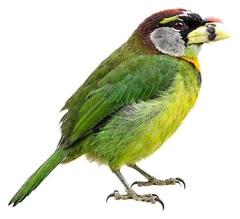 Fire-tufted BarbetPsilopogon pyrolophus
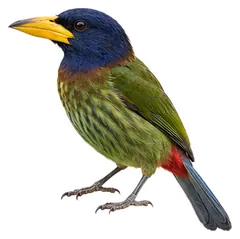 Great BarbetPsilopogon virens
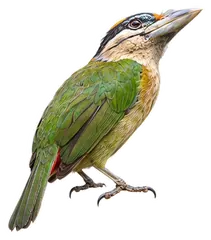 Red-vented BarbetPsilopogon lagrandieri
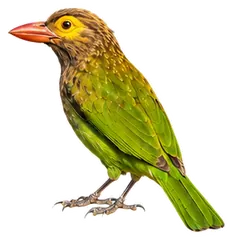 Brown-headed BarbetPsilopogon zeylanicus
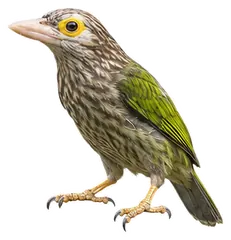 Lineated BarbetPsilopogon lineatus
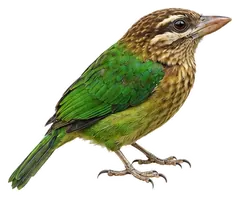 White-cheeked BarbetPsilopogon viridis
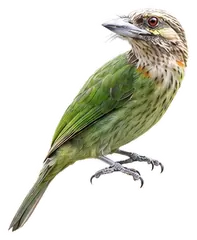 Green-eared BarbetPsilopogon faiostrictus
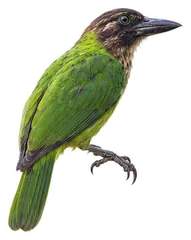 Brown-throated BarbetPsilopogon corvinus
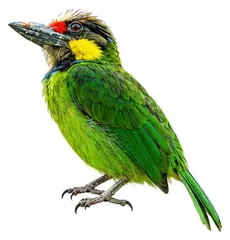 Golden-whiskered BarbetPsilopogon chrysopogon
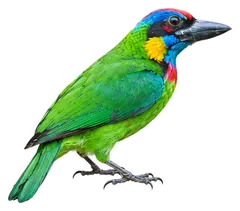 Red-crowned BarbetPsilopogon rafflesii
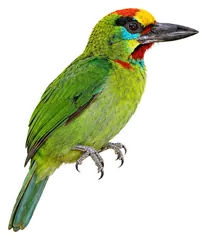 Red-throated BarbetPsilopogon mystacophanos
 Black-banded BarbetPsilopogon javensis
Download illustration
Free to use with credit: “Illustration: Bird Album (birdalbum.com)”. Drawn by AI from a reference photo by Timothy A. Gonsalves. ↗

Heard it but can't see it? Mingji identifies birds by sound and photo, on your phone.
In other languages
- EnglishBlue-throated Barbet
- 简体中文蓝喉拟啄木鸟
- 繁體中文藍喉擬啄木
- 日本語アオノドゴシキドリ
- DeutschBlauwangen-Bartvogel
- FrançaisBarbu à gorge bleue
- EspañolBarbudo gorjiazul común
- Portuguêsbarbichas-de-garganta-azul
- ItalianoBarbetto golablu
- NederlandsBlauwkeelbaardvogel
- РусскийГолубощёкий бородастик
- Svenskablåstrupig barbett
- DanskBlåstrubet Skægfugl
- Polskipstrogłów niebieskolicy