 Bird Album
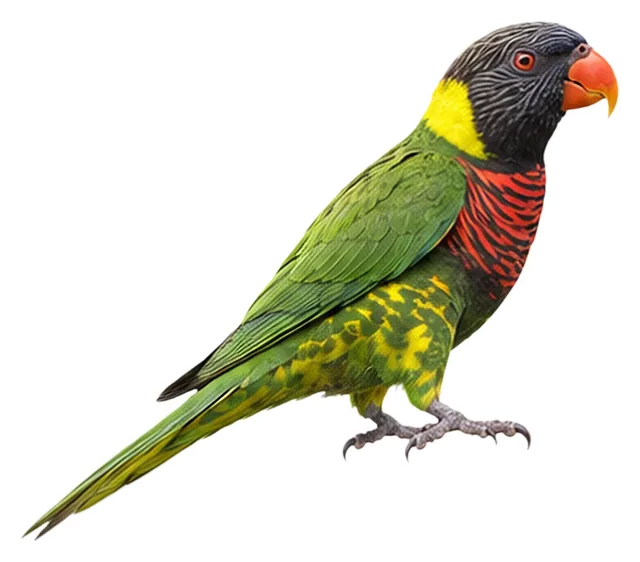
Coconut Lorikeet
Trichoglossus haematodus (Linnaeus, 1771)
25–30 cmLength113 gWeight
This brightly colored lorikeet has a blue head, red breast and orange-red bill as an adult.
Most records: Papua New Guinea, Singapore, New Caledonia
How to identify
Field marks
- Head blue, grading to brown toward neck
- Bill orange-red
- Yellow collar on neck, varying in width
- Adult breast red, upperparts green
Male, female and young
Sexes look similar; iris color differences are affected by health and should not be used alone to determine sex; juveniles are darker and smaller.
Where and when it's recorded

Coconut Lorikeet has been recorded at 129 of the 8,171 birding hotspots we track, in 5 countries and regions.
Records by month Southern Hemisphere
Where it's recorded most
- Varirata National ParkPapua New Guinea914 records
- Singapore Botanic GardensSingapore633 records
- Pacific Adventist UniversityPapua New Guinea410 records
More places
- MacRitchie Reservoir ParkSingapore251 records
- Parc de la Rivière BleueNew Caledonia219 records
- Bishan-Ang Mo Kio ParkSingapore200 records
- Kulu RiverPapua New Guinea162 records
- Central Catchment Nature ReserveSingapore156 records
- Garu WMAPapua New Guinea108 records
- Parc des Grandes FougèresNew Caledonia91 records
Countries and regions with the most records
eBird records via GBIF up to 2024-12-31. A record means someone listed it; more records partly mean more birders, not more birds.
About
The coconut lorikeet (Trichoglossus haematodus), also known as the green-naped lorikeet and Swainson’s lorikeet, is a parrot in the family Psittaculidae. Several species of lorikeets now recognised as distinct were once lumped together under Trichoglossus haematodus; together they form the "rainbow lorikeet" species complex.
Excerpt from Wikipedia, CC BY-SA 4.0 · authors · Read more on Wikipedia
Questions
How big is the Coconut Lorikeet?
The Coconut Lorikeet is about 25–30 cm long and weighs around 113 g.
Where does the Coconut Lorikeet live?
Its breeding range: Australasia: central, southern Moluccas, western New Guinea, east to Bismarck Archipelago, Solomon Islands, Vanuatu and New Caledonia. It is most often recorded in Papua New Guinea, Singapore and New Caledonia.
Is the Coconut Lorikeet endangered?
The IUCN Red List classifies the Coconut Lorikeet as Least Concern.
What does the Coconut Lorikeet eat?
Main food: Omnivore.
What family is the Coconut Lorikeet in?
It belongs to the family Old World Parrots (Psittaculidae), order Parrot (Psittaciformes).
At a glance
- Length
- 25–30 cm
- Weight
- 113 g
- Habitat
- Forest
- Diet
- Omnivore
- Lifestyle
- Perches in trees
- Migration
- Resident (barely migrates)
- Conservation
- Least Concern
More measurements
- Wing
- 143 mm
- Tail
- 118 mm
- Bill
- 22 mm
- Tarsus
- 18 mm
Averages from the AVONET dataset; length from field guides where available.
Range
Australasia: central, southern Moluccas, western New Guinea, east to Bismarck Archipelago, Solomon Islands, Vanuatu and New Caledonia
Breeding range, IOC World Bird List 15.2
Classification
- Order
- Parrot Psittaciformes
- Family
- Old World Parrots Psittaculidae
- Genus
- Trichoglossus
Other birds in the genus Trichoglossus
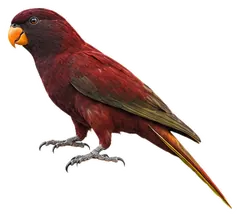 Pohnpei LorikeetTrichoglossus rubiginosus
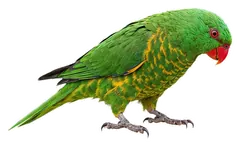 Scaly-breasted LorikeetTrichoglossus chlorolepidotus
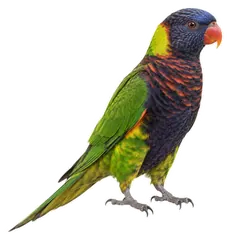 Biak LorikeetTrichoglossus rosenbergii
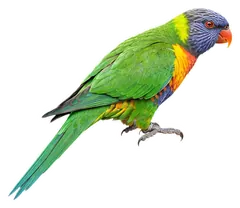 Rainbow LorikeetTrichoglossus moluccanus
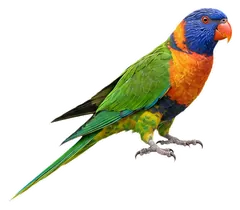 Red-collared LorikeetTrichoglossus rubritorquis
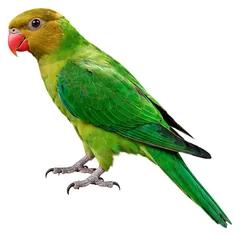 Olive-headed LorikeetTrichoglossus euteles
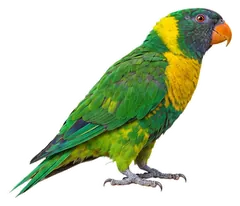 Marigold LorikeetTrichoglossus capistratus
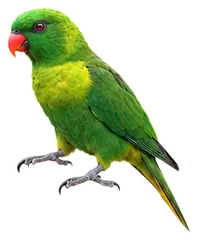 Leaf LorikeetTrichoglossus weberi
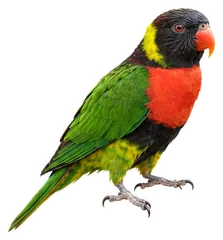 Sunset LorikeetTrichoglossus forsteni
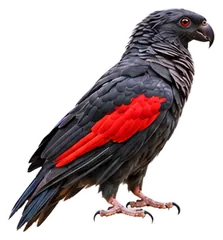 Pesquet's ParrotPsittrichas fulgidus
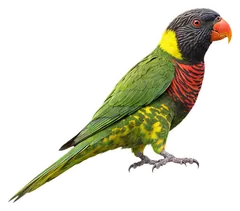
Download illustration
Free to use with credit: “Illustration: Bird Album (birdalbum.com)”. Drawn by AI from a reference photo by Dipika n Bhupesh Kurade. ↗
Heard it but can't see it? Mingji identifies birds by sound and photo, on your phone.