 Bird Album
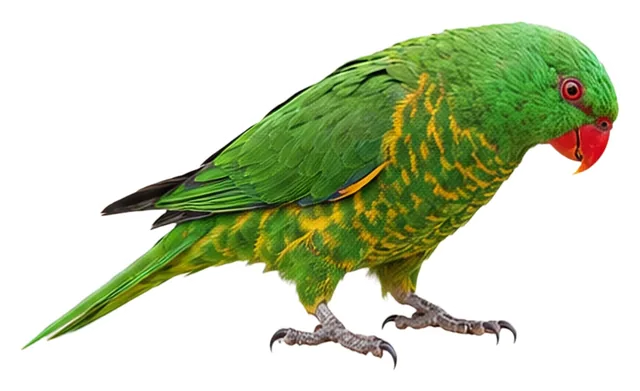
Scaly-breasted Lorikeet
Trichoglossus chlorolepidotus (Kuhl, 1820)
23 cmLength87 gWeight
The scaly-breasted lorikeet (Trichoglossus chlorolepidotus) is an Australian lorikeet found in woodland in eastern Australia.
Busiest months: May and September–November · Most records: Australia
Where and when it's recorded

Scaly-breasted Lorikeet has been recorded at 128 of the 8,171 birding hotspots we track, in 1 country or region.
Records by month Southern Hemisphere
Where it's recorded most
- Oxley Creek CommonAustralia2,217 records
- Toohey MountainAustralia1,548 records
- Sandy Camp Road WetlandsAustralia1,417 records
More places
- Bundaberg Botanical GardensAustralia1,249 records
- Sherwood ArboretumAustralia1,188 records
- Nature Refuge Hawkesbury RoadAustralia1,086 records
- Dowse LagoonAustralia1,055 records
- Anstead Bushland ReserveAustralia930 records
- Fairfield areaAustralia833 records
- Ovens Head and adjacent mangrovesAustralia802 records
Countries and regions with the most records
eBird records via GBIF up to 2024-12-31. A record means someone listed it; more records partly mean more birders, not more birds.
About
The scaly-breasted lorikeet (Trichoglossus chlorolepidotus) is an Australian lorikeet found in woodland in eastern Australia. The common name aptly describes this bird, which has yellow breast feathers broadly edged with green that look like scales.
Excerpt from Wikipedia, CC BY-SA 4.0 · authors · Read more on Wikipedia
Questions
How big is the Scaly-breasted Lorikeet?
The Scaly-breasted Lorikeet is about 23 cm long and weighs around 87 g.
Where does the Scaly-breasted Lorikeet live?
Its breeding range: Australasia: southeastern Cape York Peninsula, northeastern Queensland to east-central New South Wales (eastern Australia). It is most often recorded in Australia.
When is the best time to see the Scaly-breasted Lorikeet?
At the hotspots we track, it is recorded most in May, September, October and November (Southern Hemisphere).
Is the Scaly-breasted Lorikeet endangered?
The IUCN Red List classifies the Scaly-breasted Lorikeet as Least Concern.
What does the Scaly-breasted Lorikeet eat?
Main food: Nectar.
What family is the Scaly-breasted Lorikeet in?
It belongs to the family Old World Parrots (Psittaculidae), order Parrot (Psittaciformes).
At a glance
- Length
- 23 cm
- Weight
- 87 g
- Habitat
- Woodland
- Diet
- Nectar
- Lifestyle
- Perches in trees
- Migration
- Resident (barely migrates)
- Conservation
- Least Concern
More measurements
- Wing
- 128 mm
- Tail
- 95 mm
- Bill
- 19 mm
- Tarsus
- 15 mm
Averages from the AVONET dataset; length from field guides where available.
Range
Australasia: southeastern Cape York Peninsula, northeastern Queensland to east-central New South Wales (eastern Australia)
Breeding range, IOC World Bird List 15.2
Classification
- Order
- Parrot Psittaciformes
- Family
- Old World Parrots Psittaculidae
- Genus
- Trichoglossus
Other birds in the genus Trichoglossus
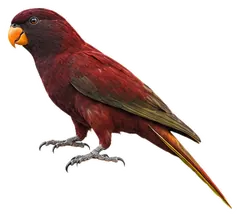 Pohnpei LorikeetTrichoglossus rubiginosus
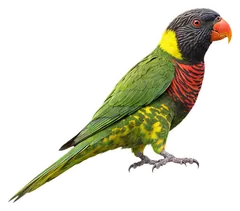 Coconut LorikeetTrichoglossus haematodus
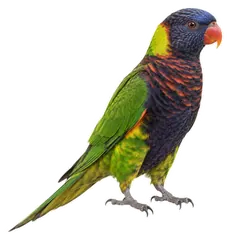 Biak LorikeetTrichoglossus rosenbergii
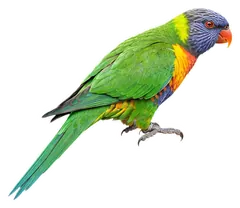 Rainbow LorikeetTrichoglossus moluccanus
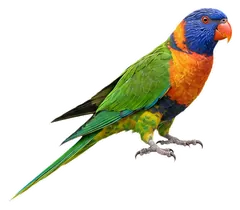 Red-collared LorikeetTrichoglossus rubritorquis
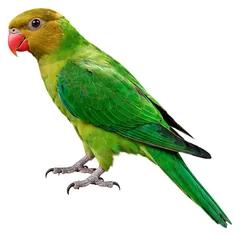 Olive-headed LorikeetTrichoglossus euteles
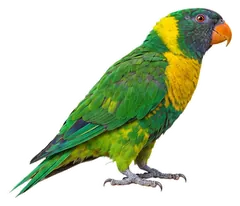 Marigold LorikeetTrichoglossus capistratus
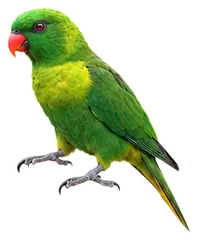 Leaf LorikeetTrichoglossus weberi
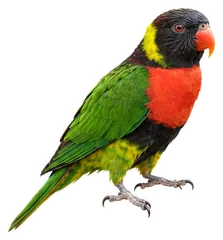 Sunset LorikeetTrichoglossus forsteni
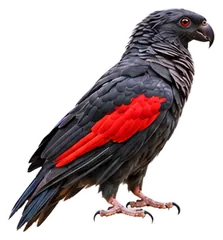 Pesquet's ParrotPsittrichas fulgidus
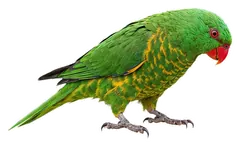
Download illustration
Free to use with credit: “Illustration: Bird Album (birdalbum.com)”. Drawn by AI from reference photos. ↗
Heard it but can't see it? Mingji identifies birds by sound and photo, on your phone.