 Bird Album
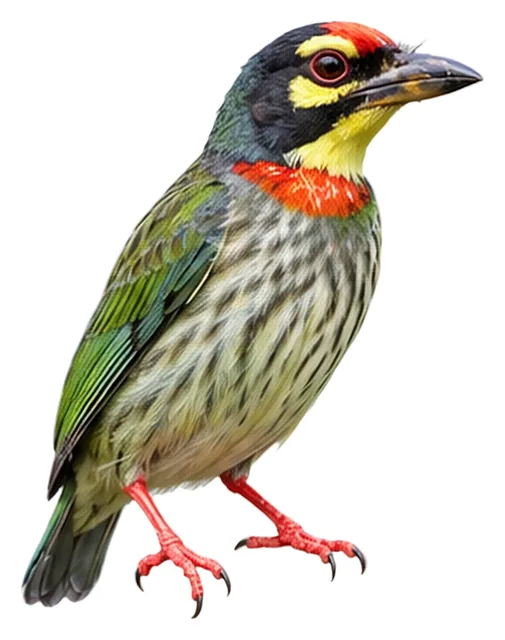
Coppersmith Barbet
Psilopogon haemacephalus (Müller, PLS, 1776)
15–17 cmLength44 gWeight
This small barbet has a green body, red forehead and yellow cheeks, with a call like a coppersmith striking metal.
Busiest months: February · Most records: India, Thailand, Philippines
How to identify
Field marks
- Green body
- Red forehead and yellow cheeks
- Gray-black streaks on the underparts
Voice
A loud, metallic “tuk…tuk…tuk”, like striking a copper sheet, repeated monotonously for long periods.
Where and when it's recorded

Coppersmith Barbet has been recorded at 823 of the 8,171 birding hotspots we track, in 17 countries and regions.
Records by month Northern Hemisphere
Where it's recorded most
- GKVK CampusIndia10,935 records
- Kanha NP – Mukki ZoneIndia6,854 records
- Fergusson College CampusIndia6,566 records
More places
- Salim Ali Centre for Ornithology and Natural HistoryIndia3,315 records
- IIT BombayIndia3,198 records
- Kerala Agricultural UniversityIndia2,997 records
- Valley SchoolIndia2,925 records
- Rishi Valley – School CampusIndia2,563 records
- Vetal Tekdi/HillIndia2,302 records
- Saul Kere / Sowl KereIndia2,271 records
Countries and regions with the most records
eBird records via GBIF up to 2024-12-31. A record means someone listed it; more records partly mean more birders, not more birds.
About
The coppersmith barbet (Psilopogon haemacephalus), also called crimson-breasted barbet and coppersmith, is an Asian barbet with crimson forehead and throat, known for its metronomic call that sounds similar to a coppersmith striking metal with a hammer. It is a resident bird in the Indian subcontinent and parts of Southeast Asia. It carves out holes inside a tree to build its nest.
Excerpt from Wikipedia, CC BY-SA 4.0 · authors · Read more on Wikipedia
Questions
How big is the Coppersmith Barbet?
The Coppersmith Barbet is about 15–17 cm long and weighs around 44 g.
Where does the Coppersmith Barbet live?
Its breeding range: Oriental: widespread. It is most often recorded in India, Thailand and Philippines.
When is the best time to see the Coppersmith Barbet?
At the hotspots we track, it is recorded most in February (Northern Hemisphere).
Is the Coppersmith Barbet endangered?
The IUCN Red List classifies the Coppersmith Barbet as Least Concern.
What does the Coppersmith Barbet eat?
Main food: Fruit.
What family is the Coppersmith Barbet in?
It belongs to the family Asian Barbets (Megalaimidae), order Piciformes.
At a glance
- Length
- 15–17 cm
- Weight
- 44 g
- Habitat
- Woodland
- Diet
- Fruit
- Lifestyle
- Perches in trees
- Migration
- Resident (barely migrates)
- Conservation
- Least Concern
More measurements
- Wing
- 81 mm
- Tail
- 36 mm
- Bill
- 19 mm
- Tarsus
- 19 mm
Averages from the AVONET dataset; length from field guides where available.
Range
Oriental: widespread
Breeding range, IOC World Bird List 15.2
Subspecies · 1
- Psilopogon haemacephalus indicus ne Pakistan, India and Sri Lanka to s China, Vietnam and s Malaysia
Classification
- Order
- Piciformes
- Family
- Asian Barbets Megalaimidae
- Genus
- Psilopogon
Other birds in the genus Psilopogon
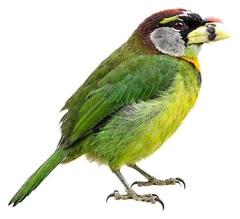 Fire-tufted BarbetPsilopogon pyrolophus
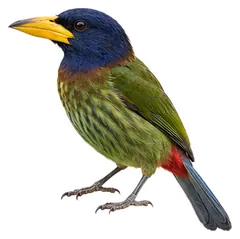 Great BarbetPsilopogon virens
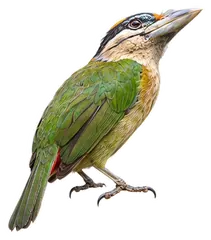 Red-vented BarbetPsilopogon lagrandieri
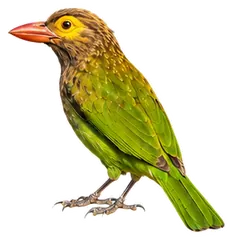 Brown-headed BarbetPsilopogon zeylanicus
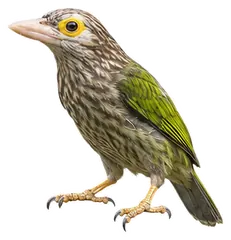 Lineated BarbetPsilopogon lineatus
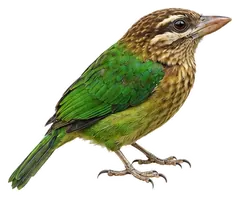 White-cheeked BarbetPsilopogon viridis
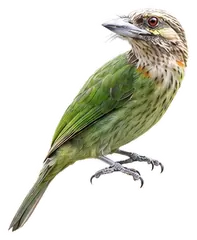 Green-eared BarbetPsilopogon faiostrictus
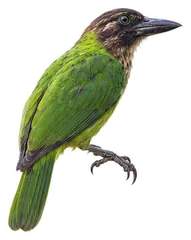 Brown-throated BarbetPsilopogon corvinus
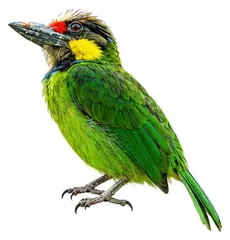 Golden-whiskered BarbetPsilopogon chrysopogon
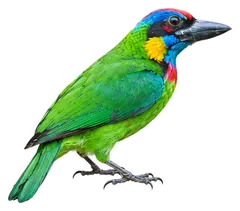 Red-crowned BarbetPsilopogon rafflesii
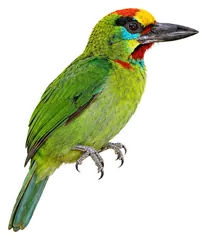 Red-throated BarbetPsilopogon mystacophanos
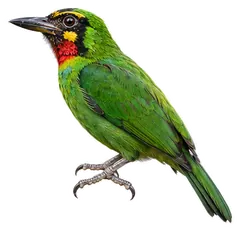 Black-banded BarbetPsilopogon javensis
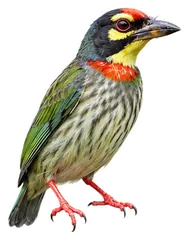
Download illustration
Free to use with credit: “Illustration: Bird Album (birdalbum.com)”. Drawn by AI from a reference photo by Shantanu Kuveskar. ↗

Heard it but can't see it? Mingji identifies birds by sound and photo, on your phone.
In other languages
- EnglishCoppersmith Barbet
- 简体中文赤胸拟啄木鸟
- 繁體中文赤胸擬啄木
- 日本語ムネアカゴシキドリ
- DeutschKupferschmied-Bartvogel
- FrançaisBarbu à plastron rouge
- EspañolBarbudo calderero
- Portuguêsbarbichas-ferreiro
- ItalianoBarbetto ramatore
- NederlandsKopersmid
- РусскийКраснолобый бородастик
- Svenskakopparslagarbarbett
- DanskKobbersmed
- Polskipstrogłów żółtogardły