 Bird Album
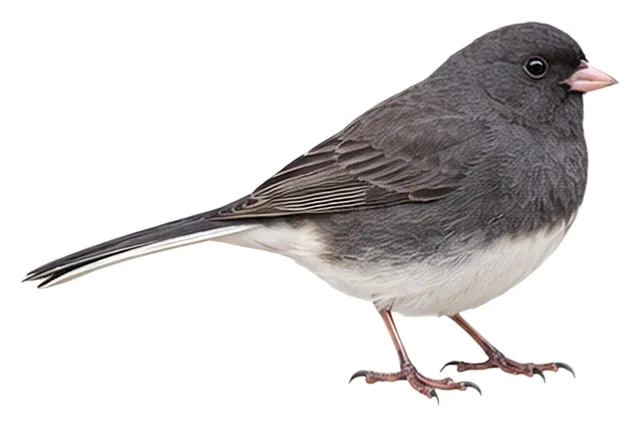
Dark-eyed Junco
Junco hyemalis (Linnaeus, 1758)
20 gWeight
The dark-eyed junco (Junco hyemalis) is a species of junco, a group of small, grayish New World sparrows.
Busiest months: April and October–November · Most records: United States, Canada, St. Pierre & Miquelon
Where and when it's recorded
Busiest months: April and October–November · Most records: United States, Canada, St. Pierre & Miquelon

Dark-eyed Junco has been recorded at 730 of the 8,276 birding hotspots we track, in 9 countries and regions.
Records by month Northern Hemisphere
Where it's recorded most
- Montrose Point Bird Sanctuary, Lincoln Park, ChicagoUnited States14,779 records
- Discovery ParkUnited States11,694 records
- Union Bay Natural Area/Montlake FillUnited States11,403 records
More places
- Reifel Bird SanctuaryCanada11,352 records
- Central ParkUnited States11,003 records
- Madera Canyon – Santa Rita LodgeUnited States10,620 records
- Mt. Tabor ParkUnited States9,691 records
- Prospect ParkUnited States9,431 records
- Jardin botanique de MontréalCanada9,006 records
- Magnuson ParkUnited States8,684 records
Countries and regions with the most records
eBird records via GBIF up to 2024-12-31. A record means someone listed it; more records partly mean more birders, not more birds.
About
The dark-eyed junco (Junco hyemalis) is a species of junco, a group of small, grayish New World sparrows. The species is common across much of temperate North America and in summer it ranges far into the Arctic. It is a variable species, much like the related fox sparrow (Passerella iliaca), and its systematics are still not completely resolved.
Excerpt from Wikipedia, CC BY-SA 4.0 · authors · Read more on Wikipedia
Questions
How big is the Dark-eyed Junco?
The Dark-eyed Junco weighs around 20 g.
Where does the Dark-eyed Junco live?
Its breeding range: North America, Middle America: northern, western. It is most often recorded in United States, Canada and St. Pierre & Miquelon.
When is the best time to see the Dark-eyed Junco?
At the hotspots we track, it is recorded most in April, October and November (Northern Hemisphere).
Is the Dark-eyed Junco endangered?
The IUCN Red List classifies the Dark-eyed Junco as Least Concern.
What does the Dark-eyed Junco eat?
Main food: Seeds.
What family is the Dark-eyed Junco in?
It belongs to the family New World Sparrows (Passerellidae), order Passerines (Passeriformes).
At a glance
- Weight
- 20 g
- Habitat
- Forest
- Diet
- Seeds
- Lifestyle
- Varied
- Migration
- Migratory
- Conservation
- Least Concern
More measurements
- Wing
- 75 mm
- Tail
- 64 mm
- Bill
- 12 mm
- Tarsus
- 21 mm
Averages from the AVONET dataset; length from field guides where available.
Range
North America, Middle America: northern, western
Breeding range, IOC World Bird List 15.2
Classification
- Order
- Passerines Passeriformes
- Family
- New World Sparrows Passerellidae
- Genus
- Junco
Other birds in the genus Junco
 Volcano JuncoJunco vulcani
 Guadalupe JuncoJunco insularis
 Yellow-eyed JuncoJunco phaeonotus
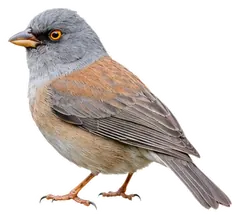 Baird's JuncoJunco bairdi
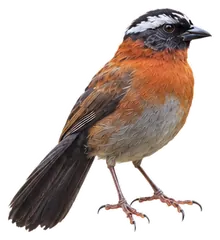 Tanager FinchOreothraupis arremonops
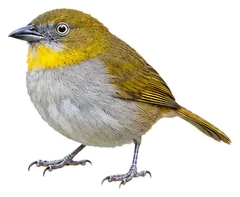 Yellow-throated ChlorospingusChlorospingus flavigularis
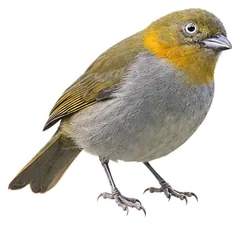 Yellow-whiskered ChlorospingusChlorospingus parvirostris
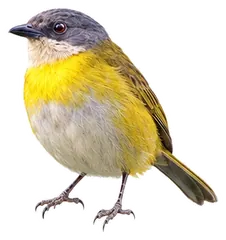 Ashy-throated ChlorospingusChlorospingus canigularis
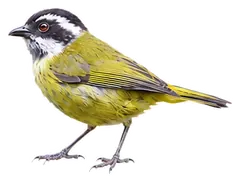 Sooty-capped ChlorospingusChlorospingus pileatus
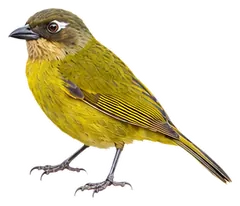 Common ChlorospingusChlorospingus flavopectus
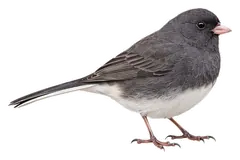
Download illustration
Free to use with credit: “Illustration: Bird Album (birdalbum.com)”. Drawn by AI from a reference photo by Craig K. Hunt. ↗
Heard it but can't see it? Mingji identifies birds by sound and photo, on your phone.