 Bird Album
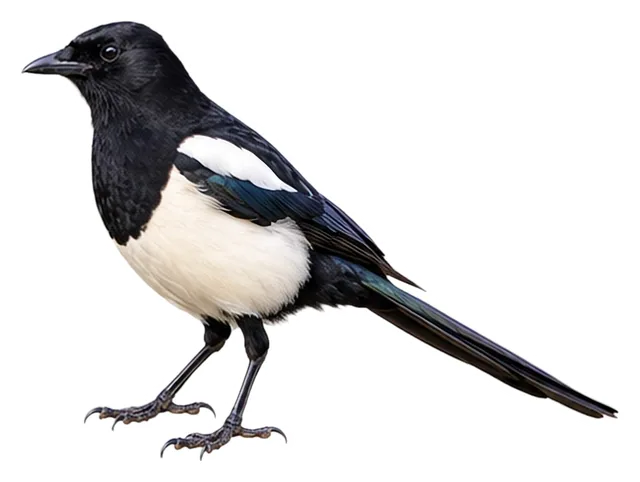
Eurasian Magpie
Pica pica (Linnaeus, 1758)
≈43 cmLength56 cmWingspan218 gWeight
It is a sharply patterned black-and-white bird with a long tail, pure white scapulars and belly, and a white V on the back in flight.
Busiest months: April–May · Most records: United Kingdom, Spain, Portugal
How to identify
Field marks
- Head, neck, breast and back black, with a blue-purple metallic gloss
- Scapulars and upper and lower belly pure white
- White wingtips and a white V on the back visible in flight
- Bill, legs and feet black
Male, female and young
Sexes similar in plumage, with the female slightly smaller; juveniles initially lack metallic gloss, have pinkish cheeks and a shorter tail.
Voice
A noisy, choking “chac-chac”, also given in repeated series.
Where and when it's recorded
Busiest months: April–May · Most records: United Kingdom, Spain, Portugal

Eurasian Magpie has been recorded at 1,369 of the 8,276 birding hotspots we track, in 66 countries and regions.
Records by month Northern Hemisphere
Where it's recorded most
- Amwell HMWT NRUnited Kingdom7,746 records
- Minsmere RSPB ReserveUnited Kingdom5,515 records
- Beddington FarmlandsUnited Kingdom4,878 records
More places
- Parque El Retiro-MadridSpain4,054 records
- Titchwell Marsh RSPB ReserveUnited Kingdom3,974 records
- Txingudi – PlaiaundiSpain3,818 records
- Spurn Bird Observatory Recording AreaUnited Kingdom3,702 records
- WWT London Wetland CentreUnited Kingdom3,648 records
- Walthamstow WetlandsUnited Kingdom3,648 records
- Rainham Marshes RSPB Reserve, SSSI and LNRUnited Kingdom3,533 records
Countries and regions with the most records
eBird records via GBIF up to 2024-12-31. A record means someone listed it; more records partly mean more birders, not more birds.
About
The Eurasian magpie or common magpie (Pica pica) is a resident breeding bird throughout the northern part of the Eurasian continent. It is one of several birds in the crow family (corvids) that are designated as magpies, and it belongs to the Holarctic radiation of "monochrome" magpies. In Europe, the term "magpie" is used by English speakers as a synonym for the Eurasian magpie; the only other species of magpie in Europe being the Iberian magpie (Cyanopica cooki), which is restricted to the Iberian Peninsula.
Excerpt from Wikipedia, CC BY-SA 4.0 · authors · Read more on Wikipedia
Questions
How big is the Eurasian Magpie?
The Eurasian Magpie is about ≈43 cm long, with a wingspan of 56 cm and weighs around 218 g.
Where does the Eurasian Magpie live?
Its breeding range: Palearctic: northern Eurasia from British Isles and western Europe to eastern Siberia. It is most often recorded in United Kingdom, Spain and Portugal.
When is the best time to see the Eurasian Magpie?
At the hotspots we track, it is recorded most in April and May (Northern Hemisphere).
Is the Eurasian Magpie endangered?
The IUCN Red List classifies the Eurasian Magpie as Least Concern.
What does the Eurasian Magpie eat?
Main food: Omnivore.
What family is the Eurasian Magpie in?
It belongs to the family Crows, Jays (Corvidae), order Passerines (Passeriformes).
At a glance
- Length
- ≈43 cm
- Wingspan
- 56 cm
- Weight
- 218 g
- Habitat
- Towns & farmland
- Diet
- Omnivore
- Lifestyle
- Active on the ground
- Migration
- Resident (barely migrates)
- Conservation
- Least Concern
More measurements
- Wing
- 193 mm
- Tail
- 242 mm
- Bill
- 41 mm
- Tarsus
- 47 mm
Averages from the AVONET dataset; length from field guides where available.
Range
Palearctic: northern Eurasia from British Isles and western Europe to eastern Siberia
Breeding range, IOC World Bird List 15.2
Subspecies · 1
- Pica pica leucoptera se Siberia, Mongolia and ne China
Classification
- Order
- Passerines Passeriformes
- Family
- Crows, Jays Corvidae
- Genus
- Pica
Other birds in the genus Pica
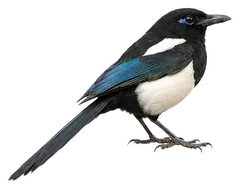 Maghreb MagpiePica mauritanica
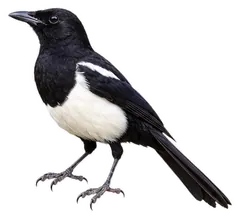 Asir MagpiePica asirensis
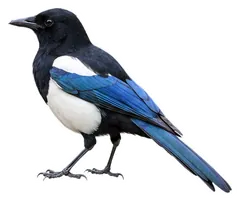 Black-rumped MagpiePica bottanensis
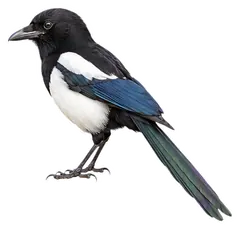 Oriental MagpiePica serica
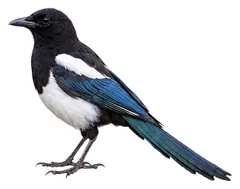 Black-billed MagpiePica hudsonia
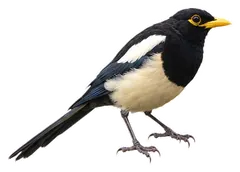 Yellow-billed MagpiePica nuttallii
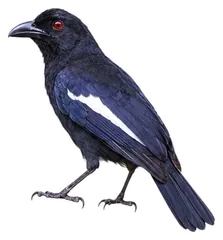 Malayan Black MagpiePlatysmurus leucopterus
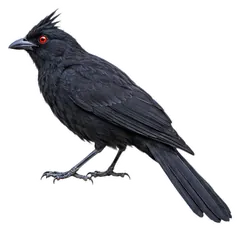 Bornean Black MagpiePlatysmurus aterrimus
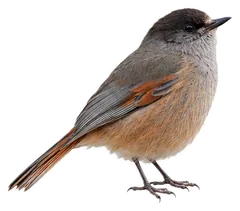 Siberian JayPerisoreus infaustus
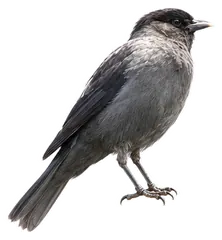 Sichuan JayPerisoreus internigrans
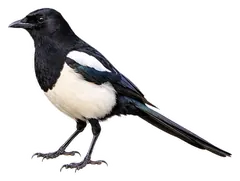
Download illustration
Free to use with credit: “Illustration: Bird Album (birdalbum.com)”. Drawn by AI from a reference photo by Francisco Clamote. ↗
Heard it but can't see it? Mingji identifies birds by sound and photo, on your phone.