 Bird Album
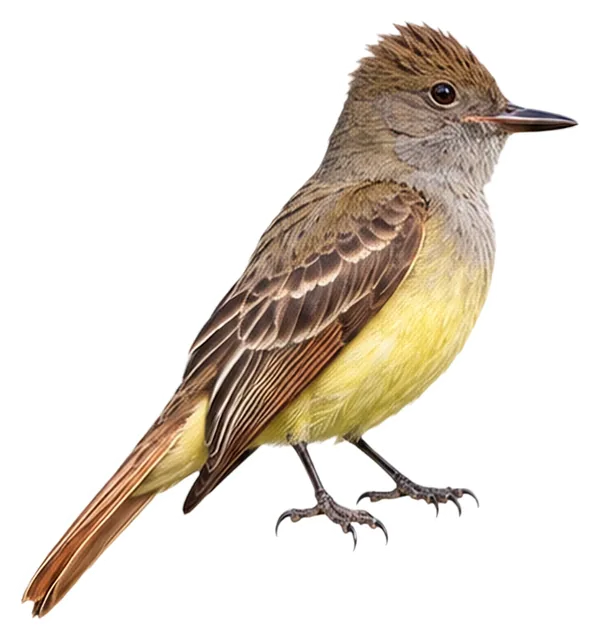
Great Crested Flycatcher
Myiarchus crinitus (Linnaeus, 1758)
32 gWeight
The great crested flycatcher (Myiarchus crinitus) is a large insect-eating bird of the tyrant flycatcher family.
Busiest months: May · Most records: United States, Canada, Costa Rica
Where and when it's recorded

Great Crested Flycatcher has been recorded at 882 of the 8,171 birding hotspots we track, in 20 countries and regions.
Records by month Northern Hemisphere
Where it's recorded most
- Audubon Corkscrew Swamp SanctuaryUnited States15,197 records
- Point Pelee National ParkCanada9,730 records
- Magee Marsh – BoardwalkUnited States8,054 records
More places
- Sabine WoodsUnited States7,352 records
- Mount Auburn CemeteryUnited States5,772 records
- John Heinz NWR – impoundmentUnited States5,534 records
- Cape Island – Higbee Beach WMAUnited States5,401 records
- Prospect ParkUnited States4,973 records
- Central ParkUnited States4,791 records
- Parker River NWRUnited States4,647 records
Countries and regions with the most records
eBird records via GBIF up to 2024-12-31. A record means someone listed it; more records partly mean more birders, not more birds.
About
The great crested flycatcher (Myiarchus crinitus) is a large insect-eating bird of the tyrant flycatcher family. It is the most widespread member of the genus Myiarchus in North America, and is found over most of the eastern and mid-western portions of the continent. It dwells mostly in the treetops and rarely is found on the ground.
Excerpt from Wikipedia, CC BY-SA 4.0 · authors · Read more on Wikipedia
Questions
How big is the Great Crested Flycatcher?
The Great Crested Flycatcher weighs around 32 g.
Where does the Great Crested Flycatcher live?
Its breeding range: North America: south-central, southeastern Canada to south-central, southeastern USA. It is most often recorded in United States, Canada and Costa Rica.
When is the best time to see the Great Crested Flycatcher?
At the hotspots we track, it is recorded most in May (Northern Hemisphere).
Is the Great Crested Flycatcher endangered?
The IUCN Red List classifies the Great Crested Flycatcher as Least Concern.
What does the Great Crested Flycatcher eat?
Main food: Insects & other invertebrates.
What family is the Great Crested Flycatcher in?
It belongs to the family Tyrant Flycatchers, Calyptura (Tyrannidae), order Passerines (Passeriformes).
At a glance
- Weight
- 32 g
- Habitat
- Woodland
- Diet
- Insects & other invertebrates
- Lifestyle
- Perches in trees
- Migration
- Migratory
- Conservation
- Least Concern
More measurements
- Wing
- 99 mm
- Tail
- 88 mm
- Bill
- 23 mm
- Tarsus
- 22 mm
Averages from the AVONET dataset; length from field guides where available.
Range
North America: south-central, southeastern Canada to south-central, southeastern USA
Breeding range, IOC World Bird List 15.2
Classification
- Order
- Passerines Passeriformes
- Family
- Tyrant Flycatchers, Calyptura Tyrannidae
- Genus
- Myiarchus
Other birds in the genus Myiarchus
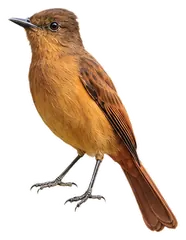 Rufous FlycatcherMyiarchus semirufus
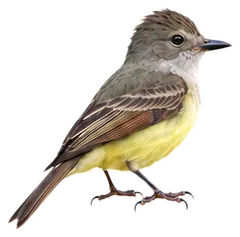 Yucatan FlycatcherMyiarchus yucatanensis
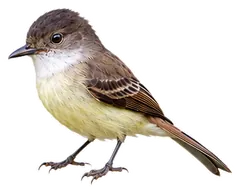 Sad FlycatcherMyiarchus barbirostris
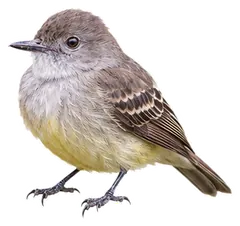 Dusky-capped FlycatcherMyiarchus tuberculifer
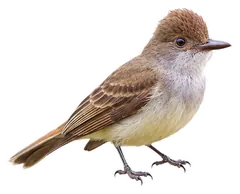 Swainson's FlycatcherMyiarchus swainsoni
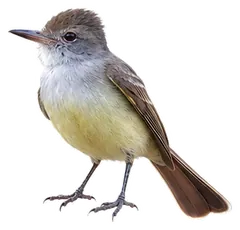 Venezuelan FlycatcherMyiarchus venezuelensis
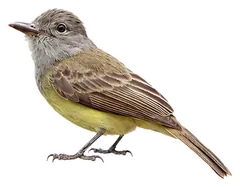 Panama FlycatcherMyiarchus panamensis
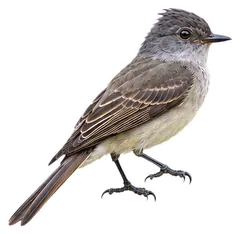 Short-crested FlycatcherMyiarchus ferox
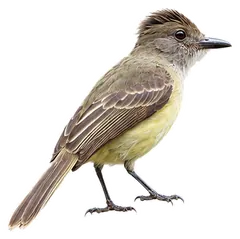 Apical FlycatcherMyiarchus apicalis
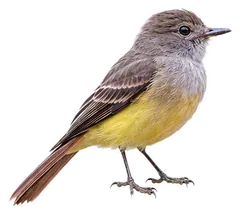 Pale-edged FlycatcherMyiarchus cephalotes
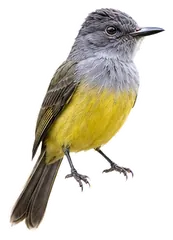 Sooty-crowned FlycatcherMyiarchus phaeocephalus
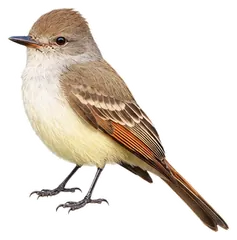 Ash-throated FlycatcherMyiarchus cinerascens
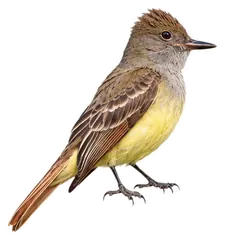
Download illustration
Free to use with credit: “Illustration: Bird Album (birdalbum.com)”. Drawn by AI from a reference photo by Chrissy McClarren and Andy Reago. ↗
Heard it but can't see it? Mingji identifies birds by sound and photo, on your phone.
In other languages
- EnglishGreat Crested Flycatcher
- 简体中文大冠蝇霸鹟
- 繁體中文大冠蠅霸鶲
- 日本語オオヒタキモドキ
- DeutschGelbbauch-Schopftyrann
- FrançaisTyran huppé
- EspañolCopetón viajero
- Portuguêsmaria-cavaleira-neártica
- ItalianoPigliamosche crestato maggiore
- NederlandsGrote Kuiftiran
- РусскийХохлатый миарх
- Svenskastörre topptyrann
- DanskToppet Skovtyran
- Polskimuchołap czubaty