 Bird Album
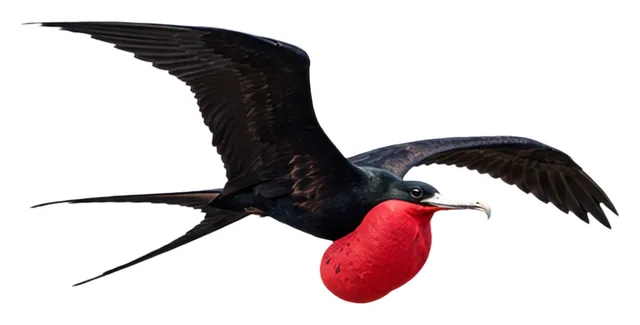
Great Frigatebird
Fregata minor (Gmelin, JF, 1789)
105 cmLength218 cmWingspan1.3 kgWeight
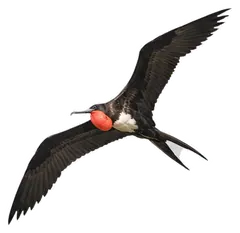
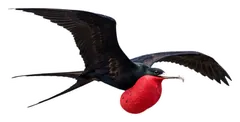
The male of this large black seabird can inflate its red gular pouch until it looks like a red balloon.
Most records: U.S. Outlying Islands, Christmas Island, Ecuador
How to identify
Field marks
- Wings long, narrow and pointed, tail long and deeply forked
- Male black, with a green sheen on the scapulars
- Female throat and breast white, eye-ring red
- Male gular pouch red and inflated in the breeding season
Male, female and young
Female larger than male, with a white throat and breast; juvenile black, with rusty-tinged white on the face, head and throat.
Where and when it's recorded

Great Frigatebird has been recorded at 208 of the 8,171 birding hotspots we track, in 39 countries and regions.
Records by month Southern Hemisphere
Where it's recorded most
- Midway Atoll – Water Catchment AreaU.S. Outlying Islands806 records
- Midway Atoll NWR – Sand IslandU.S. Outlying Islands501 records
- Española – Punta SuárezEcuador476 records
More places
- Midway Atoll NWR – Eastern IslandU.S. Outlying Islands442 records
- TetiaroaFrench Polynesia224 records
- ArideSeychelles189 records
- Norfolk Island National Park – Captain Cook MemorialNorfolk Island162 records
- SettlementChristmas Island107 records
- Christmas Island National ParkChristmas Island95 records
- Diego GarciaBritish Indian Ocean Territory95 records
Countries and regions with the most records
eBird records via GBIF up to 2024-12-31. A record means someone listed it; more records partly mean more birders, not more birds.
About
The great frigatebird (Fregata minor) is a large seabird in the frigatebird family. There are major nesting populations in the tropical Pacific Ocean, such as Hawaii and the Galápagos Islands; in the Indian Ocean, colonies can be found in the Seychelles (on Aldabra and Aride Islands) and Mauritius, and there is a tiny population in the South Atlantic, mostly on and around St. Helena and Boatswain Bird Island (Ascension Island).
Excerpt from Wikipedia, CC BY-SA 4.0 · authors · Read more on Wikipedia
Questions
How big is the Great Frigatebird?
The Great Frigatebird is about 105 cm long, with a wingspan of 218 cm and weighs around 1.3 kg.
Where does the Great Frigatebird live?
Its breeding range: Tropical Oceans: widespread, islands of tropical Indian and Pacific oceans, local east of eastern Brazil (tropical Atlantic Ocean). It is most often recorded in U.S. Outlying Islands, Christmas Island and Ecuador.
Is the Great Frigatebird endangered?
The IUCN Red List classifies the Great Frigatebird as Least Concern.
What does the Great Frigatebird eat?
Main food: Fish, shrimp & shellfish.
What family is the Great Frigatebird in?
It belongs to the family Frigatebirds (Fregatidae), order Suliformes.
At a glance
- Length
- 105 cm
- Wingspan
- 218 cm
- Weight
- 1.3 kg
- Habitat
- Ocean
- Diet
- Fish, shrimp & shellfish
- Lifestyle
- Feeds in the air
- Migration
- Migratory
- Conservation
- Least Concern
More measurements
- Wing
- 568 mm
- Tail
- 396 mm
- Bill
- 117 mm
- Tarsus
- 20 mm
Averages from the AVONET dataset; length from field guides where available.
Range
Tropical Oceans: widespread, islands of tropical Indian and Pacific oceans, local east of eastern Brazil (tropical Atlantic Ocean)
Breeding range, IOC World Bird List 15.2
Classification
- Order
- Suliformes
- Family
- Frigatebirds Fregatidae
- Genus
- Fregata
Other birds in the genus Fregata
 Ascension FrigatebirdFregata aquila
 Magnificent FrigatebirdFregata magnificens
 Lesser FrigatebirdFregata ariel
 Christmas FrigatebirdFregata andrewsi
Download illustration
Free to use with credit: “Illustration: Bird Album (birdalbum.com)”. Drawn by AI from a reference photo by Denis. ↗
Heard it but can't see it? Mingji identifies birds by sound and photo, on your phone.
In other languages
- EnglishGreat Frigatebird
- 简体中文黑腹军舰鸟
- 繁體中文大軍艦鳥
- 日本語オオグンカンドリ
- 한국어큰군함조
- DeutschBindenfregattvogel
- FrançaisFrégate du Pacifique
- EspañolRabihorcado grande
- Portuguêsrabiforcado-grande
- ItalianoFregata maggiore
- NederlandsGrote Fregatvogel
- РусскийБольшой фрегат
- Svenskastörre fregattfågel
- DanskStor Fregatfugl
- Polskifregata średnia