 Bird Album
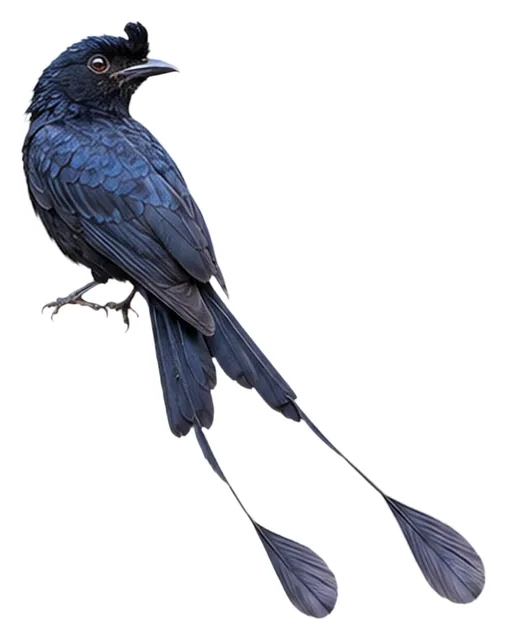
Greater Racket-tailed Drongo
Dicrurus paradiseus (Linnaeus, 1766)
≈32 cmLength86 gWeight
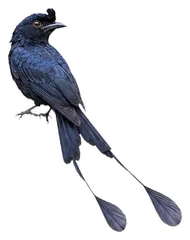
It has greatly elongated outer tail feathers with vanes only at the tips, and is the largest drongo across most of its range.
Busiest months: February–March · Most records: India, Thailand, Singapore
Looks like Lesser Racket-tailed Drongo
How to identify
Field marks
- Outer tail feathers elongated, with vanes only at the tips
- Curled crest arises above the bill and varies between subspecies
- Largest drongo across most of its range
Male, female and young
Juvenile duller and may lack a crest.
Voice
Calls are extremely varied; often begins calling in the early morning with a metallic “tunk-tunk-tunk”, and also mimics other birds.
Similar species
Where and when it's recorded
Busiest months: February–March · Most records: India, Thailand, Singapore

Greater Racket-tailed Drongo has been recorded at 557 of the 8,276 birding hotspots we track, in 15 countries and regions.
Records by month Northern Hemisphere
Where it's recorded most
- Kanha NP – Mukki ZoneIndia7,897 records
- Dairy Farm Nature ParkSingapore2,752 records
- Thattekkad Bird SanctuaryIndia2,080 records
More places
- Sepilok – Rainforest Discovery CenterMalaysia2,046 records
- Kerala Agricultural UniversityIndia1,871 records
- Kanha Tiger Reserve – Mukki GateIndia1,758 records
- Kanha NP – Kanha ZoneIndia1,655 records
- Singapore Botanic GardensSingapore1,640 records
- Gunung Panti Recreational Forest – Panti Bird Sanctuary and North AreaMalaysia1,489 records
- Chidyatapu Biological ParkIndia1,382 records
Countries and regions with the most records
eBird records via GBIF up to 2024-12-31. A record means someone listed it; more records partly mean more birders, not more birds.
About
The greater racket-tailed drongo (Dicrurus paradiseus) is a medium-sized Asian bird which is distinctive in having elongated outer tail feathers with webbing restricted to the tips. They are placed along with other drongos in the family Dicruridae. They are conspicuous in the forest habitats often perching in the open and by attracting attention with a wide range of loud calls that include perfect imitations of many other birds.
Excerpt from Wikipedia, CC BY-SA 4.0 · authors · Read more on Wikipedia
Questions
How big is the Greater Racket-tailed Drongo?
The Greater Racket-tailed Drongo is about ≈32 cm long and weighs around 86 g.
Where does the Greater Racket-tailed Drongo live?
Its breeding range: Oriental: widespread. It is most often recorded in India, Thailand and Singapore.
When is the best time to see the Greater Racket-tailed Drongo?
At the hotspots we track, it is recorded most in February and March (Northern Hemisphere).
Is the Greater Racket-tailed Drongo endangered?
The IUCN Red List classifies the Greater Racket-tailed Drongo as Least Concern.
What does the Greater Racket-tailed Drongo eat?
Main food: Insects & other invertebrates.
What family is the Greater Racket-tailed Drongo in?
It belongs to the family Drongos (Dicruridae), order Passerines (Passeriformes).
At a glance
- Length
- ≈32 cm
- Weight
- 86 g
- Habitat
- Forest
- Diet
- Insects & other invertebrates
- Lifestyle
- Perches in trees
- Migration
- Resident (barely migrates)
- Conservation
- Least Concern
More measurements
- Wing
- 143 mm
- Tail
- 205 mm
- Bill
- 32 mm
- Tarsus
- 24 mm
Averages from the AVONET dataset; length from field guides where available.
Range
Oriental: widespread
Breeding range, IOC World Bird List 15.2
Subspecies · 2
- Dicrurus paradiseus grandis n India through w, n Myanmar and s China to n Indochina
- Dicrurus paradiseus johni Hainan I. (off se China)
Classification
- Order
- Passerines Passeriformes
- Family
- Drongos Dicruridae
- Genus
- Dicrurus
Other birds in the genus Dicrurus
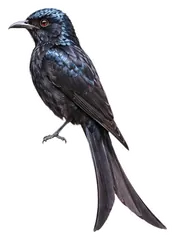 Bronzed DrongoDicrurus aeneus
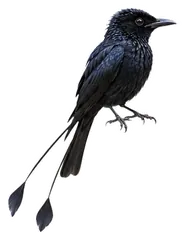 Lesser Racket-tailed DrongoDicrurus remifer
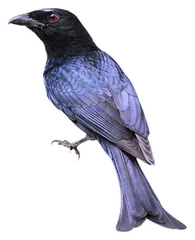 Crow-billed DrongoDicrurus annectens
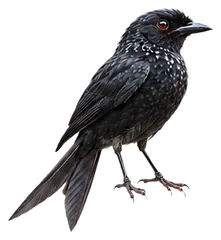 Sri Lanka DrongoDicrurus lophorinus
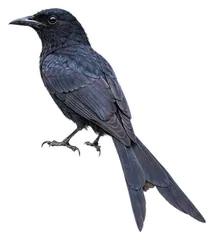 Andaman DrongoDicrurus andamanensis
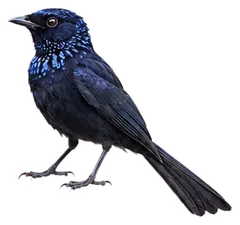 Sumatran DrongoDicrurus sumatranus
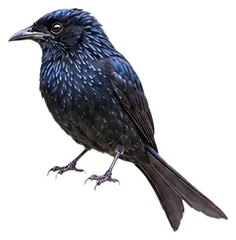 Sulawesi DrongoDicrurus montanus
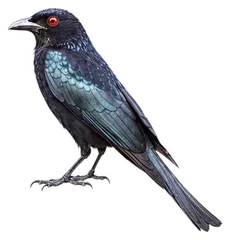 Spangled DrongoDicrurus bracteatus
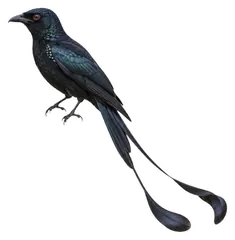 Paradise DrongoDicrurus megarhynchus
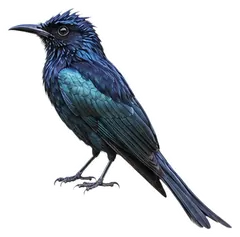 Hair-crested DrongoDicrurus hottentottus
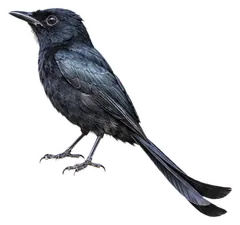 Tablas DrongoDicrurus menagei
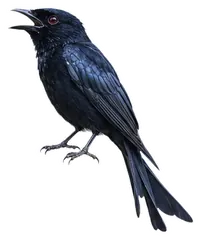 Palawan DrongoDicrurus palawanensis
Download illustration
Free to use with credit: “Illustration: Bird Album (birdalbum.com)”. Drawn by AI from a reference photo by Swardeepak. ↗

Heard it but can't see it? Mingji identifies birds by sound and photo, on your phone.
In other languages
- EnglishGreater Racket-tailed Drongo
- 简体中文大盘尾
- 繁體中文大盤尾
- 日本語カザリオウチュウ
- DeutschFlaggendrongo
- FrançaisDrongo à raquettes
- EspañolDrongo de raquetas grande
- Portuguêsdrongo-de-raquetes-grande
- ItalianoDrongo codaracchetta maggiore
- NederlandsVlaggendrongo
- РусскийРайский дронго
- Svenskastörre vimpeldrongo
- DanskStor Pragtdrongo
- Polskidziwogon rajski