 Bird Album
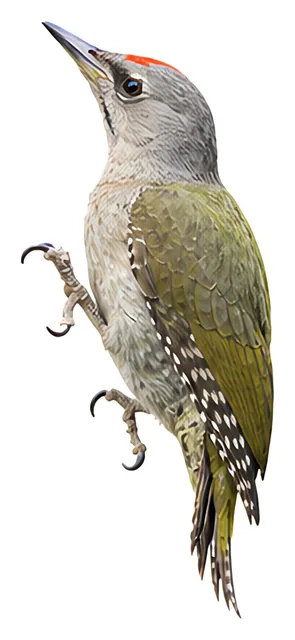
Grey-headed Woodpecker
Picus canus Gmelin, JF, 1788
27–29 cmLength38–40 cmWingspan137 gWeight
This gray-headed, green-bodied woodpecker has a call resembling loud human laughter.
Busiest months: February–May · Most records: China, India, South Korea
How to identify
Field marks
- Male has red from the forehead to the forecrown
- Gray head, black lores and a fine black moustachial stripe
- Gray-green back and wings; pale yellow rump
Male, female and young
The female lacks red on the crown, with fine black streaks instead.
Voice
A loud call closely resembling loud human laughter.
Where and when it's recorded
Busiest months: February–May · Most records: China, India, South Korea

Grey-headed Woodpecker has been recorded at 1,191 of the 8,276 birding hotspots we track, in 46 countries and regions.
Records by month Northern Hemisphere
Where it's recorded most
- Wildlife Institute of IndiaIndia1,542 records
- SattalIndia1,133 records
- Olympic Forest Park SouthChina1,010 records
More places
- Forest Research Institute (FRI), New Forest CampusIndia799 records
- Shahe ReservoirChina748 records
- Olympic Forest ParkChina531 records
- Beijing Botanical GardenChina510 records
- Peking UniversityChina494 records
- Corbett NP – DhikalaIndia490 records
- Wildlife Institute of India (WII) – Nature Trail & LakeIndia451 records
Countries and regions with the most records
eBird records via GBIF up to 2024-12-31. A record means someone listed it; more records partly mean more birders, not more birds.
About
The grey-headed woodpecker (Picus canus), also known as the grey-faced woodpecker, is a Eurasian member of the woodpecker family, Picidae. Along with the more commonly found European green woodpecker and the Iberian green woodpecker, it is one of three closely related species found in Europe. Its distribution also stretches across large parts of the central and Eastern Palaearctic, all the way to the Pacific Ocean and south to the Himalaya and the Malay Peninsula.
Excerpt from Wikipedia, CC BY-SA 4.0 · authors · Read more on Wikipedia
Questions
How big is the Grey-headed Woodpecker?
The Grey-headed Woodpecker is about 27–29 cm long, with a wingspan of 38–40 cm and weighs around 137 g.
Where does the Grey-headed Woodpecker live?
Its breeding range: Palearctic, Oriental: widespread. It is most often recorded in China, India and South Korea.
When is the best time to see the Grey-headed Woodpecker?
At the hotspots we track, it is recorded most in February, March, April and May (Northern Hemisphere).
Is the Grey-headed Woodpecker endangered?
The IUCN Red List classifies the Grey-headed Woodpecker as Least Concern.
What does the Grey-headed Woodpecker eat?
Main food: Insects & other invertebrates.
What family is the Grey-headed Woodpecker in?
It belongs to the family Woodpeckers (Picidae), order Piciformes.
At a glance
- Length
- 27–29 cm
- Wingspan
- 38–40 cm
- Weight
- 137 g
- Habitat
- Forest
- Diet
- Insects & other invertebrates
- Lifestyle
- Perches in trees
- Migration
- Resident (barely migrates)
- Conservation
- Least Concern
More measurements
- Wing
- 143 mm
- Tail
- 103 mm
- Bill
- 39 mm
- Tarsus
- 26 mm
Averages from the AVONET dataset; length from field guides where available.
Range
Palearctic, Oriental: widespread
Breeding range, IOC World Bird List 15.2
Subspecies · 6
- Picus canus jessoensis e Siberia to ne China, Korean Pen. and n Japan
- Picus canus kogo c China
- Picus canus guerini nc, ec China
- Picus canus sobrinus se China and ne Vietnam
- Picus canus tancolo Hainan I. (off se China) and Taiwan (China)
- Picus canus sordidior se Tibet and sw China to ne Myanmar
Classification
- Order
- Piciformes
- Family
- Woodpeckers Picidae
- Genus
- Picus
Other birds in the genus Picus
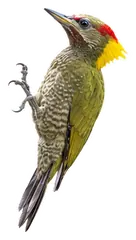 Lesser YellownapePicus chlorolophus
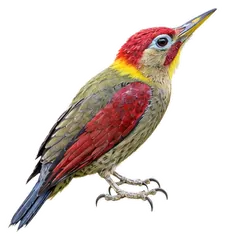 Crimson-winged WoodpeckerPicus puniceus
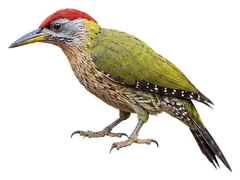 Streak-breasted WoodpeckerPicus viridanus
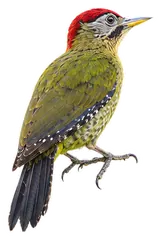 Laced WoodpeckerPicus vittatus
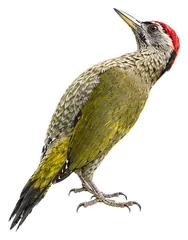 Streak-throated WoodpeckerPicus xanthopygaeus
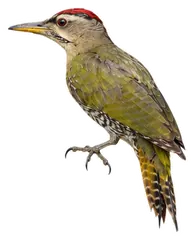 Scaly-bellied WoodpeckerPicus squamatus
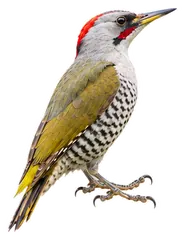 Japanese Green WoodpeckerPicus awokera
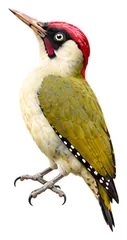 European Green WoodpeckerPicus viridis
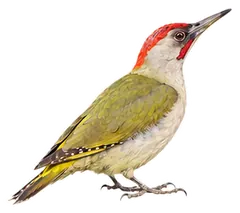 Iberian Green WoodpeckerPicus sharpei
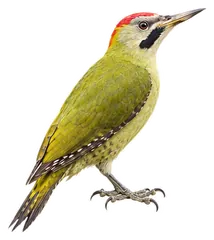 Levaillant's WoodpeckerPicus vaillantii
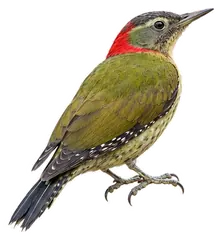 Red-collared WoodpeckerPicus rabieri
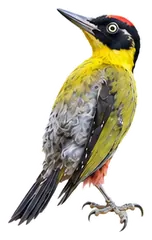 Black-headed WoodpeckerPicus erythropygius
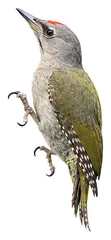
Download illustration
Free to use with credit: “Illustration: Bird Album (birdalbum.com)”. Drawn by AI from a reference photo by Dion Art. ↗

Heard it but can't see it? Mingji identifies birds by sound and photo, on your phone.