 Bird Album
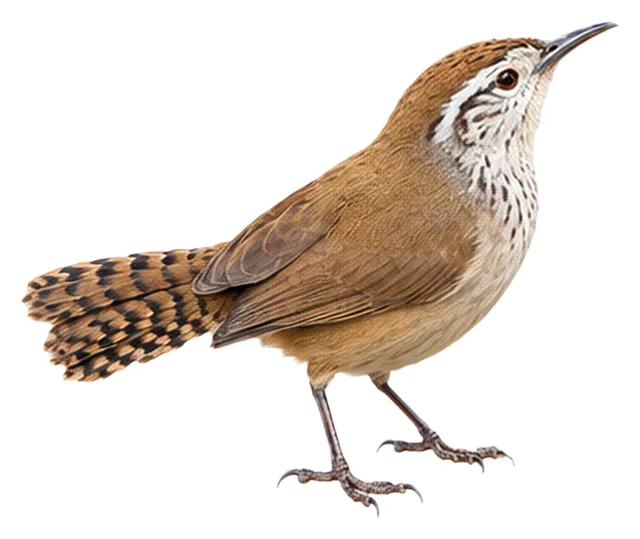
Happy Wren
Pheugopedius felix (Sclater, PL, 1860)
12–14 cmLength13 gWeight
The happy wren (Pheugopedius felix) is a species of bird in the family Troglodytidae.
Busiest months: January · Most records: Mexico
Where and when it's recorded
Busiest months: January · Most records: Mexico

Happy Wren has been recorded at 16 of the 8,276 birding hotspots we track, in 1 country or region.
Records by month Northern Hemisphere
Where it's recorded most
- Rancho PrimaveraMexico1,360 records
- ChacalillaMexico609 records
- Camino SingaytaMexico520 records
More places
- TecuitataMexico485 records
- Rio PitillalMexico430 records
- Jardín Botánico VallartaMexico348 records
- Playa YelapaMexico292 records
- Reserva Ecológica Sierra de San Juan – La NoriaMexico284 records
- Rio La TovaraMexico218 records
- Granja de Camarón ChacalillaMexico171 records
Countries and regions with the most records
eBird records via GBIF up to 2024-12-31. A record means someone listed it; more records partly mean more birders, not more birds.
About
The happy wren (Pheugopedius felix) is a species of bird in the family Troglodytidae. It is endemic to the Pacific slope of western Mexico, from the state of Sonora to the state of Oaxaca, and also on islands west of the Mexican coast. As with other species of Pheugopedius, older sources (e.g.
Excerpt from Wikipedia, CC BY-SA 4.0 · authors · Read more on Wikipedia
Questions
How big is the Happy Wren?
The Happy Wren is about 12–14 cm long and weighs around 13 g.
Where does the Happy Wren live?
Its breeding range: Middle America: Mexico. It is most often recorded in Mexico.
When is the best time to see the Happy Wren?
At the hotspots we track, it is recorded most in January (Northern Hemisphere).
Is the Happy Wren endangered?
The IUCN Red List classifies the Happy Wren as Least Concern.
What does the Happy Wren eat?
Main food: Insects & other invertebrates.
What family is the Happy Wren in?
It belongs to the family Wrens (Troglodytidae), order Passerines (Passeriformes).
At a glance
- Length
- 12–14 cm
- Weight
- 13 g
- Habitat
- Woodland
- Diet
- Insects & other invertebrates
- Lifestyle
- Perches in trees
- Migration
- Resident (barely migrates)
- Conservation
- Least Concern
More measurements
- Wing
- 57 mm
- Tail
- 56 mm
- Bill
- 17 mm
- Tarsus
- 21 mm
Averages from the AVONET dataset; length from field guides where available.
Range
Middle America: Mexico
Breeding range, IOC World Bird List 15.2
Classification
- Order
- Passerines Passeriformes
- Family
- Wrens Troglodytidae
- Genus
- Pheugopedius
Other birds in the genus Pheugopedius
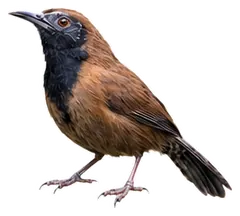 Black-throated WrenPheugopedius atrogularis
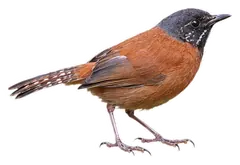 Sooty-headed WrenPheugopedius spadix
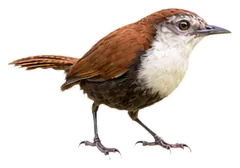 Black-bellied WrenPheugopedius fasciatoventris
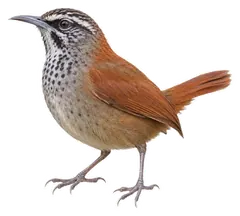 Plain-tailed WrenPheugopedius euophrys
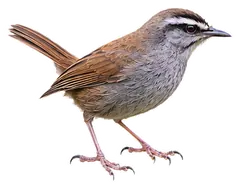 Grey-browed WrenPheugopedius schulenbergi
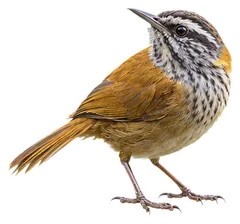 Inca WrenPheugopedius eisenmanni
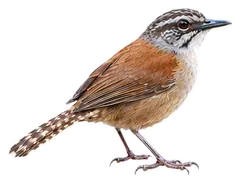 Moustached WrenPheugopedius genibarbis
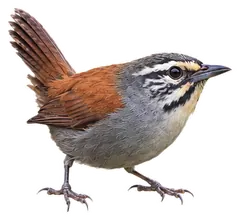 Whiskered WrenPheugopedius mystacalis
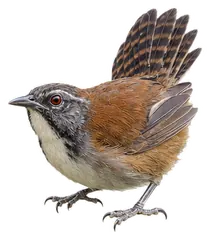 Coraya WrenPheugopedius coraya
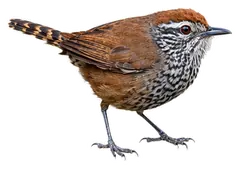 Spot-breasted WrenPheugopedius maculipectus
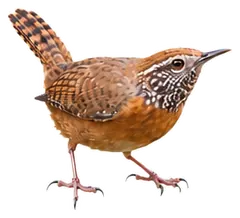 Rufous-breasted WrenPheugopedius rutilus
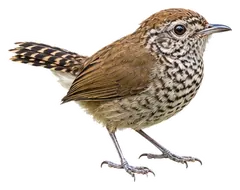 Speckle-breasted WrenPheugopedius sclateri
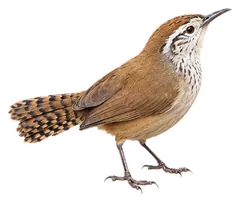
Download illustration
Free to use with credit: “Illustration: Bird Album (birdalbum.com)”. Drawn by AI from a reference photo by Max Jackson. ↗
Heard it but can't see it? Mingji identifies birds by sound and photo, on your phone.