 Bird Album
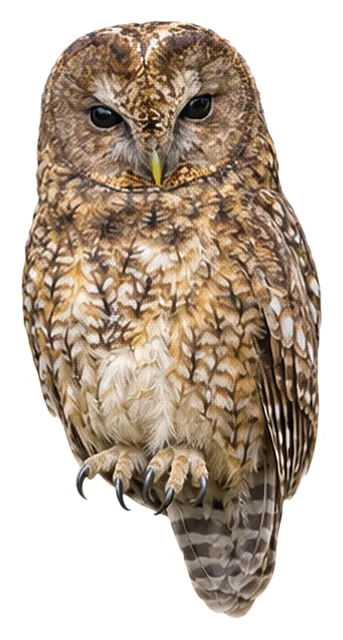
Himalayan Owl
Strix nivicolum (Blyth, 1845)
≈47 cmLength472 gWeight
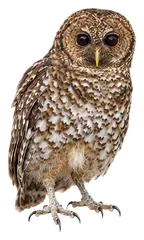
This medium-sized, warm rufous owl is active at night and has a round head without ear tufts.
Busiest months: May–June · Most records: China, Bhutan, Nepal
Looks like Tawny Owl
How to identify
Field marks
- Head round, without ear tufts, dark brown with pale markings
- Small yellow hooked bill at the center of the paler facial disc
- Breast pale brown with white and dark brown streaks
- Wings and tail darker, with white bands
Male, female and young
Sexes similar and indistinguishable in appearance; juvenile has fine white barring on the dark areas of the crown.
Voice
The song is a quick, dove-like “coo-coo” consisting of two notes; the call is a single high, loud “whoo”.
Similar species
Where and when it's recorded
Busiest months: May–June · Most records: China, Bhutan, Nepal

Himalayan Owl has been recorded at 100 of the 8,276 birding hotspots we track, in 5 countries and regions.
Records by month Northern Hemisphere
Where it's recorded most
- Beijing Botanical GardenChina76 records
- Wuling Mountain NNRChina46 records
- Longcanggou [General Area]China46 records
More places
- Sengor – camp and upper Lingmethan RdBhutan44 records
- Wawu Mountain – Upper LevelChina44 records
- Dalaoling National Forest ParkChina30 records
- Xiaolongmen National Forest ParkChina27 records
- Lingshan Scenic AreaChina20 records
- Baihualing [General Area]China20 records
- Kunming Botanical GardenChina18 records
Countries and regions with the most records
eBird records via GBIF up to 2024-12-31. A record means someone listed it; more records partly mean more birders, not more birds.
About
The Himalayan owl or Himalayan wood owl (Strix nivicolum) is a medium-sized owl native to the forests and mountain ranges of the Himalayas, Taiwan (China) and Korea. Although populations are declining, this owl is not considered endangered and is currently listed as a species of Least Concern on the IUCN Red List due to its large range and slow decline. The Himalayan owl is nocturnal and is rarely seen in most areas of its range.
Excerpt from Wikipedia, CC BY-SA 4.0 · authors · Read more on Wikipedia
Questions
How big is the Himalayan Owl?
The Himalayan Owl is about ≈47 cm long and weighs around 472 g.
Where does the Himalayan Owl live?
Its breeding range: Palearctic, Oriental: Himalayas to East Asia. It is most often recorded in China, Bhutan and Nepal.
When is the best time to see the Himalayan Owl?
At the hotspots we track, it is recorded most in May and June (Northern Hemisphere).
Is the Himalayan Owl endangered?
The IUCN Red List classifies the Himalayan Owl as Least Concern.
What does the Himalayan Owl eat?
Main food: Vertebrate prey.
What family is the Himalayan Owl in?
It belongs to the family Owls (Strigidae), order Strigiformes.
At a glance
- Length
- ≈47 cm
- Weight
- 472 g
- Habitat
- Forest
- Diet
- Vertebrate prey
- Lifestyle
- Perches in trees
- Migration
- Resident (barely migrates)
- Conservation
- Least Concern
More measurements
- Wing
- 292 mm
- Tail
- 163 mm
- Bill
- 33 mm
- Tarsus
- 54 mm
Averages from the AVONET dataset; length from field guides where available.
Range
Palearctic, Oriental: Himalayas to East Asia
Breeding range, IOC World Bird List 15.2
Subspecies · 3
- Strix nivicolum nivicolum ne India and Nepal to se China, Myanmar and Vietnam
- Strix nivicolum yamadae s Taiwan (China)
- Strix nivicolum ma ne China and Korean Pen.
Classification
- Order
- Strigiformes
- Family
- Owls Strigidae
- Genus
- Strix
Other birds in the genus Strix
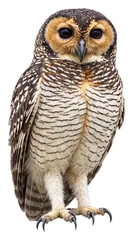 Spotted Wood OwlStrix seloputo
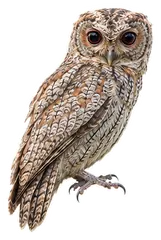 Mottled Wood OwlStrix ocellata
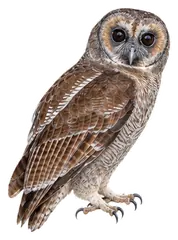 Brown Wood OwlStrix leptogrammica
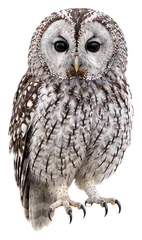 Tawny OwlStrix aluco
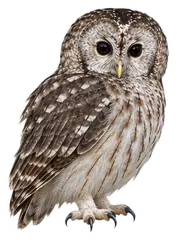 Maghreb OwlStrix mauritanica
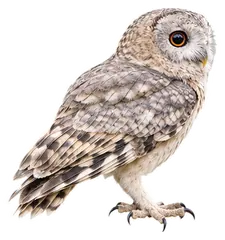 Desert OwlStrix hadorami
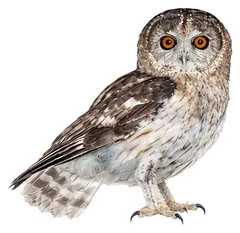 Omani OwlStrix butleri
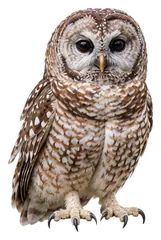 Spotted OwlStrix occidentalis
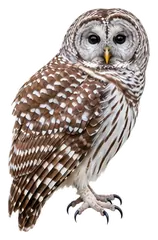 Barred OwlStrix varia
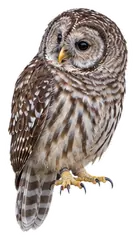 Cinereous OwlStrix sartorii
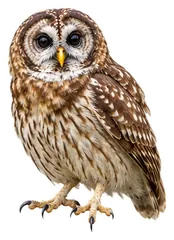 Fulvous OwlStrix fulvescens
 Rusty-barred OwlStrix hylophila
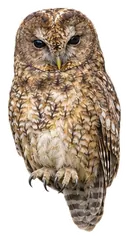
Download illustration
Free to use with credit: “Illustration: Bird Album (birdalbum.com)”. Drawn by AI from a reference photo by Mousam ray. ↗

Heard it but can't see it? Mingji identifies birds by sound and photo, on your phone.