 Bird Album
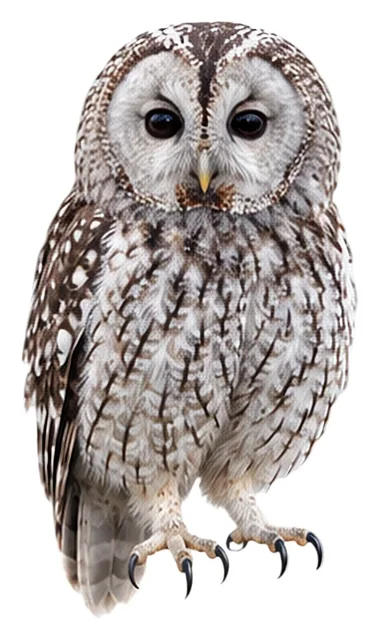
Tawny Owl
Strix aluco Linnaeus, 1758
37–43 cmLength99 cmWingspan472 gWeight
It has a large, round head without ear tufts and flies almost silently through the night.
Busiest months: January, April–May and September–October · Most records: United Kingdom, Spain, Germany
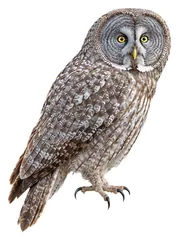
Looks like Great Grey Owl
How to identify
Field marks
- Head large and round, without ear tufts
- Eyes dark brown
- Nominate subspecies has color morphs with reddish-brown or gray-brown upperparts
- Nominate subspecies has white underparts with brown markings
Male, female and young
Female larger and heavier than male.
Voice
The female gives a shrill “kew-wick” and the male replies with “hooo”, as if in a duet.
Similar species
Where and when it's recorded

Tawny Owl has been recorded at 530 of the 8,171 birding hotspots we track, in 51 countries and regions.
Records by month Northern Hemisphere
Where it's recorded most
- Parque El Retiro-MadridSpain735 records
- Leutratal und CospothGermany540 records
- Peak District NP – Underhill Farm, ElkstoneUnited Kingdom528 records
More places
- Stodmarsh NNRUnited Kingdom278 records
- Titchwell Marsh RSPB ReserveUnited Kingdom256 records
- Amwell HMWT NRUnited Kingdom243 records
- Minsmere RSPB ReserveUnited Kingdom206 records
- RN Estuário do Tejo – Monte de PancasPortugal197 records
- Osowiec FortressPoland192 records
- Elton ReservoirUnited Kingdom170 records
Countries and regions with the most records
eBird records via GBIF up to 2024-12-31. A record means someone listed it; more records partly mean more birders, not more birds.
About
The tawny owl (Strix aluco), also called the brown owl, is a stocky, medium-sized owl in the family Strigidae. It is commonly found in woodlands across Europe, as well as western Siberia, and has seven recognized subspecies. The tawny owl typically makes its nest in a tree hole where it can protect its eggs and young against potential predators.
Excerpt from Wikipedia, CC BY-SA 4.0 · authors · Read more on Wikipedia
Questions
How big is the Tawny Owl?
The Tawny Owl is about 37–43 cm long, with a wingspan of 99 cm and weighs around 472 g.
Where does the Tawny Owl live?
Its breeding range: Palearctic: western Eurasia. It is most often recorded in United Kingdom, Spain and Germany.
When is the best time to see the Tawny Owl?
At the hotspots we track, it is recorded most in January, April, May, September and October (Northern Hemisphere).
Is the Tawny Owl endangered?
The IUCN Red List classifies the Tawny Owl as Least Concern.
What does the Tawny Owl eat?
Main food: Vertebrate prey.
What family is the Tawny Owl in?
It belongs to the family Owls (Strigidae), order Strigiformes.
At a glance
- Length
- 37–43 cm
- Wingspan
- 99 cm
- Weight
- 472 g
- Habitat
- Forest
- Diet
- Vertebrate prey
- Lifestyle
- Perches in trees
- Migration
- Resident (barely migrates)
- Conservation
- Least Concern
More measurements
- Wing
- 265 mm
- Tail
- 171 mm
- Bill
- 30 mm
- Tarsus
- 46 mm
Averages from the AVONET dataset; length from field guides where available.
Range
Palearctic: western Eurasia
Breeding range, IOC World Bird List 15.2
Classification
- Order
- Strigiformes
- Family
- Owls Strigidae
- Genus
- Strix
Other birds in the genus Strix
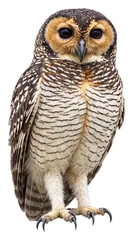 Spotted Wood OwlStrix seloputo
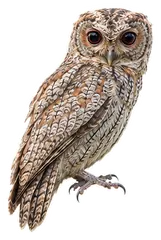 Mottled Wood OwlStrix ocellata
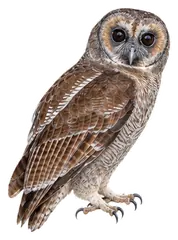 Brown Wood OwlStrix leptogrammica
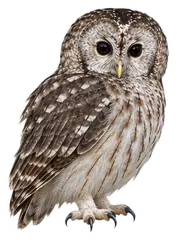 Maghreb OwlStrix mauritanica
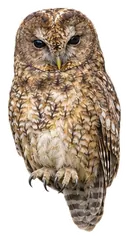 Himalayan OwlStrix nivicolum
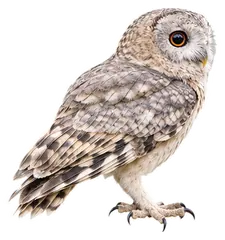 Desert OwlStrix hadorami
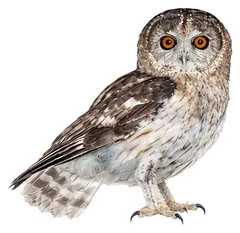 Omani OwlStrix butleri
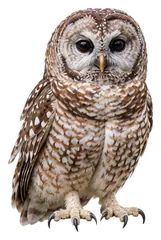 Spotted OwlStrix occidentalis
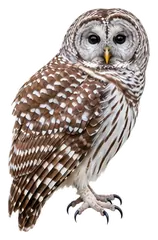 Barred OwlStrix varia
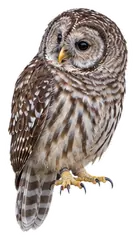 Cinereous OwlStrix sartorii
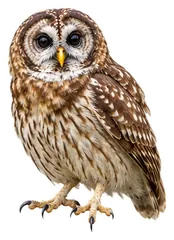 Fulvous OwlStrix fulvescens
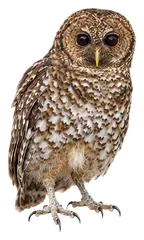 Rusty-barred OwlStrix hylophila
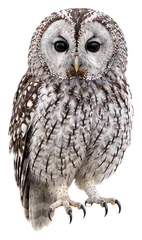
Download illustration
Free to use with credit: “Illustration: Bird Album (birdalbum.com)”. Drawn by AI from a reference photo by J. Alfonso Diéguez Millán 👀. ↗
Heard it but can't see it? Mingji identifies birds by sound and photo, on your phone.