 Bird Album
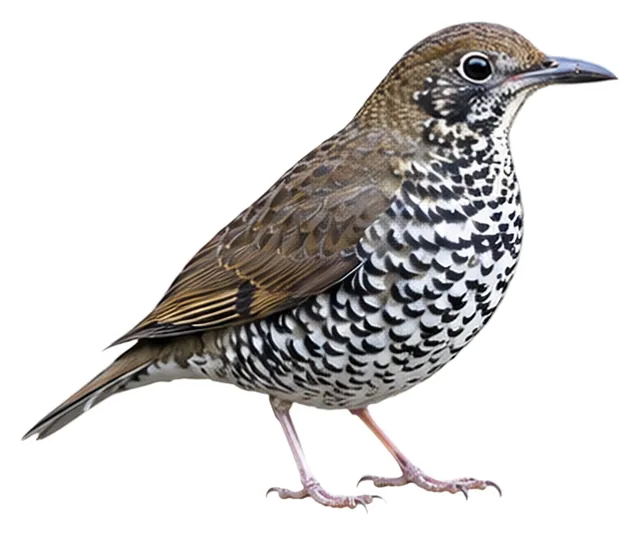
Himalayan Thrush
Zoothera salimalii Alström, Rasmussen, Zhao J, Xu J, Dalvi, Cai T, Guan Y, Zhang R, Kalyakin, Lei F & Olsson, 2016
≈26 cmLength98 gWeight
It breeds in forest and has a more melodious call than its close relatives.
Busiest months: February · Most records: China, Bhutan, Thailand
Looks like Alpine Thrush
How to identify
Voice
The call is rather melodious, unlike the harsh, grating calls of its close relatives.
Similar species
Where and when it's recorded
Busiest months: February · Most records: China, Bhutan, Thailand

Himalayan Thrush has been recorded at 30 of the 8,276 birding hotspots we track, in 3 countries and regions.
Records by month Northern Hemisphere
Where it's recorded most
- Baihualing [General Area]China32 records
- Dulong River ValleyChina13 records
- ChelelaBhutan5 records
More places
- Baihualing – Jiujiezi SaddleChina5 records
- Punakha DzongBhutan4 records
- Dochula – Royal Botanical ParkBhutan3 records
- Gaoligongshan Nature Park at NankangChina3 records
- Cheri ValleyBhutan2 records
- Punakha – Puna Tsang ChuBhutan2 records
- Jigme Dorji NP – Cheri valleyBhutan2 records
Countries and regions with the most records
eBird records via GBIF up to 2024-12-31. A record means someone listed it; more records partly mean more birders, not more birds.
About
The Himalayan thrush or Himalayan forest thrush (Zoothera salimalii) is a species of bird described in 2016 and separated out from the alpine thrush Zoothera mollissima with which they were formerly lumped. The species is separated on the basis of phylogenetic studies that suggest that the population diverged from the common ancestor at least 3 million years ago (estimates vary from 3-6 mya). The alpine thrush (Zoothera mollissima in the restricted sense) breeds above the tree line whereas the Himalayan thrush breeds in forested habitats.
Excerpt from Wikipedia, CC BY-SA 4.0 · authors · Read more on Wikipedia
Questions
How big is the Himalayan Thrush?
The Himalayan Thrush is about ≈26 cm long and weighs around 98 g.
Where does the Himalayan Thrush live?
Its breeding range: Oriental: northeastern India (West Bengal, Arunachal Pradesh) to southern China (Yunnan). It is most often recorded in China, Bhutan and Thailand.
When is the best time to see the Himalayan Thrush?
At the hotspots we track, it is recorded most in February (Northern Hemisphere).
Is the Himalayan Thrush endangered?
The IUCN Red List classifies the Himalayan Thrush as Least Concern.
What does the Himalayan Thrush eat?
Main food: Insects & other invertebrates.
What family is the Himalayan Thrush in?
It belongs to the family Thrushes (Turdidae), order Passerines (Passeriformes).
At a glance
- Length
- ≈26 cm
- Weight
- 98 g
- Habitat
- Shrubland
- Diet
- Insects & other invertebrates
- Lifestyle
- Active on the ground
- Migration
- Resident (barely migrates)
- Conservation
- Least Concern
More measurements
- Wing
- 138 mm
- Tail
- 96 mm
- Bill
- 25 mm
- Tarsus
- 36 mm
Averages from the AVONET dataset; length from field guides where available.
Range
Oriental: northeastern India (West Bengal, Arunachal Pradesh) to southern China (Yunnan)
Breeding range, IOC World Bird List 15.2
Classification
- Order
- Passerines Passeriformes
- Family
- Thrushes Turdidae
- Genus
- Zoothera
Other birds in the genus Zoothera
 Long-tailed ThrushZoothera dixoni
 Alpine ThrushZoothera mollissima
 Sichuan ThrushZoothera griseiceps
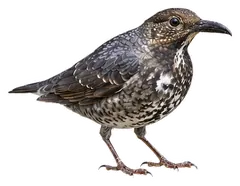 Long-billed ThrushZoothera monticola
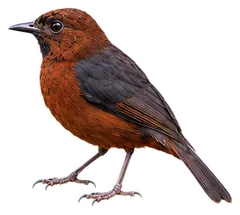 GeomaliaZoothera heinrichi
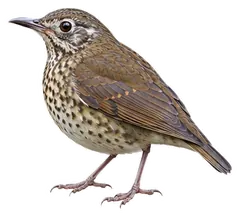 Dark-sided ThrushZoothera marginata
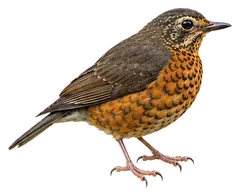 Everett's ThrushZoothera everetti
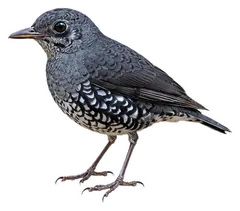 Sunda ThrushZoothera andromedae
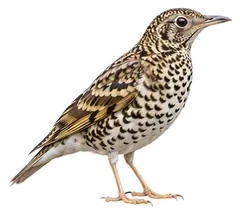 White's ThrushZoothera aurea
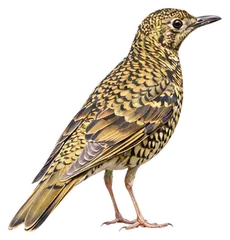 Scaly ThrushZoothera dauma
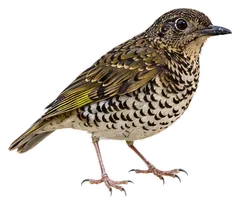 Nilgiri ThrushZoothera neilgherriensis
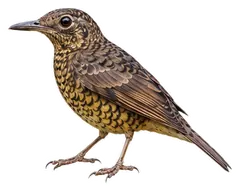 Sri Lanka ThrushZoothera imbricata
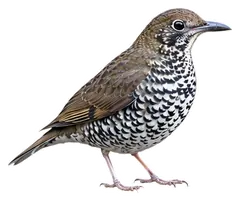
Download illustration
Free to use with credit: “Illustration: Bird Album (birdalbum.com)”. Drawn by AI from a reference photo by ZhenningLiu. ↗
Heard it but can't see it? Mingji identifies birds by sound and photo, on your phone.