 Bird Album
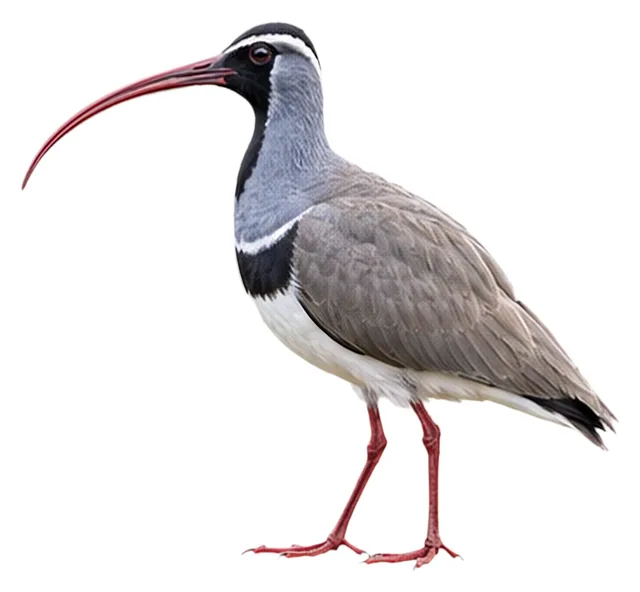
Ibisbill
Ibidorhyncha struthersii Vigors, 1832
38–41 cmLength74 cmWingspan294 gWeight
This bird in the order Charadriiformes is the sole species in its family worldwide.
Busiest months: April · Most records: Bhutan, China, Kazakhstan
How to identify
Where and when it's recorded

Ibisbill has been recorded at 96 of the 8,171 birding hotspots we track, in 6 countries and regions.
Records by month Northern Hemisphere
Where it's recorded most
- Thimpu Sewage LagoonsBhutan153 records
- Paro to ThimphuBhutan150 records
- Ile Alatau NP – Big Almaty LakeKazakhstan145 records
More places
- Nameri National Park & SurroundingsIndia99 records
- Bumthang – JakarBhutan97 records
- JilakouChina39 records
- Punakha DzongBhutan37 records
- JieguChina37 records
- Punakha – Puna Tsang ChuBhutan36 records
- Corbett NPIndia36 records
Countries and regions with the most records
eBird records via GBIF up to 2024-12-31. A record means someone listed it; more records partly mean more birders, not more birds.
About
The ibisbill (Ibidorhyncha struthersii) is a bird related to the waders, but sufficiently distinctive to merit its own family Ibidorhynchidae. It occurs on the shingle riverbanks of the high plateaux of central Asia and the Himalayas.
Excerpt from Wikipedia, CC BY-SA 4.0 · authors · Read more on Wikipedia
Questions
How big is the Ibisbill?
The Ibisbill is about 38–41 cm long, with a wingspan of 74 cm and weighs around 294 g.
Where does the Ibisbill live?
Its breeding range: Palearctic: rivers of western Tajikistan, southeastern Kazakhstan, northwestern Xinjiang (northwestern China) and northeastern Afghanistan through Himalayas and Tibetan Plateau to Qinghai, Gansu, eastern Inner Mongolia, Hebei and north of Beijing (northeastern China). It is most often recorded in Bhutan, China and Kazakhstan.
When is the best time to see the Ibisbill?
At the hotspots we track, it is recorded most in April (Northern Hemisphere).
Is the Ibisbill endangered?
The IUCN Red List classifies the Ibisbill as Least Concern.
What does the Ibisbill eat?
Main food: Fish, shrimp & shellfish.
What family is the Ibisbill in?
It belongs to the family Ibisbill (Ibidorhynchidae), order Charadriiformes.
At a glance
- Length
- 38–41 cm
- Wingspan
- 74 cm
- Weight
- 294 g
- Habitat
- Rivers & streams
- Diet
- Fish, shrimp & shellfish
- Lifestyle
- Active on the ground
- Migration
- Partial migrant
- Conservation
- Least Concern
More measurements
- Wing
- 231 mm
- Tail
- 112 mm
- Bill
- 79 mm
- Tarsus
- 46 mm
Averages from the AVONET dataset; length from field guides where available.
Range
Palearctic: rivers of western Tajikistan, southeastern Kazakhstan, northwestern Xinjiang (northwestern China) and northeastern Afghanistan through Himalayas and Tibetan Plateau to Qinghai, Gansu, eastern Inner Mongolia, Hebei and north of Beijing (northeastern China)
Breeding range, IOC World Bird List 15.2
Classification
- Order
- Charadriiformes
- Family
- Ibisbill Ibidorhynchidae
- Genus
- Ibidorhyncha
Download illustration
Free to use with credit: “Illustration: Bird Album (birdalbum.com)”. Drawn by AI from a reference photo by Dr. Raju Kasambe. ↗

Heard it but can't see it? Mingji identifies birds by sound and photo, on your phone.