 Bird Album
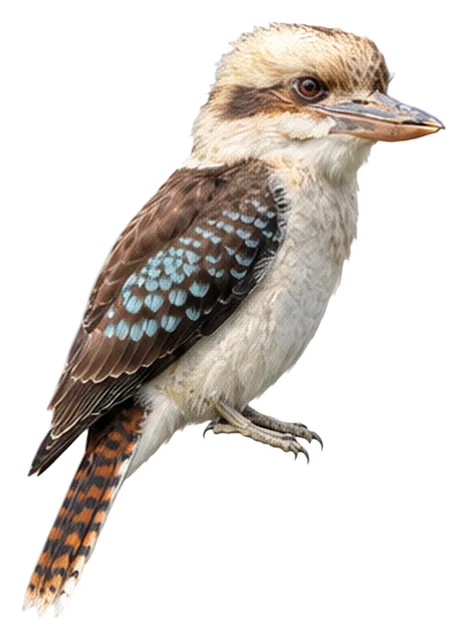
Laughing Kookaburra
Dacelo novaeguineae (Hermann, 1783)
≈47 cmLength334 gWeight
It is a large kingfisher whose call resembles a person laughing wildly.
Busiest months: January and August–November · Most records: Australia, New Zealand
How to identify
Field marks
- Head large; bill thick and long, with black upper mandible and pale lower mandible
- Head and body white or cream; eyestripe dark brown
- Wings and back brown; sky-blue spots on scapulars
- Tail rusty-orange, with dark brown barring
Male, female and young
Sexes very similar; female is usually larger and has less blue on the rump than male.
Voice
Like laughter: starts with low hiccups, building into loud laughter; several birds often join in, most often at dawn and dusk.
Where and when it's recorded

Laughing Kookaburra has been recorded at 202 of the 8,171 birding hotspots we track, in 2 countries and regions.
Records by month Southern Hemisphere
Where it's recorded most
- Oxley Creek CommonAustralia4,189 records
- Sandy Camp Road WetlandsAustralia3,423 records
- Centennial ParkAustralia3,014 records
More places
- Banyule Flats ReserveAustralia2,348 records
- Lake Samsonvale – Golds Scrub LaneAustralia2,259 records
- Gold Creek ReservoirAustralia2,156 records
- Coachwood ParkAustralia2,029 records
- Dowse LagoonAustralia1,837 records
- Shepherds BushAustralia1,824 records
- Kumbartcho SanctuaryAustralia1,808 records
Countries and regions with the most records
eBird records via GBIF up to 2024-12-31. A record means someone listed it; more records partly mean more birders, not more birds.
About
The laughing kookaburra (Dacelo novaeguineae) is a bird in the kingfisher subfamily Halcyoninae. The territorial call is a distinctive laugh that is often delivered by several birds at the same time, and is widely used as a stock sound effect in situations that involve a jungle setting.
Excerpt from Wikipedia, CC BY-SA 4.0 · authors · Read more on Wikipedia
Questions
How big is the Laughing Kookaburra?
The Laughing Kookaburra is about ≈47 cm long and weighs around 334 g.
Where does the Laughing Kookaburra live?
Its breeding range: Australasia: southwestern, eastern Australia. It is most often recorded in Australia and New Zealand.
When is the best time to see the Laughing Kookaburra?
At the hotspots we track, it is recorded most in January, August, September, October and November (Southern Hemisphere).
Is the Laughing Kookaburra endangered?
The IUCN Red List classifies the Laughing Kookaburra as Least Concern.
What does the Laughing Kookaburra eat?
Main food: Omnivore.
What family is the Laughing Kookaburra in?
It belongs to the family Kingfishers (Alcedinidae), order Coraciiformes.
At a glance
- Length
- ≈47 cm
- Weight
- 334 g
- Habitat
- Forest
- Diet
- Omnivore
- Lifestyle
- Perches in trees
- Migration
- Resident (barely migrates)
- Conservation
- Least Concern
More measurements
- Wing
- 216 mm
- Tail
- 153 mm
- Bill
- 69 mm
- Tarsus
- 27 mm
Averages from the AVONET dataset; length from field guides where available.
Range
Australasia: southwestern, eastern Australia
Breeding range, IOC World Bird List 15.2
Classification
- Order
- Coraciiformes
- Family
- Kingfishers Alcedinidae
- Genus
- Dacelo
Other birds in the genus Dacelo
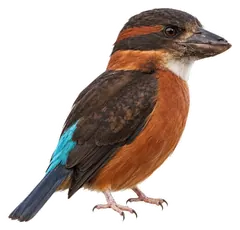 Shovel-billed KookaburraDacelo rex
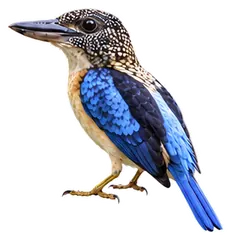 Spangled KookaburraDacelo tyro
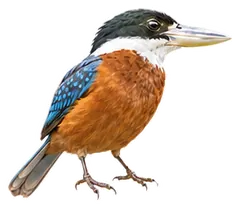 Rufous-bellied KookaburraDacelo gaudichaud
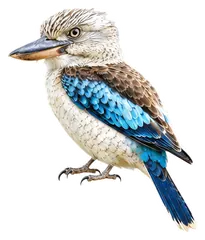 Blue-winged KookaburraDacelo leachii
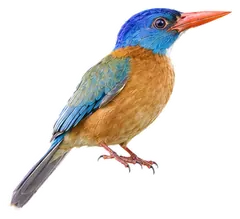 Green-backed KingfisherActenoides monachus
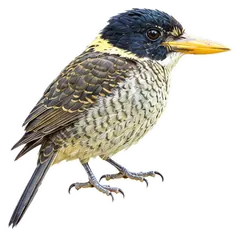 Scaly-breasted KingfisherActenoides princeps
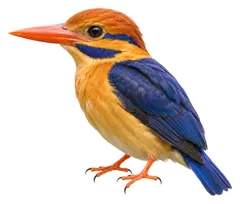 Moustached KingfisherActenoides bougainvillei
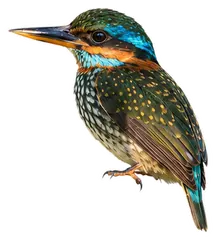 Spotted Wood KingfisherActenoides lindsayi
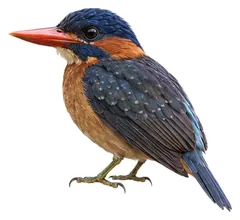 Blue-capped KingfisherActenoides hombroni
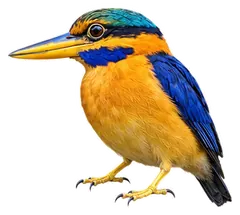 Rufous-collared KingfisherActenoides concretus
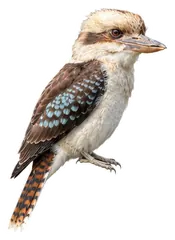
Download illustration
Free to use with credit: “Illustration: Bird Album (birdalbum.com)”. Drawn by AI from a reference photo by Emanuele Santarelli. ↗
Heard it but can't see it? Mingji identifies birds by sound and photo, on your phone.