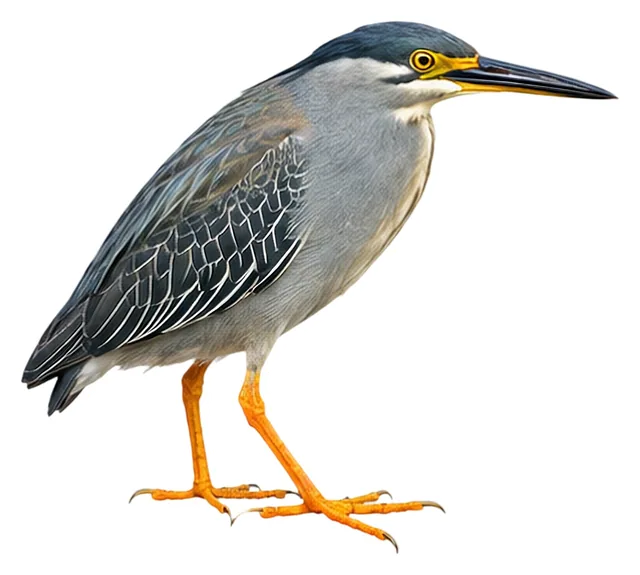
Little Heron
Butorides atricapilla (Afzelius, 1804)
35–48 cmLength55 cmWingspan
It is a black-crowned, gray-backed, short-necked heron that often stands motionless by the water to ambush prey.
How to identify
Field marks
- A tuft of long black feathers on the crown
- Gray-green feathers; paler belly
- Dark line from the base of the bill to below the eye
- Black bill; pale yellow to orange legs
Male, female and young
The sexes differ little; juveniles are paler, with a dark brown back, white patches on the wings, and a rufous neck and breast with white stripes.
Where and when it's recorded
No records at the public birding hotspots we track. It may be rare, remote, or its locations protected.
About
The little heron (Butorides atricapilla) is a small heron, about 44 cm tall. It is mostly sedentary and frequents both fresh and salt water habitats. It is found in the Old World tropics from west Africa to Japan and Australia.
Excerpt from Wikipedia, CC BY-SA 4.0 · authors · Read more on Wikipedia
Questions
How big is the Little Heron?
The Little Heron is about 35–48 cm long, with a wingspan of 55 cm.
Where does the Little Heron live?
Its breeding range: Palearctic, Africa, Australasia: widespread.
What family is the Little Heron in?
It belongs to the family Herons, Bitterns (Ardeidae), order Pelecaniformes.
At a glance
- Length
- 35–48 cm
- Wingspan
- 55 cm
Range
Palearctic, Africa, Australasia: widespread
Breeding range, IOC World Bird List 15.2
Subspecies · 2
- Butorides atricapilla amurensis se Siberia, ne China and Japan
- Butorides atricapilla actophila e China to n Myanmar and n Vietnam
Classification
- Order
- Pelecaniformes
- Family
- Herons, Bitterns Ardeidae
- Genus
- Butorides
Other birds in the genus Butorides
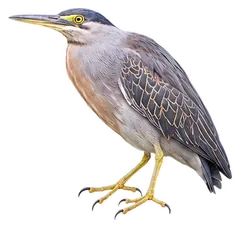 Striated HeronButorides striata
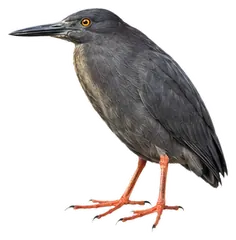 Lava HeronButorides sundevalli
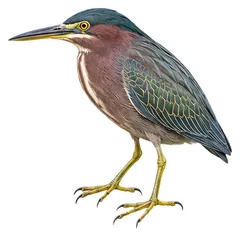 Green HeronButorides virescens
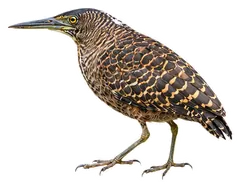 White-crested Tiger HeronTigriornis leucolopha
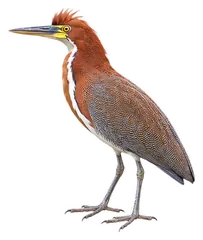 Rufescent Tiger HeronTigrisoma lineatum
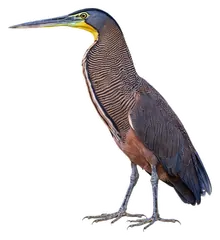 Bare-throated Tiger HeronTigrisoma mexicanum
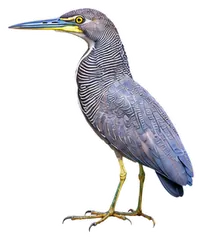 Fasciated Tiger HeronTigrisoma fasciatum
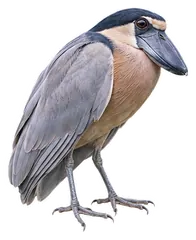 Boat-billed HeronCochlearius cochlearius
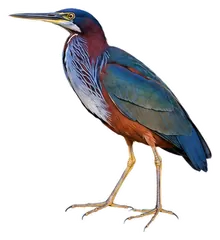 Agami HeronAgamia agami
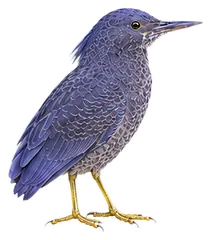 Zigzag HeronZebrilus undulatus
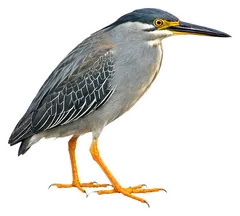
Download illustration
Free to use with credit: “Illustration: Bird Album (birdalbum.com)”. Drawn by AI from a reference photo by Bernard DUPONT. ↗

Heard it but can't see it? Mingji identifies birds by sound and photo, on your phone.