 Bird Album
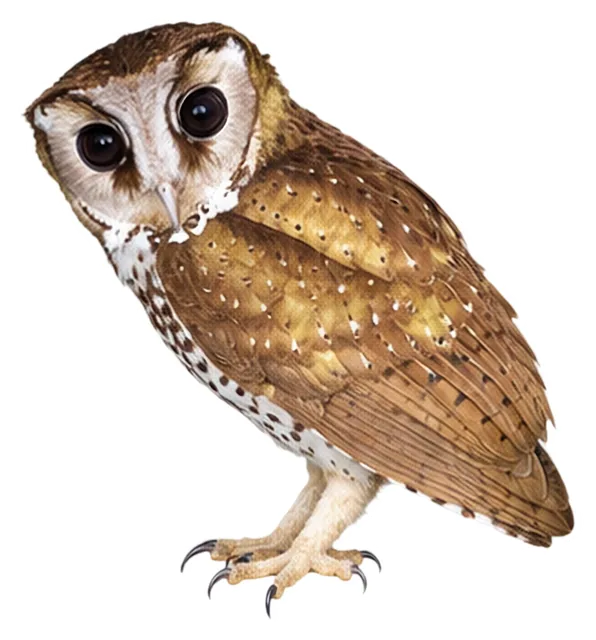
Oriental Bay Owl
Phodilus badius (Horsfield, 1821)
≈34 cmLength280 gWeight
Its heart-shaped face has ear-like projections at the sides.
Busiest months: February–March and July · Most records: Malaysia, Thailand, India
How to identify
Field marks
- Face heart-shaped, with ear-like projections at the sides
- Crown and upperparts dark chestnut
- Underparts creamy-white to pale yellowish-brown
- Eyes large and black
Male, female and young
Female usually larger than male.
Voice
The song usually consists of four to seven mournful whistles, rising slightly in pitch at the end.
Where and when it's recorded
Busiest months: February–March and July · Most records: Malaysia, Thailand, India

Oriental Bay Owl has been recorded at 103 of the 8,276 birding hotspots we track, in 7 countries and regions.
Records by month Northern Hemisphere
Where it's recorded most
- Sepilok – Rainforest Discovery CenterMalaysia121 records
- Kinabatangan River – SukauMalaysia83 records
- Khao Pra – Bang Khram Wildlife Sanctuary / Khao Nor Chu ChiThailand70 records
More places
- Dihing Patkai NP – SoraipungIndia63 records
- Dihing Patkai NP – SoraipungIndia59 records
- Kinabatangan Wildlife SanctuaryMalaysia51 records
- Kaeng Krachan NP – Baan Maka Nature LodgeThailand49 records
- OkokiCambodia47 records
- Kinabatangan River – Sukau Rainforest LodgeMalaysia46 records
- San Kala Khiri NP – headquartersThailand45 records
Countries and regions with the most records
eBird records via GBIF up to 2024-12-31. A record means someone listed it; more records partly mean more birders, not more birds.
About
The Oriental bay owl (Phodilus badius) is a species of bay owl. It is completely nocturnal, and can be found throughout Southeast Asia and parts of India. It has several subspecies.
Excerpt from Wikipedia, CC BY-SA 4.0 · authors · Read more on Wikipedia
Questions
How big is the Oriental Bay Owl?
The Oriental Bay Owl is about ≈34 cm long and weighs around 280 g.
Where does the Oriental Bay Owl live?
Its breeding range: Oriental: Southeast Asia to Borneo and Java. It is most often recorded in Malaysia, Thailand and India.
When is the best time to see the Oriental Bay Owl?
At the hotspots we track, it is recorded most in February, March and July (Northern Hemisphere).
Is the Oriental Bay Owl endangered?
The IUCN Red List classifies the Oriental Bay Owl as Least Concern.
What does the Oriental Bay Owl eat?
Main food: Vertebrate prey.
What family is the Oriental Bay Owl in?
It belongs to the family Barn Owls (Tytonidae), order Strigiformes.
At a glance
- Length
- ≈34 cm
- Weight
- 280 g
- Habitat
- Forest
- Diet
- Vertebrate prey
- Lifestyle
- Perches in trees
- Migration
- Resident (barely migrates)
- Conservation
- Least Concern
More measurements
- Wing
- 191 mm
- Tail
- 80 mm
- Bill
- 35 mm
- Tarsus
- 36 mm
Averages from the AVONET dataset; length from field guides where available.
Range
Oriental: Southeast Asia to Borneo and Java
Breeding range, IOC World Bird List 15.2
Subspecies · 1
- Phodilus badius saturatus ne India to s China, n Thailand and Indochina
Classification
- Order
- Strigiformes
- Family
- Barn Owls Tytonidae
- Genus
- Phodilus
Other birds in the genus Phodilus
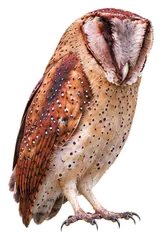 Sri Lanka Bay OwlPhodilus assimilis
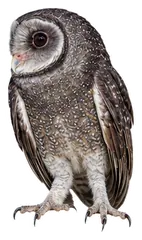 Greater Sooty OwlTyto tenebricosa
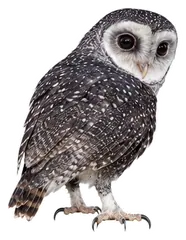 Lesser Sooty OwlTyto multipunctata
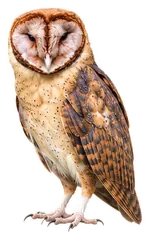 Minahasa Masked OwlTyto inexspectata
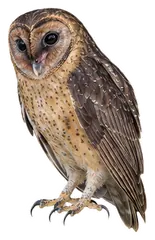 Taliabu Masked OwlTyto nigrobrunnea
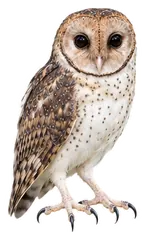 Moluccan Masked OwlTyto sororcula
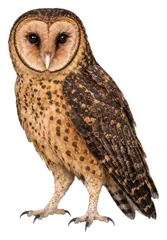 Manus Masked OwlTyto manusi
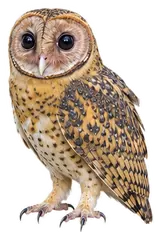 Golden Masked OwlTyto aurantia
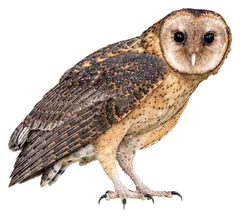 Australian Masked OwlTyto novaehollandiae
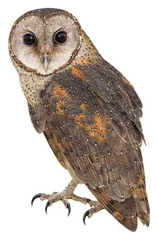 Sulawesi Masked OwlTyto rosenbergii
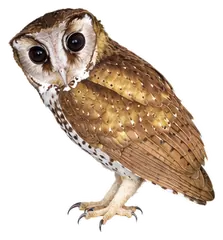
Download illustration
Free to use with credit: “Illustration: Bird Album (birdalbum.com)”. Drawn by AI from a reference photo by Chris Burney. ↗
Heard it but can't see it? Mingji identifies birds by sound and photo, on your phone.