 Bird Album
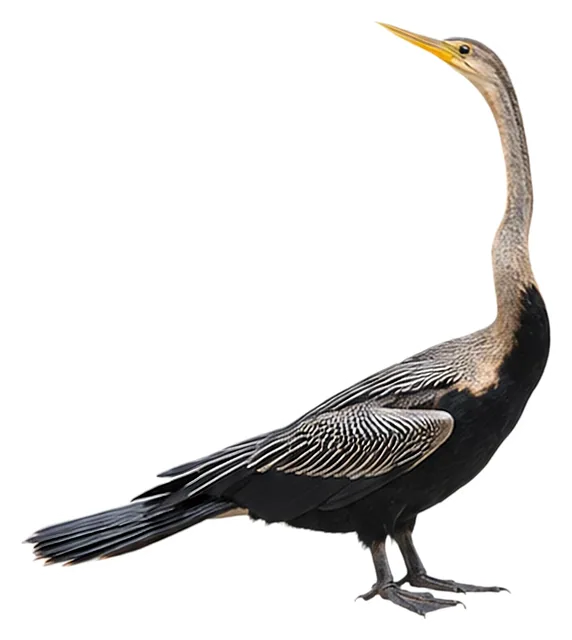
Oriental Darter
Anhinga melanogaster Pennant, 1769
≈76 cmLength121 cmWingspan1.5 kgWeight
When swimming, its body is submerged with only the slender neck showing.
Busiest months: December–February · Most records: India, Sri Lanka, Malaysia
How to identify
Field marks
- Neck slender, bill straight and pointed
- Adult body feathers mainly black
- Adult has a pale longitudinal line along the side of the neck
- Tail wedge-shaped in flight
Male, female and young
Adult sexes difficult to distinguish; female has a shorter bill. Juvenile has a pale brown neck and whitish underparts, with no white stripe on the side of the neck.
Voice
Adults usually quiet; at the nest they grunt, give harsh calls and also call “chigi-chigi-chigi”.
Where and when it's recorded

Oriental Darter has been recorded at 475 of the 8,171 birding hotspots we track, in 15 countries and regions.
Records by month Northern Hemisphere
Where it's recorded most
- Changaram Wetlands – EzhupunnaIndia4,548 records
- Bharatpur – Keoladeo Ghana NPIndia4,397 records
- Saul Kere / Sowl KereIndia3,463 records
More places
- Krishnampathi Lake, SeeranaickenpalayamIndia2,283 records
- Sultanpur National ParkIndia1,829 records
- Muthanallur KereIndia1,391 records
- Hoskote / Hosakote KereIndia1,388 records
- KattampallyIndia1,354 records
- Vellayani – Punchakkari WetlandsIndia1,247 records
- Matara – Kirala Kele SanctuarySri Lanka1,188 records
Countries and regions with the most records
eBird records via GBIF up to 2024-12-31. A record means someone listed it; more records partly mean more birders, not more birds.
About
The Oriental darter (Anhinga melanogaster) is a water bird of tropical South Asia and Southeast Asia. It has a long and slender neck with a straight, pointed bill and, like the cormorant, it hunts for fish while its body is submerged in water. It spears a fish underwater, bringing it above the surface, tossing and juggling it before swallowing the fish head first.
Excerpt from Wikipedia, CC BY-SA 4.0 · authors · Read more on Wikipedia
Questions
How big is the Oriental Darter?
The Oriental Darter is about ≈76 cm long, with a wingspan of 121 cm and weighs around 1.5 kg.
Where does the Oriental Darter live?
Its breeding range: Oriental, Australasia: Indus Valley (central Pakistan) south to Sri Lanka and east to Vietnam, south to Greater Sundas, Sulawesi and Philippines (now only Mindanao and Jolo, Sulu Archipelago, southern Philippines). It is most often recorded in India, Sri Lanka and Malaysia.
When is the best time to see the Oriental Darter?
At the hotspots we track, it is recorded most in January, February and December (Northern Hemisphere).
Is the Oriental Darter endangered?
The IUCN Red List classifies the Oriental Darter as Least Concern.
What does the Oriental Darter eat?
Main food: Fish, shrimp & shellfish.
What family is the Oriental Darter in?
It belongs to the family Anhingas, Darters (Anhingidae), order Suliformes.
At a glance
- Length
- ≈76 cm
- Wingspan
- 121 cm
- Weight
- 1.5 kg
- Habitat
- Wetland
- Diet
- Fish, shrimp & shellfish
- Lifestyle
- On the water surface
- Migration
- Partial migrant
- Conservation
- Least Concern
More measurements
- Wing
- 342 mm
- Tail
- 238 mm
- Bill
- 88 mm
- Tarsus
- 42 mm
Averages from the AVONET dataset; length from field guides where available.
Range
Oriental, Australasia: Indus Valley (central Pakistan) south to Sri Lanka and east to Vietnam, south to Greater Sundas, Sulawesi and Philippines (now only Mindanao and Jolo, Sulu Archipelago, southern Philippines)
Breeding range, IOC World Bird List 15.2
Classification
- Order
- Suliformes
- Family
- Anhingas, Darters Anhingidae
- Genus
- Anhinga
Other birds in the genus Anhinga
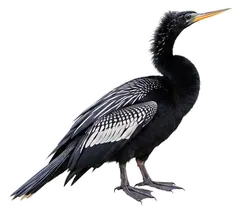 AnhingaAnhinga anhinga
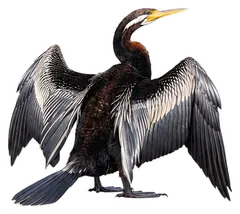 Australasian DarterAnhinga novaehollandiae
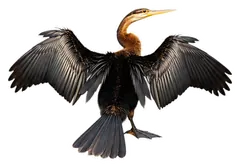 African DarterAnhinga rufa
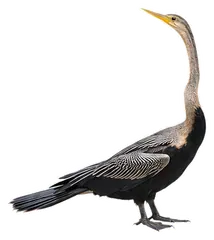
Download illustration
Free to use with credit: “Illustration: Bird Album (birdalbum.com)”. Drawn by AI from a reference photo by TAM Phan Minh. ↗
Heard it but can't see it? Mingji identifies birds by sound and photo, on your phone.
In other languages
- EnglishOriental Darter
- 简体中文黑腹蛇鹈
- 繁體中文黑腹蛇鵜
- 日本語アジアヘビウ
- DeutschOrient-Schlangenhalsvogel
- FrançaisAnhinga roux
- EspañolAnhinga asiática
- Portuguêsmergulhão-serpente-oriental
- ItalianoAninga comune
- NederlandsIndische Slangenhalsvogel
- РусскийАзиатская змеешейка
- Svenskaindisk ormhalsfågel
- DanskIndisk Slangehalsfugl
- Polskiwężówka indyjska