 Bird Album
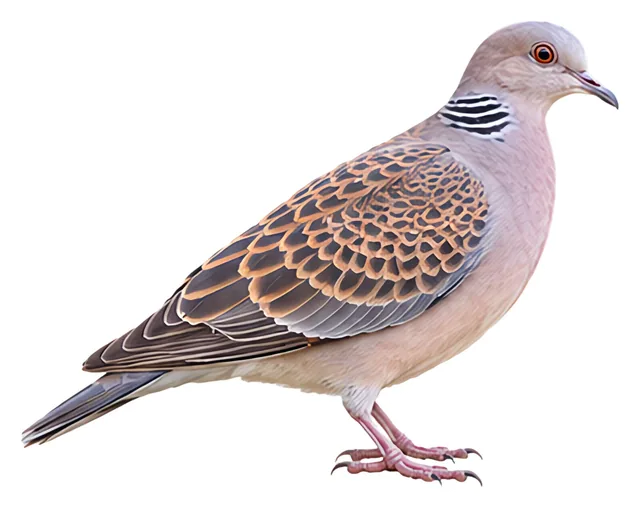
Oriental Turtle Dove
Streptopelia orientalis (Latham, 1790)
≈33 cmLength233 gWeight
It has black-and-white striped patches on the side of the neck and scaling on the upper back and wings.
Busiest months: April and November–December · Most records: China, Japan, South Korea
Looks like European Turtle Dove
How to identify
Field marks
- Silver-and-black striped patches on side of neck
- Upper back and wings rufous, with scaling on feathers
- Breast and belly reddish-brown
- Tail wedge-shaped
Voice
A four-syllable “her-her-oo-oo”, varying greatly between populations.
Similar species
Where and when it's recorded
Busiest months: April and November–December · Most records: China, Japan, South Korea

Oriental Turtle Dove has been recorded at 1,924 of the 8,276 birding hotspots we track, in 38 countries and regions.
Records by month Northern Hemisphere
Where it's recorded most
- Taipei – National Taiwan University Main CampusTaiwan (China)5,145 records
- Taipei – Tianliaoyang WetlandTaiwan (China)3,243 records
- Taipei – Taipei Botanical GardenTaiwan (China)2,831 records
More places
- Taipei – Da'an Forest ParkTaiwan (China)2,799 records
- Kanha NP – Mukki ZoneIndia2,257 records
- Wildlife Institute of IndiaIndia2,023 records
- Edogawa Ward – Kasai Rinkai Park / Kasai Kaihin ParkJapan1,742 records
- Guandu IBA – Nature ParkTaiwan (China)1,624 records
- Taipei – Beitou Guizikeng Drainage CanalTaiwan (China)1,580 records
- Nantou – Meifeng Highland Experimental Farm of NTUTaiwan (China)1,370 records
Countries and regions with the most records
eBird records via GBIF up to 2024-12-31. A record means someone listed it; more records partly mean more birders, not more birds.
About
The Oriental turtle dove or rufous turtle dove (Streptopelia orientalis) is a member of the bird family Columbidae. The species has a wide native distribution range from Central Asia east across Asia to Japan. The populations show variations in the patterning of plumage and have been designated into at least six named subspecies.
Excerpt from Wikipedia, CC BY-SA 4.0 · authors · Read more on Wikipedia
Questions
How big is the Oriental Turtle Dove?
The Oriental Turtle Dove is about ≈33 cm long and weighs around 233 g.
Where does the Oriental Turtle Dove live?
Its breeding range: Palearctic, Oriental: central, East Asia through India and Southeast Asia. It is most often recorded in China, Japan and South Korea.
When is the best time to see the Oriental Turtle Dove?
At the hotspots we track, it is recorded most in April, November and December (Northern Hemisphere).
Is the Oriental Turtle Dove endangered?
The IUCN Red List classifies the Oriental Turtle Dove as Least Concern.
What does the Oriental Turtle Dove eat?
Main food: Omnivore.
What family is the Oriental Turtle Dove in?
It belongs to the family Pigeons, Doves (Columbidae), order Columbiformes.
At a glance
- Length
- ≈33 cm
- Weight
- 233 g
- Habitat
- Woodland
- Diet
- Omnivore
- Lifestyle
- Active on the ground
- Migration
- Migratory
- Conservation
- Least Concern
More measurements
- Wing
- 176 mm
- Tail
- 127 mm
- Bill
- 22 mm
- Tarsus
- 26 mm
Averages from the AVONET dataset; length from field guides where available.
Range
Palearctic, Oriental: central, East Asia through India and Southeast Asia
Breeding range, IOC World Bird List 15.2
Subspecies · 2
- Streptopelia orientalis orientalis c Siberia to Japan, China, the e Himalayas and Taiwan (China) | non-breeding: s, e Asia
- Streptopelia orientalis agricola ne India, Myanmar and n Thailand to sc China
Classification
- Order
- Columbiformes
- Family
- Pigeons, Doves Columbidae
- Genus
- Streptopelia
Other birds in the genus Streptopelia
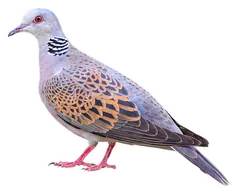 European Turtle DoveStreptopelia turtur
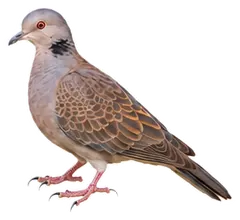 Dusky Turtle DoveStreptopelia lugens
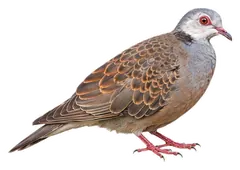 Adamawa Turtle DoveStreptopelia hypopyrrha
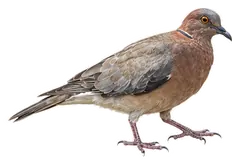 Sunda Collared DoveStreptopelia bitorquata
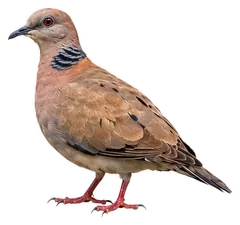 Philippine Collared DoveStreptopelia dusumieri
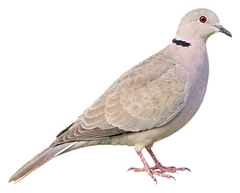 Eurasian Collared DoveStreptopelia decaocto
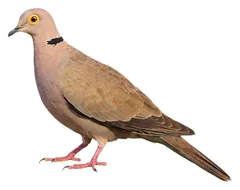 Burmese Collared DoveStreptopelia xanthocycla
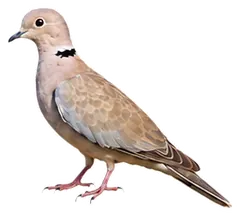 African Collared DoveStreptopelia roseogrisea
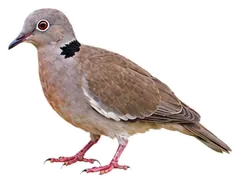 White-winged Collared DoveStreptopelia reichenowi
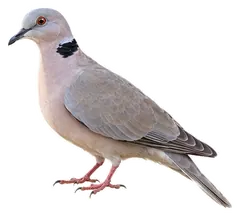 Mourning Collared DoveStreptopelia decipiens
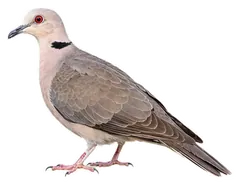 Red-eyed DoveStreptopelia semitorquata
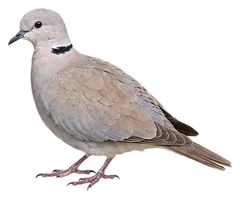 Ring-necked DoveStreptopelia capicola
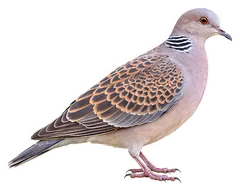
Download illustration
Free to use with credit: “Illustration: Bird Album (birdalbum.com)”. Drawn by AI from a reference photo by J. Patrick Fischer. ↗

Heard it but can't see it? Mingji identifies birds by sound and photo, on your phone.