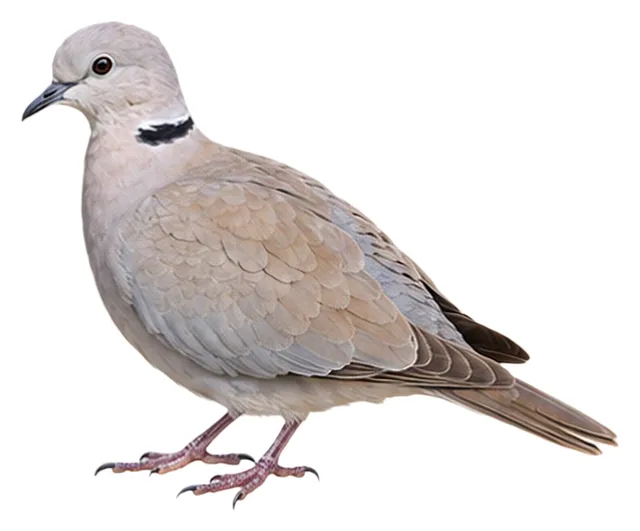
Ring-necked Dove
Streptopelia capicola (Sundevall, 1857)
25–26 cmLength142 gWeight
The ring-necked dove (Streptopelia capicola), also known as the Cape turtle dove, half-collared dove, or the Cape Lager is a widespread and often abundant dove species in East and southern Africa.
Busiest months: November · Most records: South Africa, Kenya, Tanzania
Where and when it's recorded
Busiest months: November · Most records: South Africa, Kenya, Tanzania

Ring-necked Dove has been recorded at 447 of the 8,276 birding hotspots we track, in 25 countries and regions.
Records by month Southern Hemisphere
Where it's recorded most
- Nairobi NPKenya1,744 records
- Kirstenbosch Botanical GardenSouth Africa1,422 records
- Lake Nakuru NPKenya1,147 records
More places
- Tarangire NPTanzania1,117 records
- Lake Mburo NPUganda1,064 records
- Rietvlei NRSouth Africa992 records
- Marievale Bird SanctuarySouth Africa949 records
- Etosha NP – Okaukuejo CampNamibia764 records
- Etosha NP – Halali CampNamibia680 records
- Maasai Mara NR – Mara TriangleKenya676 records
Countries and regions with the most records
eBird records via GBIF up to 2024-12-31. A record means someone listed it; more records partly mean more birders, not more birds.
About
The ring-necked dove (Streptopelia capicola), also known as the Cape turtle dove, half-collared dove, or the Cape Lager is a widespread and often abundant dove species in East and southern Africa. It is a mostly sedentary bird, found in a variety of open habitats. Within range, its penetrating and rhythmic, three-syllabled crooning is a familiar sound at any time of the year.
Excerpt from Wikipedia, CC BY-SA 4.0 · authors · Read more on Wikipedia
Questions
How big is the Ring-necked Dove?
The Ring-necked Dove is about 25–26 cm long and weighs around 142 g.
Where does the Ring-necked Dove live?
Its breeding range: Africa: eastern, southern; also Comoros. It is most often recorded in South Africa, Kenya and Tanzania.
When is the best time to see the Ring-necked Dove?
At the hotspots we track, it is recorded most in November (Southern Hemisphere).
Is the Ring-necked Dove endangered?
The IUCN Red List classifies the Ring-necked Dove as Least Concern.
What does the Ring-necked Dove eat?
Main food: Seeds.
What family is the Ring-necked Dove in?
It belongs to the family Pigeons, Doves (Columbidae), order Columbiformes.
At a glance
- Length
- 25–26 cm
- Weight
- 142 g
- Habitat
- Shrubland
- Diet
- Seeds
- Lifestyle
- Active on the ground
- Migration
- Resident (barely migrates)
- Conservation
- Least Concern
More measurements
- Wing
- 151 mm
- Tail
- 107 mm
- Bill
- 21 mm
- Tarsus
- 22 mm
Averages from the AVONET dataset; length from field guides where available.
Range
Africa: eastern, southern; also Comoros
Breeding range, IOC World Bird List 15.2
Classification
- Order
- Columbiformes
- Family
- Pigeons, Doves Columbidae
- Genus
- Streptopelia
Other birds in the genus Streptopelia
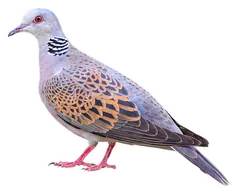 European Turtle DoveStreptopelia turtur
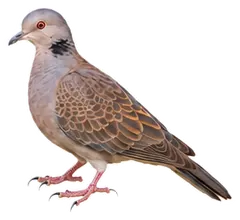 Dusky Turtle DoveStreptopelia lugens
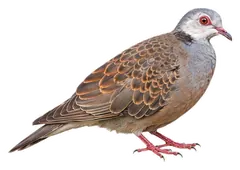 Adamawa Turtle DoveStreptopelia hypopyrrha
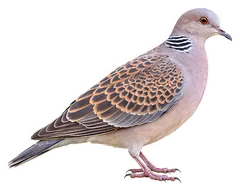 Oriental Turtle DoveStreptopelia orientalis
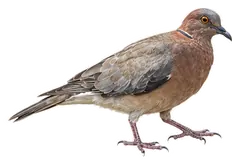 Sunda Collared DoveStreptopelia bitorquata
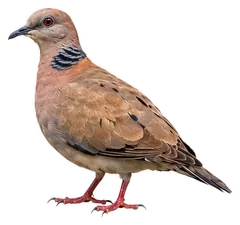 Philippine Collared DoveStreptopelia dusumieri
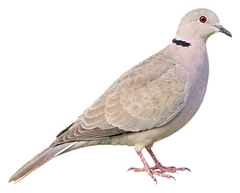 Eurasian Collared DoveStreptopelia decaocto
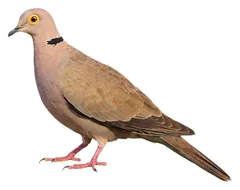 Burmese Collared DoveStreptopelia xanthocycla
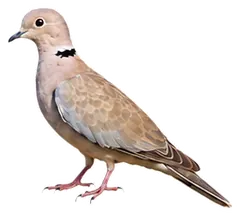 African Collared DoveStreptopelia roseogrisea
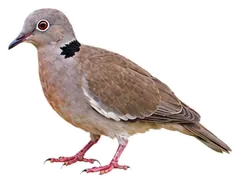 White-winged Collared DoveStreptopelia reichenowi
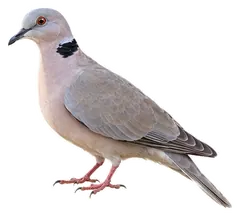 Mourning Collared DoveStreptopelia decipiens
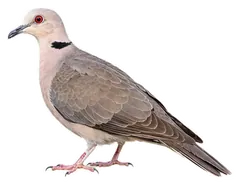 Red-eyed DoveStreptopelia semitorquata
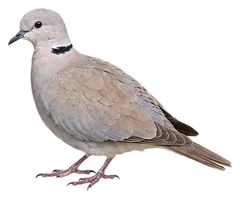
Download illustration
Free to use with credit: “Illustration: Bird Album (birdalbum.com)”. Drawn by AI from a reference photo by copper. ↗
Heard it but can't see it? Mingji identifies birds by sound and photo, on your phone.