 Bird Album
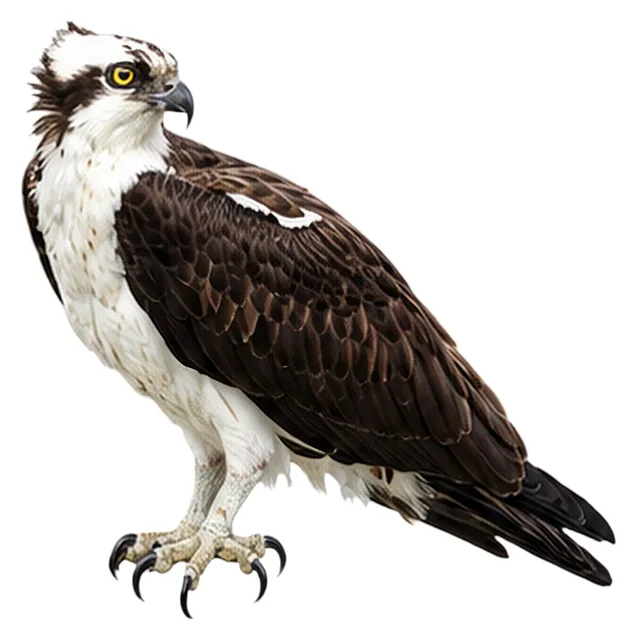
Osprey
Pandion haliaetus (Linnaeus, 1758)
50–66 cmLength160 cmWingspan1.5 kgWeight
The Osprey has a white head with a dark mask and arches its wings like a gull in flight.
Busiest months: April–May · Most records: United States, Canada, China
How to identify
Field marks
- Head white, with a dark mask around the eye
- Upperparts dark brown with a metallic gloss; underparts pure white
- Carpal area of underwing black in flight
- Wings narrow and long, tail short, with finger-like feathers at wingtips
Male, female and young
Sexes similar; male more slender, with narrower wings and a breast-band that is paler than the female’s or absent. Juvenile has pale yellow feather edges on upperparts and stripes on head feathers.
Voice
A series of whistles, resembling repeated chirping or squealing notes.
Where and when it's recorded

Osprey has been recorded at 4,514 of the 8,171 birding hotspots we track, in 198 countries and regions.
Records by month Northern Hemisphere
Where it's recorded most
- Fort De Soto ParkUnited States23,844 records
- Cape Island – South Cape May MeadowsUnited States18,406 records
- Parker River NWRUnited States17,325 records
More places
- Cape Island – Cape May Point SPUnited States15,784 records
- Edwin B. Forsythe NWRUnited States15,362 records
- Lake Apopka Wildlife DriveUnited States12,995 records
- The Celery FieldsUnited States12,865 records
- Merritt Island NWR – Black Point Wildlife DriveUnited States12,859 records
- John Heinz NWR – impoundmentUnited States12,606 records
- IRWD San Joaquin Marsh & Wildlife Sanctuary, IrvineUnited States12,438 records
Countries and regions with the most records
eBird records via GBIF up to 2024-12-31. A record means someone listed it; more records partly mean more birders, not more birds.
About
The osprey (Pandion haliaetus), historically known as sea hawk, river hawk, and fish hawk, is a diurnal, fish-eating bird of prey with a cosmopolitan range.
Excerpt from Wikipedia, CC BY-SA 4.0 · authors · Read more on Wikipedia
Questions
How big is the Osprey?
The Osprey is about 50–66 cm long, with a wingspan of 160 cm and weighs around 1.5 kg.
Where does the Osprey live?
Its breeding range: Worldwide: widespread. It is most often recorded in United States, Canada and China.
When is the best time to see the Osprey?
At the hotspots we track, it is recorded most in April and May (Northern Hemisphere).
Is the Osprey endangered?
The IUCN Red List classifies the Osprey as Least Concern.
What does the Osprey eat?
Main food: Fish, shrimp & shellfish.
What family is the Osprey in?
It belongs to the family Osprey (Pandionidae), order Accipitriformes.
At a glance
- Length
- 50–66 cm
- Wingspan
- 160 cm
- Weight
- 1.5 kg
- Habitat
- Ocean
- Diet
- Fish, shrimp & shellfish
- Lifestyle
- Feeds in the air
- Migration
- Migratory
- Conservation
- Least Concern
More measurements
- Wing
- 468 mm
- Tail
- 201 mm
- Bill
- 47 mm
- Tarsus
- 50 mm
Averages from the AVONET dataset; length from field guides where available.
Range
Worldwide: widespread
Breeding range, IOC World Bird List 15.2
Classification
- Order
- Accipitriformes
- Family
- Osprey Pandionidae
- Genus
- Pandion
Download illustration
Free to use with credit: “Illustration: Bird Album (birdalbum.com)”. Drawn by AI from a reference photo by Chuck Homler / Focus On Wildlife. ↗

Heard it but can't see it? Mingji identifies birds by sound and photo, on your phone.