 Bird Album
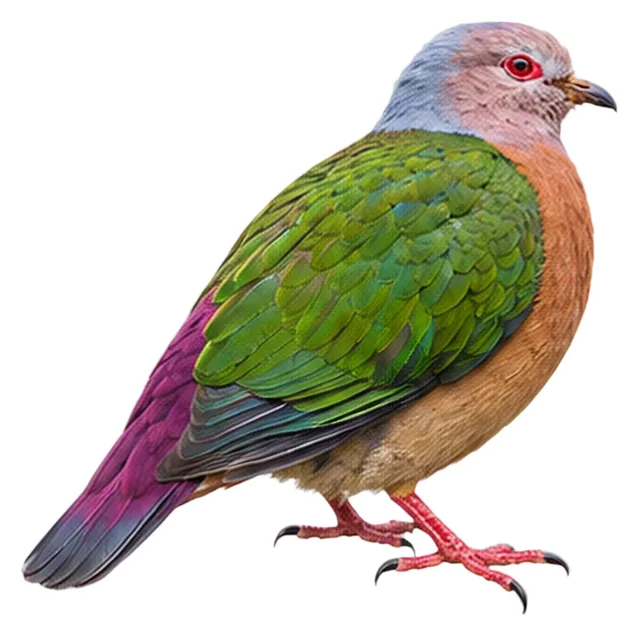
Purple-tailed Imperial Pigeon
Ducula rufigaster (Quoy & Gaimard, 1832)
436 gWeight
The purple-tailed imperial pigeon (Ducula rufigaster) is a species of bird in the family Columbidae.
Busiest months: July–August · Most records: Papua New Guinea, Indonesia
Where and when it's recorded
Busiest months: July–August · Most records: Papua New Guinea, Indonesia

Purple-tailed Imperial Pigeon has been recorded at 24 of the 8,276 birding hotspots we track, in 2 countries and regions.
Records by month Southern Hemisphere
Where it's recorded most
- Varirata National ParkPapua New Guinea298 records
- West Waigeo birding roadIndonesia108 records
- Kwatu LodgePapua New Guinea83 records
More places
- MalagufukIndonesia63 records
- Tabubil-Kiunga Rd – Km 17Papua New Guinea46 records
- Elevala and Ketu RiversPapua New Guinea45 records
- Malagufuk villageIndonesia33 records
- Boystown Road – Bowerbird HillPapua New Guinea31 records
- West Waigeo forest - Red and Wilson's BOP sites areaIndonesia28 records
- Nimbokrang – Jalan Korea swamp forestIndonesia24 records
Countries and regions with the most records
eBird records via GBIF up to 2024-12-31. A record means someone listed it; more records partly mean more birders, not more birds.
About
The purple-tailed imperial pigeon (Ducula rufigaster) is a species of bird in the family Columbidae. It is found in New Guinea. Its natural habitat is subtropical or tropical moist lowland forests.
Excerpt from Wikipedia, CC BY-SA 4.0 · authors · Read more on Wikipedia
Questions
How big is the Purple-tailed Imperial Pigeon?
The Purple-tailed Imperial Pigeon weighs around 436 g.
Where does the Purple-tailed Imperial Pigeon live?
Its breeding range: Australasia: Raja Ampat Islands (northwest of New Guinea), Yapen (Geelvink Bay islands, northwestern New Guinea) and New Guinea. It is most often recorded in Papua New Guinea and Indonesia.
When is the best time to see the Purple-tailed Imperial Pigeon?
At the hotspots we track, it is recorded most in July and August (Southern Hemisphere).
Is the Purple-tailed Imperial Pigeon endangered?
The IUCN Red List classifies the Purple-tailed Imperial Pigeon as Least Concern.
What does the Purple-tailed Imperial Pigeon eat?
Main food: Fruit.
What family is the Purple-tailed Imperial Pigeon in?
It belongs to the family Pigeons, Doves (Columbidae), order Columbiformes.
At a glance
- Weight
- 436 g
- Habitat
- Forest
- Diet
- Fruit
- Lifestyle
- Perches in trees
- Migration
- Resident (barely migrates)
- Conservation
- Least Concern
More measurements
- Wing
- 197 mm
- Tail
- 109 mm
- Bill
- 28 mm
- Tarsus
- 31 mm
Averages from the AVONET dataset; length from field guides where available.
Range
Australasia: Raja Ampat Islands (northwest of New Guinea), Yapen (Geelvink Bay islands, northwestern New Guinea) and New Guinea
Breeding range, IOC World Bird List 15.2
Classification
- Order
- Columbiformes
- Family
- Pigeons, Doves Columbidae
- Genus
- Ducula
Other birds in the genus Ducula
 Pink-bellied Imperial PigeonDucula poliocephala
 White-bellied Imperial PigeonDucula forsteni
 Mindoro Imperial PigeonDucula mindorensis
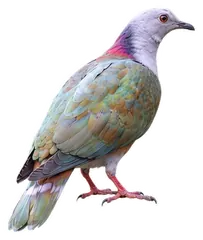 Grey-headed Imperial PigeonDucula radiata
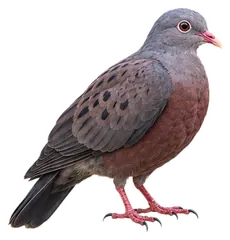 Spotted Imperial PigeonDucula carola
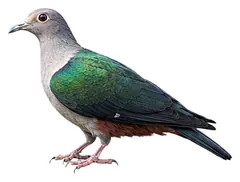 Green Imperial PigeonDucula aenea
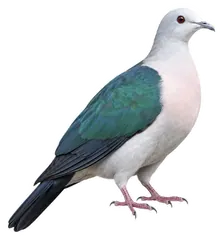 Enggano Imperial PigeonDucula oenothorax
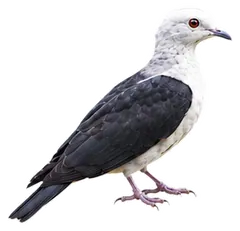 Nicobar Imperial PigeonDucula nicobarica
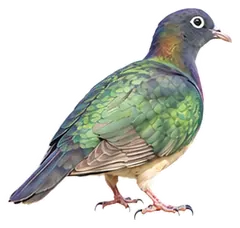 Spectacled Imperial PigeonDucula perspicillata
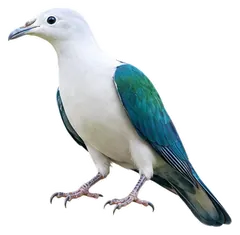 Seram Imperial PigeonDucula neglecta
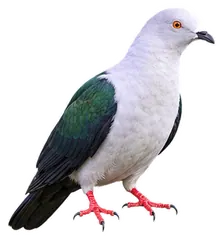 Elegant Imperial PigeonDucula concinna
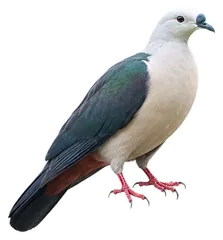 Pacific Imperial PigeonDucula pacifica
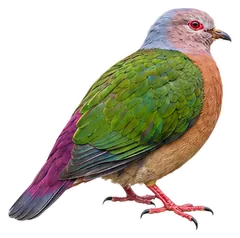
Download illustration
Free to use with credit: “Illustration: Bird Album (birdalbum.com)”. Drawn by AI from a reference photo by Gouldy. ↗
Heard it but can't see it? Mingji identifies birds by sound and photo, on your phone.
In other languages
- EnglishPurple-tailed Imperial Pigeon
- 简体中文紫尾皇鸠
- 繁體中文紫尾皇鳩
- 日本語スミレオミカドバト
- DeutschRostbauch-Fruchttaube
- FrançaisCarpophage à ventre roux
- EspañolDúcula ventrirrufa
- Portuguêspombo-imperial-de-barriga-ruiva
- ItalianoPiccione imperiale codaviola
- NederlandsRode Muskaatduif
- РусскийРыжебрюхий плодовый голубь
- Svenskarostbröstad kejsarduva
- DanskPurpurhalet Kejserdue
- Polskimuszkatela czerwonorzytna